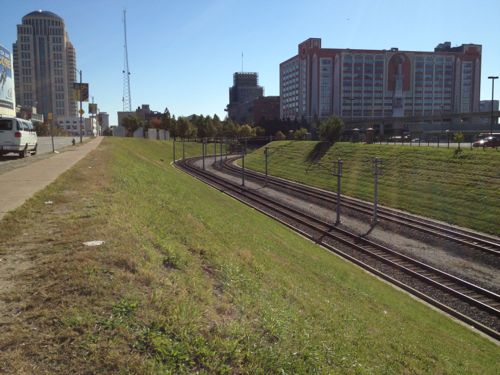
New Nonprofit Formed Focusing On “(re)Connecting Cities” Through Pedestrian Networks

Metropolitan areas were once designed for pedestrians — compact with businesses accessed right off the public sidewalk. People lived and worked their entire lives in a very small area, there was no alternative. Streetcars and subways provided mobility allowing cities to expand in area, but people remained pedestrians when going to or leaving transit.

The private automobile changed things, requiring more and more space as more and more cars hit to the roads. As the car took hold land-use and buildings reflected this change. Tight grids of streets gave way to larger blocks without on-street parking in an effort to keep the cars moving.
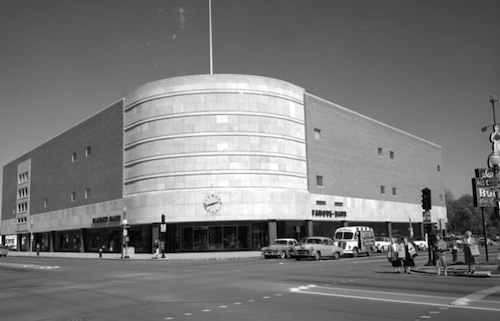
ABOVE: Southtown Famous-Barr at Kingshhway & Chippewa 1951-1992/3

Even then the street corner was still an important place. New department stores, such as the Southtown Famous-Barr, were built up to the sidewalk making the journey easy for pedestrians and motorists had plenty of parking as well. In the 1950s many still didn’t drive but since then new development began to forget about the pedestrian, making car ownership a necessity for the first time.

A Walgreens now sits on the same corner as the old Famous-Barr, its relationship with Kingshighway and Chippewa is radically different.
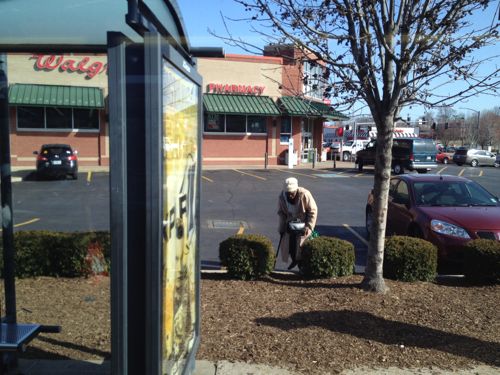
ABOVE: An elderly woman leaving the Walgreens had to walk through the parking lot and step up a curb while carrying her shopping bag.
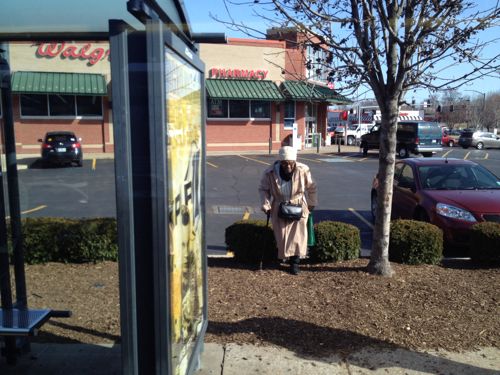
ABOVE: Yes she walks with a cane through the mulched area to reach the bus stop

Despite what you may think, not everyone in society drives. I don’t know this elderly woman’s history — she may have driven in her younger days but she’s not walking now for the fun of it. She walks though planted areas, parking lots, etc because we’ve designed our built environment in such a way this is the reality for many to buy the necessities.

This is a long way of introducing my new nonprofit:  (re)Connecting Cities. My idea is to advocate for all pedestrians, to work to make walking from the bus to the store and back not the undignified chore it is now.

(re)Connecting Cities will work to educate everyone on the benefits to society to connecting our buildings via sidewalks as well as we do for cars. Imagine if you had to drive through a muddy creek to get to the grocery store or over a pile of rocks — making a 4WD with high ground clearance a necessity? If you want milk & eggs you need a monster truck to do that.

We just expect roads, driveways and parking lots to be connected. Zoning makes sure there is an abundance of places to store vehicles yet in most cities/states nothing about being able to arrive on foot. Very unbalanced and unsustainable!

I don’t want to ban cars or have pedestrian-only streets, based on my research those rarely work in North America. I do want pedestrians to be given equal consideration when enacting zoning & building codes. I want architects, civil engineers and their clients to think about pedestrian arrival points, routes, and circulation, along with vehicular circulation. Communities often demand expensive traffic studies when a developer proposes a new project and nearby residents fear traffic congestion, yet a pedestrian access plan is never mentioned.

You’ll be hearing more about (re)Connecting Cities in the coming months and years.

— Steve Patterson
 

Missouri’s Sex Offender Registry Is Overcrowded

One might think the Missouri Sex Offender Registry would be a useful tool when determining where to buy a house, or let your kid walk to school.  Think again! Legislators tried earlier this year to change the requirements so the registry would have fewer listed and be more helpful to the rest of us:

Currently, Missouri has more than 12,000 people on its sex offender registry. Crimes range from extreme rape cases to consensual sex with minors. The new law could cut as many as 5,000 people in its first year and 1,000 people each year after, according to a fiscal study. 

Rep. Rodney Schad, R-Versailles, argued that public opinion has pushed the registry too far – adding people who are not threats to society – so that it’s no longer effective. (stltoday.com)

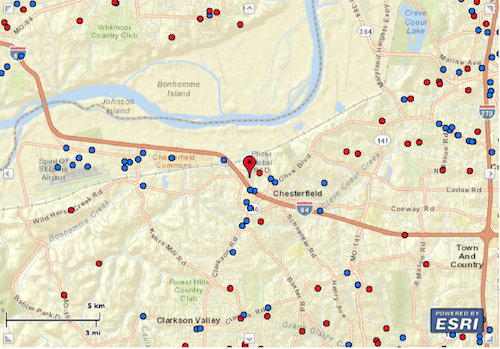
ABOVE: Registered sex offenders around Chesterfield’s city hall, blue dots represent work address and red represent home address.

JOPLIN, MO– An effort to change the makeup of the Missouri Sex Offender Registry misses the deadline. House Bill 1700 was approved by state representatives, but failed to come to a vote in the senate. The measure would have created a tiered system for sex offenders. It also would have removed some convictions from the list. Lieutenant Governor Peter Kinder says the issue will likely return in the 2013 session. (source)

A person on the registry that had consensual sex with his minor girlfriend contacted me about the need to change Missouri’s law, I was shocked as I researched it. This “Romeo and Juliet” scenario is a common reason for ending up being labeled a sex offender, which greatly hampers employment prospects. Missouri’s age of consent is 17 so consensual sex between a 16 year old female and a 21 year old male is 2nd Degree Rape per Missouri statutes.

I searched for many addresses throughout the region and everywhere blue (work) and home (red) dots appeared. A dot nearby doesn’t mean your loved ones are in danger — the offender could just be someone that didn’t realize he was just a bit too old for his girlfriend — in Missouri. In other states the age of consent might be younger, or older, than Missouri.

You want to know about the Michael Devlin’s, not a young man that got caught with his girlfriend months before she’d have been legal.

— Steve Patterson


OK, Kanas City Region To Get An Ikea Before St. Louis

October 4, 2012 Big Box, Featured, Retail 19 Comments
ABOVE: Ikea in Bolingbrook, IL, January 2009

The Kansas City region is getting an Ikea store and we’re not:

The home furnishings company, which has 38 stores in the U.S., is announcing at a press conference this morning that it is putting a store in Merriam, Kan. The store is expected to open in fall 2014.

So what does that mean for the prospects of a much desired store in St. Louis?

Joseph Roth, an Ikea spokesman, said the Kansas City store does not diminish St. Louis’ chances.

“They are completely separate trade areas in our mind,” he said. “We still recognize the customer base that exists for us in St. Louis. We just have not committed to a time frame yet or found the perfect site.” (stltoday.com)

This is pretty logical if you think about it, the nearest Ikea to the St. Louis region is the Bolingbrook, IL location in the Chicago region — that’s 273 miles from St. Louis. The closest Ikea to Kansas City, MO is Bloomington MN at 431 miles (Bolingbrook, IL is 486 miles from KC).

I know numerous people here that have driven to the Bolingbrook Ikea in the morning, shopped, and driven back to St. Louis that night, others have stayed in a nearby hotel overnight. Either way, we have much better access to Ikea than people in the Kansas City region do — for now. And once the Kansas City Ikea opens in Merriam, KS two years from now it’ll be roughly 15 miles closer to St. Louis than the Bolingbrook, IL Ikea. A change of pace for those who usually head north on I-55 for flat-packed furniture.

This summer many thought an Ikea was going to come to Richmond Heights because a developer had proposed it. Based on the 6 Ikea locations I’ve visited over the last+ 22 years I doubt we would see an idea within 15 niles of downtown St. Louis. They are a big box retailer that locates along wide exurban arterials on sites highly visible from the highway.

For my last big order I shopped through one of the two local companies that make regular trips to Bolingbrook — I had them bring back items I’d never be able to transport anyway.

My hope is the Kansas City location will be close enough to civilization that it will be on a bus route so I can visit without having to rent a car — a perfect way to make sure I don’t buy too much.

— Steve Patterson


Readers Split On O’Fallon Park Controversy, Agreement Reached

When I posted last week’s poll on Sunday September 23rd it didn’t look like we were going to see progress toward getting the new $22 million O’Fallon Park Recreation Center open for business. Agreement was reached the next day, but political posturing didn’t end.

Monday September 24th – 1pm

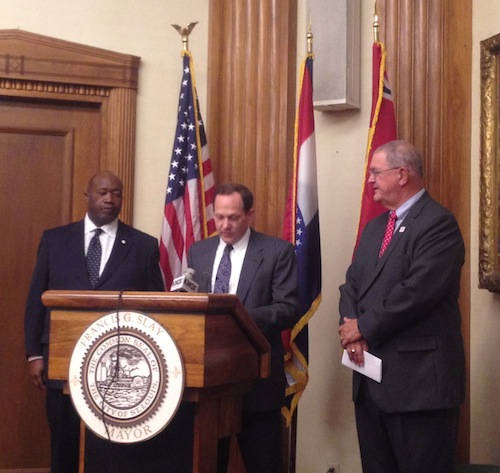
ABOVE L-R: Flint Fowler, president, Boys and Girls Clubs of Greater St. Louis, Mayor Francis Slay, Gary Schlansker, president and chief executive officer, YMCA of Greater St. Louis announce agreement at a Monday September 24th press conference.

One of the key items announced was “1300 low income kids will get $25 memberships at the O’Fallon Recreation Center.” This is $25 per year, not per month.  See the fact sheet here.

ABOVE: Ald. French wasn’t invited to participate in the press conference but talked to reporters immediately following.

Ald. French was glad more specifics were formerly outlined in the documents — that was the goal. It just needed to get through the Board of Aldermen.

Friday September 28th

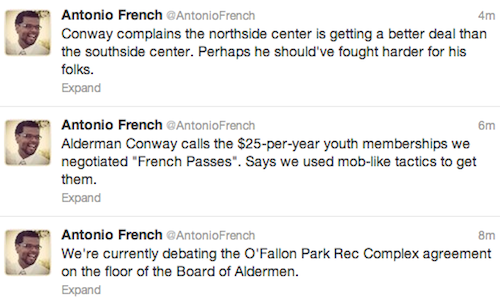
ABOVE: Three consecutive tweets friom Ald French from last friday as the Board of Aldermen debated the new agreement.

David Hunn of the Post-Dispatch reported the debate on the bill lasted for over an hour, with many in support:

Aldermen were not uniformly uncritical. Some worried about costs in years to come. Others complained that their wards lacked similarly updated facilities. Alderman Joe Roddy cautioned that the city was gaining a “champagne” appetite when what it really needed was inexpensive access for residents.

But only Alderman Steve Conway spoke fervently against French. He thought the 21st Ward alderman, who has been a paid campaign consultant for mayoral hopeful and board President Lewis Reed, delayed the center’s opening to make Slay look bad. (stltoday.com)

The bill passed, including a yes from Conway. The final vote will be this Friday October 5th. The facility should open by late this year or early 2013.

Q: Thoughts On The Not Yet Open O’Fallon Park Recreation Complex

  1. The African-American Aldermanic Caucus is trying to make Slay look bad, helping Reed in 2013 27 [29.35%]
  2. What about residents on the south side that can’t afford the new Carondelet YMCA? 25 [27.17%]
  3. If we’re subsidizing 60% of the operating costs then the agreement with the YMCA should require at least a 60% discount for low-income residents 12 [13.04%]
  4. We’re going to pay the YMCA $1.2 million per year to operate a building we spent $22 million to build? 10 [10.87%]
  5. Unsure/no opinion 9 [9.78%]
  6. Just sign the 10-year $12 million dollar deal, the YMCA will make sure low-income resident memberships are affordable 7 [7.61%]
  7. Other: 2 [2.17%]

The two “other” answers were:

  1. The deal is stupid, the city should manage the rec plex.
  2.  What kind of idiot builds something that the intended customer can’t afford?

I see validity in Ald Roddy’s comments about champagne taste. The time to question it would’ve been 8 years ago when we voted to support the sales tax. In time these two large facilities will either be viewed as a great decision or a poor decision, it’s too soon to know.

— Steve Patterson


Building Over Light Rail

Yesterday I posted about moving the Union Station MetroLink platform into the former baggage tunnel (see The Union Station MetroLink Stop Should Be Moved Under The Train Shed), my reasoning was improved connection to Union Station. Today is the rest of my thought process.

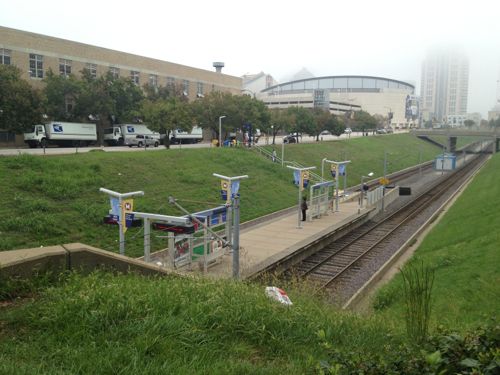
ABOVE: The MetroLink platform is located on the east side of 18th Street, totally exposed to the elements.
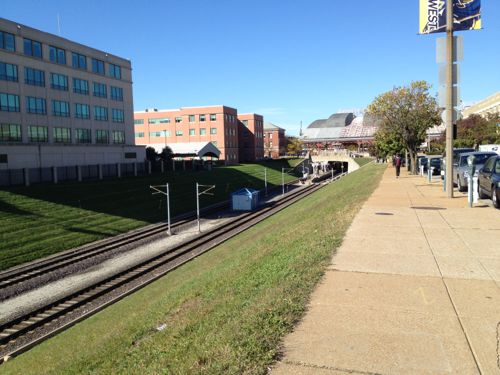
ABOVE: Looking west toward the Union Station MetroLink Station from 16th & Clark Ave.

It’s been a white but I’ve written before (link) that I want to see the tracks from 16th to 18th street built over with a new building(s). With the platform moved under the train shed the new building(s) in this two-block stretch wouldn’t have to deal with space for an entrance to the station, making it more straightforward.

ABOVE: Looking east toward the Civic Center station from 16th & Clark Ave.

Another building could be built over the tracks for a block, before the track curves. This is basically from 16th to where the former 15th Street used to be. A walkway along the east edge could connect Clark Ave to the Gateway Transportation Center (Amtrak & Greyhound).

Back at 16th new buildings would be on each side to help frame the entrance into that area, now largely a jumble of surface parking. The area isn’t very big and has defined edges. Formerly this was an eight block area but the street grid has been dismantled to the point actual blocks are no longer recognizable.  It can become more connected so when someone arrives in St. Louis they can easily walk to Union Station or the Drury Inn on 20th facing the train shed.


— Steve Patterson


Advertisement


[custom-facebook-feed]

Archives

Categories

Advertisement


Subscribe