Home » SLU » Recent Articles:

Potential Development Sites Along Proposed Streetcar Line, Part 6: Compton to Vandeventer

As I’ve done for the last month, this is another post on potential development sites along the proposed initial route of the St. Louis Streetcar.  The sections already reviewed are as follows:

  1. Olive 15th-16th
  2. Olive 16th-18th
  3. 14th & Olive To North Florissant & St. Louis Ave.
  4. Olive 18th to Jefferson
  5. Jefferson to Compton

This post will cover the section from Olive & Compton to Lindell & Vandeventer (map). For those unfamiliar with the area, Olive splits off to the north but to motorists Olive becomes Lindell (pronounced Lindle). The entire south side of this stretch of Olive/Lindell is the campus of Saint Louis University (SLU). The north is a mix of SLU, private, and institutional properties.

We’ll start at Compton and head west.

ccc

Massive SLU parking garage could be fronted with a shallow “liner building” to create a relationship with the sidewalk.

The buildings & land on the other side of Lindell from SLU’s Compton Garage are ripe for development, I’m just lacking images of them.

ABOVE:

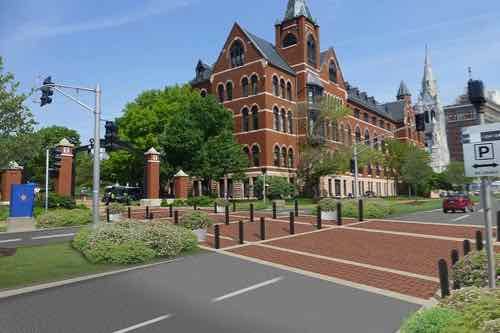
The intersection where Olive splits off to the right was redone a few years ago.

ABOVE:

gLooking the opposite direction

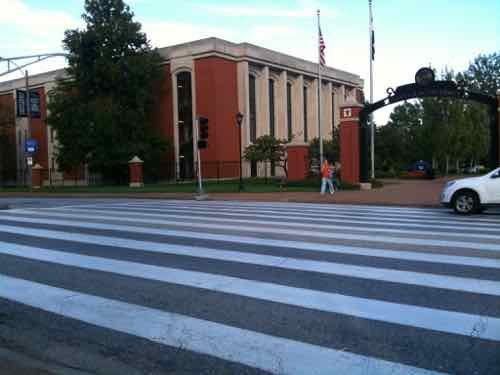
ABOVE: Looking south at a planned, but unmarked, crosswalk

It shouldn’t take a streetcar to make it safe

hotel.ignacio

Hotel Ignacio is just part of the development activity that has taken place here.

The Field House Pub & Grill is an example of positive things already underway in Midtown

The Field House Pub & Grill at 510 N. Theresa is an example of positive things already underway in Midtown

The streetcar can help the existing momentum and reduce the need for the excessive amount of surface parking.

The streetcar can help the existing momentum and reduce the need for the excessive amount of surface parking.

SLU could reskin this former state office building at 3545 Lindell, adding storefronts and new floors.

SLU could reskin this former state office building at 3545 Lindell, adding storefronts and new floors.

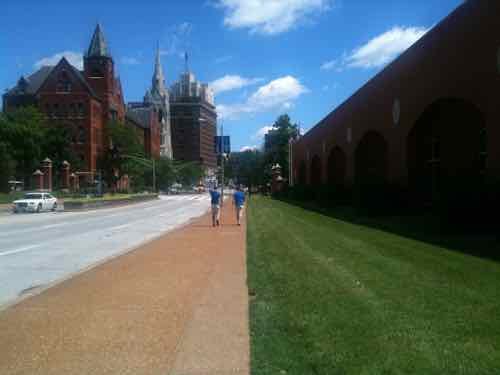
The SLU campus east of Grand has a prison feel, fences everywhere. SLU could remove the fencing to connect to the street, like the campus west of Grand.

The SLU campus east of Grand has a prison feel, fences everywhere. SLU could remove the fencing to connect to the street, like the campus west of Grand.

With a new building on the right, street trees along Grand would make this a pleasant route to take to reach the streetcar

With a new building on the right, street trees along Grand would make this a pleasant route to take to reach the streetcar

slumidtown2

Ideally SLU will build a new building on the SE corner of Lindell @ Grand

ABOVE: The once vibrant urban street corner is now a passive hole in the city

As well as the NE corner. I’d love to see a Trader Joe’s on the ground floor, with apartments above.

The corner of Lindell & Grand should get major new buildings. There are already substantial buildings in the area, especially to the north & west. These two corners were land banked by SLU so the streetcar is the perfect time to withdraw them and put them to good use activating the intersection.

I'd love to see the ground floor of Jesuit Hall activated with a cafe or bakery

I’d love to see the ground floor of Jesuit Hall activated with a cafe or bakery

The Lindell facade of Jesuit Hall also has opportunities for activity.

The Lindell facade of Jesuit Hall also has opportunities for activity.

The Masonic garage ob Olive is awful

The Masonic garage on Olive is awful, I can’t see this staying long-term

This section of Lindell has some stunning buildings, this is SLU's museum

This section of Lindell has some stunning buildings, this is SLU’s museum

The few gaps can be filled in with massive structures, student housing over retail would be nice at Lindell & Spring

The few gaps can be filled in with massive structures, student housing over retail would be nice at Lindell & Spring

Maybe we can widen the sidewalks along Spring

Maybe we can widen the sidewalks along Spring

3699 Olive

Eventually the owner of the auto repair shop at 3699 Olive @ Spring will retire and sell.

The Coronado was vacant for years until the Gill's renovated.

The Coronado was vacant for years until the Gill’s renovated.

Hopefully someone will find the right formula for the lower level space

Hopefully someone will find the right formula for the lower level space, several places have failed

A few years ago SLU razed two buildings here to make room for expansion of the law school. With the law school opening downtown this land plus the old law school are available

A few years ago SLU razed two buildings here to make room for expansion of the law school. With the law school opening downtown this land plus the old law school are available

The various modifications to the 1914 structure at 3765 Lindell has made it rather odd looking.

The various modifications to the 1914 structure at 3765 Lindell has made it rather odd looking.

The Crazy Bows & Wraps location might be developed. This 1961 structure was extensively remodeled in the 90s.

The Crazy Bows & Wraps location might be developed. This 1961 structure was extensively remodeled in the 90s.

In 1978 it was included as a "contributing structure" in the Midtown Historic District, click image to view district nomination.

In 1978 it was mentioned in the Midtown Historic District nomination as a “unfortunate intrusion which should not have been allowed”, click image to view district nomination.

This building was also part of the 1978 midtown historic district. This building should be saved as it contributes to both Lindell & Vandeventer.

This building, originally built for the Brotherhood of Railway & Airline Clerks, contributes to the 1978 midtown historic district. This building should be saved as it contributes to both Lindell & Vandeventer.

An interesting paragraph from the 1978 midtown nomination:

Unfortunately, Midtown is still perceived by many as a dangerous area riddled with street crime and all manner of urban ills, the most prominent of which is the current “black sploitation” fare served at the Fabulous Fox. In spite of this onus, a 1977 walking tour sponsored by the St. Louis Chapter of the American Institute of Architects and New Town/St. Louis, Inc. drew hundreds of curious and concerned

St. Louisans to Midtown. The solution for the revitalization of existing structures and the continuing education of the general public will not be easy, but to abandon Midtown is to dismiss one of the strongest concentrations of architecturally significant buildings in St. Louis.

There is more developable area north of Lindell and  west of Spring, both vacant buildings and vacant land.

– Steve Patterson

MetroBus Guide For SLU Law Faculty, Staff, & Students

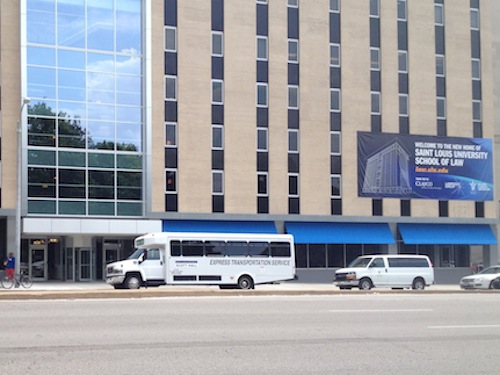
Very soon the Saint Louis University School of Law will move into a renovated building downtown, near the courts.

Last month (April 2013) the exterior of the new law school was basically complete, with new glass elements and a new top floor.

Last month (April 2013) the exterior of the new law school was basically complete, with new glass elements and a new top floor.

The same building in September 2012

The same building in September 2012

But this post isn’t about the alterations to the building, this post is meant to help faculty, staff & students understand how to use the MetroBus system.

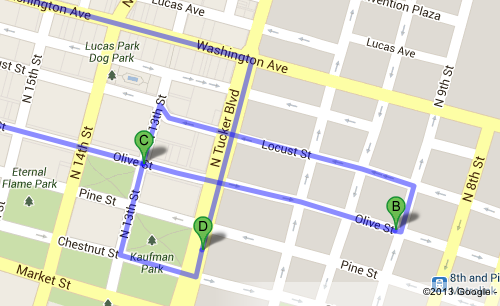
The distance between the current law school on the main SLU campus and the new building is 2.3 miles via Lindell/Olive & Tucker. Driving time is 9 minutes end to end, but no parking is available at the ends, so walking time needs to be added.

Taking the #10 (Gravois Lindell) MetroBus is 16 minutes, per Google Maps, including walking time.  Time on the bus is 11 minutes plus 5 for walking, so taking the bus is competitive with driving in this example.

Those going from the main campus can catch the #10 in one of two places: on Lindell east of Spring or Lindell east of Grand. You’ll exit the bus on just after it turns on 14th St., next to the Ford Building.

Bus stop at 14th & Pine

Riders returning the SLU main campus can catch the #10 at this bus stop at 14th & Pine, the Ford Building at left is the stop for those going to the law school.

In the opposite direction you’ll walk two blocks west along Pine to the stop shown above. You can exit at Grand to Spring for the main campus.

Frequency is every 30 minutes, 40 minutes after 11pm. The #10 line is the bus I use most often, the 30 minute frequency isn’t a problem when you know the schedule. I personally don’t use the printed schedule, I just check the times on the Google Maps iPhone app (or online) as needed.

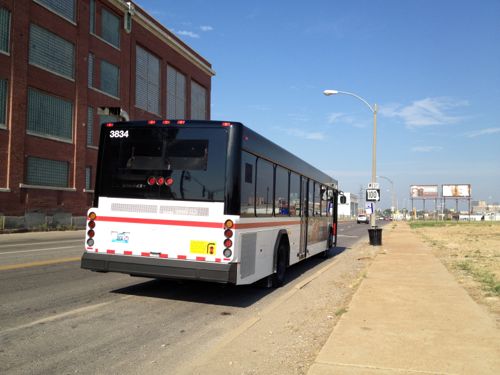
The bus route number is shown on the front left followed by the the final destination.

The bus route number is shown on the front left followed by the the final destination. This example is the #70 (Grand) MetroBus heading NB.

The route number & destination is also displayed on the curb side of the bus, just behind the door.

The route number & destination is also displayed on the curb side of the bus, just behind the door.

Here are some other things to remember:

  1. Make sure you look for your bus, if you are busy reading the bus driver may not realize you want to board and pass you.
  2. Transfers offer a good value. Say you board the bus at 10:30am and pay $3 ($2 fare + $1 transfer), you’ll get a transfer good until 1pm!
  3. Bus drivers can’t offer change, so having $1 bills is a good idea, a monthly pass is $72. Hopefully a new SLU administration will join the Metro campus programs like St. Louis Community College, Washington University, and University of Missouri-St. Louis (UMSL).
  4. Let others get off the bus before boarding, when you exit use the back door rather than the front door. This reduces delays.
  5. You’ll need to pull the cord to signal you want to stop at the next bus stop.
  6. Don’t be afraid to sit toward the back, the front seats must be given up for elderly & disabled passengers.
  7. Other MetroBus lines within 2 blocks of the law school include: 30, 41, 74, 94, 97, 99. Four blocks away at 14th & Market adds the 4 & 11.

Anyone else have any positive advice?

– Steve Patterson

My Wish List For The Next Saint Louis University President

Most likely you’ve already heard the news: Lawrence Biondi has announced he will retire as president of Saint Louis University.

The Rev. Lawrence Biondi surprised supporters and critics alike Saturday evening when he announced plans to retire from the presidency of St. Louis University.

The move follows months of campus strife that included no-confidence votes by faculty and students. (stltoday)

I’ve lived in St. Louis for nearly 23 years, most of Biondi’s 25-year tenure. I’ve witnessed the physical changes to the midtown campus along with everyone else. The public remains sharply divided on these changes. Some of us see the changes during his tenure as highly destructive and anti-urban, others view them as visionary, saving a once-dying campus.

Who’s right? Actually, both views are correct.

Biondi had a vision for the campus and was relentless in making it happen. Unfortunately, his vision was shaped by a perspective shared with many in his generation:

  1. Pedestrians stroll through park-like settings but use cars to actually get from point a to point b, pedestrians should be seperated from roads.
  2. Old urban cities are bad places with bad people, to be safe we must create physical barriers to keep them out of our space and to tell us where we shouldn’t go.
  3. Only poor people use public transit, everyone else has a car. In other words: transit brings troublesome poor folks while parking garages attracts desirable folks.
  4. Open space, with lush green lawns, solves problems.
  5. Residential, office, retail, industrial should all be separate from each other.

These views were formed in their youth, influenced by the General Motors Futurama exhibit at the 1939 World’s Fair.

The 1939 GM "Futurama" exhibit imagined intersection of 1960 with pedestrians separated from autos

The 1939 GM “Futurama” exhibit imagined intersection of 1960 with pedestrians separated from autos, click image to view 6 minute YouTube video from the 1939 New York World’s Fair (highly recommended)

My hope is the next president of Saint Louis University will reject the beliefs listed above. That he/she will instead think:

  1. The university should embrace the city, not wall it off.
  2. Supporting public transit will greatly reduce the need to take on debt to build more parking garages
  3. Thriving areas beyond campus will enrich the student experience
  4. SLU is an urban campus, the public rights-of-way (roads/sidewalks) within our boundaries should be highly active
SLU's anti-urban research building on the SE corner of Grand & Chouteau

SLU’s anti-urban research building on the SE corner of Grand & Chouteau

What is the likelihood the Board of Trustees will select someone with a viewpoint radically different from Biondi with respect to urban planning? Right, not very high…

– Steve Patterson

SLU’s Sculpture Garden Not Accessible To All

The northeast corner of Grand & Lindell, once an urban corner, is Saint Louis University’s Ellen Clark Sculpture Park. This large open site contains a number of sculptures that apparently please SLU President Lawrence Biondi.

ABOVE: The once vibrant urban street corner is now a passive hole in the city

ABOVE: The once vibrant urban street corner is now a passive hole in the city

I’ve only seen the colorful sculptures from the public sidewalk surrounding the fenced space. It is open to the public but the design isn’t accessible to those of us using wheelchairs.

Bare dirt at both entrances is  an invitation to get stuck. Even grassy areas can be a challenge for my power chair and nearly impossible for those in manual chairs.

Bare dirt at both entrances is an invitation to get stuck. Even grassy areas can be a challenge for my power chair and nearly impossible for those in manual chairs.

I can walk with my cane if there was a way to get my chair inside the gates so I don’t have to leave it out on the sidewalk to risk being stolen.  I’d think this sculpture garden should comply with the ADA due to #9 below:

Under the ADA public accommodations are private entities that own, lease, lease to or operate a place of public accommodation. This means that both a landlord who leases space in a building to a tenant and the tenant who operates a place of public accommodation have responsibilities to remove barriers.

A place of public accommodation is a facility whose operations affect commerce and fall within at least one of the following 12 categories:

  1. Places of lodging (e.g., inns, hotels, motels, except for owner-occupied establishments renting fewer than six rooms)
  2. Establishments serving food or drink (e.g. , restaurants and bars)
  3. Places of exhibition or entertainment (e.g. , motion picture houses, theaters, concert halls, stadiums)
  4. Places of public gathering (e.g. , auditoriums, convention centers, lecture halls)
  5. Sales or rental establishments (e.g. , bakeries, grocery stores, hardware stores, shopping centers)
  6. Service establishments (e.g. , laundromats, dry-cleaners, banks, barber shops, beauty shops, travel services, shoe repair services, funeral parlors, gas stations, offices of accountants or lawyers, pharmacies, insurance offices, professional offices of health care providers, hospitals)
  7. Public transportation terminals, depots, or stations (not including facilities relating to air transportation)
  8. Places of public display or collection (e.g. , museums, libraries, galleries)
  9. Places of recreation (e.g. , parks, zoos, amusement parks)
  10. Places of education (e.g. , nursery schools, elementary, secondary, undergraduate, or postgraduate private schools)
  11. Social service center establishments (e.g. , day care centers, senior citizen centers, homeless shelters, food banks, adoption agencies)
  12. Places of exercise or recreation (e.g. , gymnasiums, health spas, bowling alleys, golf courses) (source)

b

The park also serves as a dog park

The park also serves as a dog park

SLU installed a bag dispenser so dog owners can clean up and Biondi likes seeing dogs there.

“I am a dog lover,” said Biondi, who has an 8-year-old golden retriever named Iggy, in honor of St. Ignatius, founder of the Jesuit order. “But even if I didn’t love dogs, I’d still want the dogs in the park. It’s a nice opportunity for the community to get together and come to the campus and form friendships.” (stltoday.com)

Even as a dog park it has issues. If I were to try to enter the park there’s a risk someone’s dog might escape since no vestibule is provided.

Officially the entire corner is temporary, the university sought development  proposals when the recession hit. Rather than make the park accessible I’d much prefer to see it get redeveloped. SLU has tons of open land, plenty of space exists to create another dog park nearby.

Marina Building August 1977

Marina Building August 1977

The historic Marina Building was only two stories high but a new building could be many more floors given the height of others in the area. I’d love to see a Trader Joe’s in the ground floor of a new building.

Here’s an interesting tidbit I ran across researching this post:

This year [2011] marks the sesquicentennial of the Camp Jackson massacre at this site, then known as Lindell Grove on the western edge of the city. On May 10, 1861, federal troops — already on edge and spooked by the sound of gunfire — fired into the crowd, killing 28 civilians, including several children, and wounding nearly 100 more. From 1929 to 1959 a monument to the event stood nearby, but it was banished when a descendant of Daniel M. Frost, general of the pro-Confederate Missouri militia, donated funds for Saint Louis University to purchase the midtown Frost Campus. Today, the site houses the Ellen Clark Sculpture Park, which is full of colorful abstractions reflective of Saint Louis University president Lawrence Biondi’s taste in art. Not even a small plaque commemorates the historic event or the two dozen-plus civilians who died here. (RFT Best Hidden Historical Site – 2011)

- Steve Patterson

Readers: Lawrence Biondi & Robert Archibald Should Both Resign Their Positions

November 14, 2012 SLU No Comments

Saint Louis University President Lawrence Biondi and Missouri History Museum President Robert Archibald, each involved in unrelated controversies, should resign their positions according to nearly 60% of the readers who voted in the poll last week:

SLU Pres L. Biondi

Q: Should Biondi or Archibald Resign their positions?

  1. Both should resign: 219 [59.51%]
  2. Biondi yes, Archibald no: 93 [25.27%]
  3. Archibald yes, Biondi no: 30 [8.15%]
  4. Nether should resign: 19 [5.16%]
  5. Unsure/no opinion: 7 [1.9%]

For the backstory see the post introducing the poll here.

Biondi is clearly disliked more than Archibald with a quarter saying he should resign but Archibald shouldn’t. I agree with the majority, both need to step down immediately. Unfortunately their egos won’t allow them to do what is best for each institution.

With 368 responses, this was the most popular weekly poll this year.

– Steve Patterson

Readers Agree: Biondi Destroyed The Formerly Urban Midtown Area Around Saint Louis University

March 7, 2012 Featured, Midtown, SLU 63 Comments

ABOVE: SLU bought and razed the urban Marina building

The majority of the readers that voted last week agreed that Saint Louis University President Biondi has destroyed midtown since 1987 — a decade after it became a historic district on the National Register of Historic Places. Here were the final results:

Biondi has destroyed the formerly urban midtown area around the Saint Louis University campus:

  1. Strongly agree 78 [40.41%]
  2. Somewhat agree 48 [24.87%]
  3. Strongly disagree 41 [21.24%]
  4. Somewhat disagree 12 [6.22%]
  5. Neutral 7 [3.63%]
  6. Other: 7 [3.63%]

The “other” comments were:

  1. It was destroyed long before he got there; he hasn’t done enough to renew it.
  2. By Urban do you mean the drug infested Laclede Town?
  3. responding to his market,suburban parents wont send kids to school in “the hood”
  4. I don’t know.
  5. He isn’t responsible for all of it, but he most certainly has made it worse.
  6. I wasn’t here back then.
  7. Biondi could have done so much better … so much better.

The original post (Agree or Disagree: Biondi has destroyed the formerly urban midtown area around the Saint Louis University campus) generated many comments on both sides of the issue.  I’ve pulled some of my favorite comments of the more than 60:

  1. In an architecturally signigicant urban district, there is a great difference between demolition for re-purpose and demolition for grassy lots and parking.
  2. Soulard hardly had critical mass when people started rehabbing it in the 70s. it was a slum with a 50% vacancy rate, and city “leaders” had designated it as blighted and marked it for wholesale demolition. It had even been gashed in half by the highway, just as Midtown is gashed by the train yard. moreover, people DO live and/or work in Midtown. and more people COULD live there if SLU would stop demolishing homes and buildings that could be converted to residential (like the Metropolitan and Pevely). how are people supposed to live in fountains and sculpture parks?
  3. Midtown Alley has been developing over the last decade arguable independent of SLU, and on some levels in spite of SLU’s intervention.
  4. I attended SLU from 1970 to 1974. I lived in Laclede Town my junior and senior years in college. Many a night I walked or rode my bike home from Piux XII libary to my apartment on Ewing Avenue. I also worked evenings at 3800 Lindell, which was occupied by IBM at the time. I was never afraid for my safety because there were always people about, either on campus or walking up Lawton Place in Laclede Town. Would I do that same walk today? Absolutely not. Why: Because after 5:00PM, the entire stretch of land from what used to be Channing Avenue to Ewing is totally deserted most nights, the perfect setting for a crime. The last time I was in St. Louis, on a beautiful summer afternoon, the entire area was completely deserted with no pedestrians in sight and little, if any vehicular traffic. What is wrong with this picture?The City of St. Louis SLU conspired to get rid of Laclede Town, and once again both institutions were extremely short sighted. Having lived there and visited all sections, Park, Town, East and West, all 1000+ of those apartments could have been rehabbed and adapted to today’s modern standards and once again made a viable, walkable urban communhity. But once again, the slash and burn attitudes of SLU and the complete dysfunction at St. Louis City Hall prevailed and what you have today is the veritable no man’s land 2/3 of the time. And don’t tell me AG Edwards couldn’t have expanded the way it did if Laclede Town was still there. God knows there’s is still enough vacant, underutilized land in that area with plenty of room for AG Edwards and a lot of other companies to grow and expand. This slash and burn tactic is now being used to isolate the medical center from the greater city.
    I expressed my feelings about this destruction of the city to Biondi via email, and surprisingly, he responded. Not surprisingly, he was a total, arrogant tool in his response, basically telling me I didn’t know what I was talking about. I have news for Biondi and his supporters in STL: if he were at St. Joe’s here in Philly, or Fordham in NYC, he’d wouldn’t be allowed to do a fraction of the things he has done in STL. If Biondi is upset about the grief he’s getting in STL, he’d be seething in rage if he tried that crap in Wynnewood where St. Joe’s is located. He’d need an asbestos suit for the firestorm of flack he’d get.

  5. It disturbs me that Biondi and SLU doesnt care that it they have a huge image problem with the urban educated middle class – the very people that should (and do) support SLU and importantly as well the city around SLU. Boy, he needs to go sooner than later.
  6. I have lived in bombed crime infested areas all over the United States, and I am sure I would have walked around the area.
  7. There is also a light rail station just down the street on the Grand Ave Bridge connecting with the Airport, Galleria etc. The point is that if you do not complement transit with appropriate urban planning the it harms the success of transit. By designing the Doisy Center and the new medical center to be exclusively auto orientated it devalues huge public investments in mass transit. not to mention in making it more difficult to make the city a walkable environment by creating parking and open space wastelands. (The Doisy Center is not parkland, even the fountain on Lindell and Grand is a unused joke of a space, not to mention the ridiculous sculpture garden across the street)
    Again, check it out, the great cities of the world balance walking, transit and the automobile. Check out classical city planning also. Biondi is basically giving the finger to the City and to the people of St. Louis.
    So I guess you, like Biondi have a problem with balance, is that it?
  8. I’m 64 and remember the area well, saying it was not safe must mean you didn’t come into the city at all, Soulard, Lafayette Square and the West End were hardly in better shape at the time. I felt safe, I even remember wandering through the derelict Fox Theater, standing wide open in those days. The space above the ornate ceiling is amazing.
    You sound like you are afraid of your own shadow. Nor are we talking about Pevely Corporation, we are talking about the extremely poor decision making of Biondi. As I point out above Wash U. shows how it is done. You are projecting your negative views saying only chains will be able to afford the commercial space. At least there is commercial space for locals to compete for, unlike Biondi and his hysterical, self serving agenda.
    Biondi is nothing more than a greedy gangster supported by the useless City Government that lack the balls to stand up to even the dumbest morons that happen to have access to money.
    Biondi’s plan would be laughed out of most city halls in the world. These are cities that put the concerns of the public over self serving developers.
    It is absurd we even have to be talking about this, Biondi has so many other options that it is clear his underlying hate of the public drives his agenda. It can be nothing else. He certainly isn’t a peacemaker, a leader, a holy man or anything positive, face it, he is a jerk.
  9. I went to SLU 55-57. Lived on North Grand near Sportsman’s Park, before it was Busch 1. It was a real city then. Took the Grand Streetcar to Lindell for classes; ate at the deli (Carneigies?) on Olive just west of Grand; would stop at a huge billards parlor over the deli and shoot a game or two for relaxation; would stop in a little bar east of grand on Lindell for a beer or two before taking the streetcar back to my apartment; would take the streetcar back to Washington, grab the Delmar bus to Stix, Baer & Fuller (became Dillards; then the hotel/apartments) to sell women’s shoes. A bus or streetcar came every couple of minutes so REAL public transportation existed.
    After graduating, went across Grand to work at IBM on the South East corner of Grand/Lindell. Loved going to the Fox; the Missouri; the Shubert; the St. Lous; the Empress movie theaters in the 5 block area whenever we felt like it. The Melbourne hotel had a great bar loaded with after work guys and gals.It was no different from my neighborhood as a kid, an apartment at Delmar and Kingshighway. Look at the area now. Hiroshima Flats. There were at least 5 hotels in a four block radius and they were packed. I could go on, but you get the picture.

    The picture is … this was a city. People lived in the city day and night. They didn’t come into the city. We WERE the city. Of course we had 800,000 people IN the city then. Now it’s 350,000. That alone explains the lack of people. We also do not people willing to invest in the city. Take the “Bottle District” and “Ballpark Village”. Perfect examples. When we quit thinking in terms of Ladue, Clayton, etc. and think ST. LOUIS, it will continue to be a difficult battle to get back to what we were.

Biondi needs to step down and the entire community nerds to work on a plan that will reorganize this part of midtown over the next 25 years.

- Steve Patterson


Agree or Disagree: Biondi has destroyed the formerly urban midtown area around the Saint Louis University campus

In July 1978 the Midtown Historic District (large PDF) became part of the National Register of Historic Places. The entire area was very rundown at the time, numerous buildings were vacant or nearly vacant. The St Louis Symphony Orchestra moved into the former Powell Theater in the late 60s but that didn’t spur redevelopment of the area.

ABOVE: Fox Theater July 1977; Source: National Register nomination linked above

The Fox Theater was a mess at the time:

On a cold January morning in 1981 Leon and Mary Strauss first saw the Fox Theatre. With the aid of flashlights and one working light bulb, the Strausses discovered the hidden magic of the splendid theatre beneath the dirt and grime of 52 years. It was love at first sight and the rest is St. Louis history. Banding together as Fox Associates, Leon Strauss, Robert Baudendistel, Dennis McDaniel and Harvey Harris privately purchased the movie palace from the Arthur family. With Mary Strauss as director of restoration, there began a one year, $2 million plus restoration program under the aegis of Pantheon Construction Company. (Fox Theater)

ABOVE: Fox Theater June 2007

Some saw the great potential of midtown but others saw vacant buildings instead of the expansive grass so common in the suburbs. Saint Louis University President Lawrence Biondi was one of those who didn’t get it then and still doesn’t today.

Since his inauguration in 1987, Father Biondi has led Saint Louis University through a remarkable era of transformation and achievement. In addition to modernizing the campus and helping revitalize the surrounding Midtown neighborhood, Father Biondi has committed vast University resources to academics, student scholarships and financial aid, faculty research and state-of-the-art technology. (Saint Louis University)

ABOVE: Map from National Register nomination, the Fox is the large black rectangle

North of Olive St thankfully was beyond Biondi’s grasp but south of Olive St didn’t stand a chance. Six buildings listed in 1977 as having “neighborhood significance” where “demolition would be a major cultural loss” are gone. A seventh had “architectural merit — demolition would diminish the integrity of the neighborhood.”

Sadly this concentration of urban buildings was razed, the land is now parking and grass.

ABOVE: SLU razed the urban building on the NE corner of Grand & Lindell. Image saved from internet in 2007, source unknown

The Marina building stood on the NE corner of Grand & Lindell (aerial) for decades, from the National Register nomination:

The 1907 red brick and terra cotta Marina building at the northeast corner of Grand and Lindell has been subjected to similar alterations. The oldest commercial structure in the district, the pattern of arched window openings at second floor level draw the eye and define one corner of the major intersection of the district. 

This building would have been a great anchor for that corner had it been rehabbed. Sure it was an eyesore with the bad storefronts that had been built over the years.

ABOVE: Marina building in August 1977 with a Jesuit hall and Continental buildings in the background

ABOVE: The once vibrant urban street corner is now a passive hole in the city

The southeast corner was also urban but not included in the historic district because of unfortunate  alterations to the corner structure:

On the southwest [sic] corner of the same intersection, SLU bought a bank building (that was a historic structure hidden under a layer of plain stucco) and demolished it for a lifeless plaza and fountain. (VanishingSTL)

I remember that bank — I opened my first checking account there in 1990. Midtown was great — was.

ABOVE: SE corner of Grand & Lindell now

In an urban setting grass, trees & water can’t substitute for the massing a building gives by defining the urban space.

Some act like demolition is the only answer to a tired urban area. A few blocks north was just as seedy but there buildings were saved and renovated. The now celebrated Washington Ave loft district was a ghost town of old warehouses — Biondi’s solution would have been parking lots & grass. Demolition was the failed 1950s “urban renewal” solution.

Biondi is a current day Robert Moses, the sooner he retires the sooner we can begin to reurbanize midtown and undo the damage he’s inflicted on this section of St. Louis.  The poll is in the right sidebar (not visible on the mobile layout).

- Steve Patterson

Urbanists & Preservationists Will Support Pevely Dairy Today

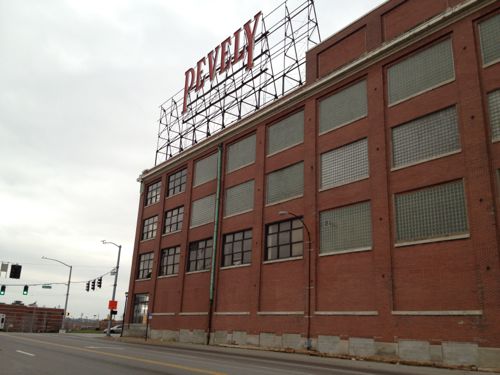
ABOVE: The historic Pevely Dairy maintains the building line at both Grand & Chouteau. Click image for my post from last month

The Preservation Board usually meets on the 4th Monday of each month but due to the holidays will instead meet tonight. On the agenda is Saint Louis University’s proposal to replace the historic structures with a lawn. And probably a fountain.

The conclusion of the staff report (see agenda):

The proposed subsequent construction of the Ambulatory Care Center cannot be evaluated at the time these comments were prepared and needs to be considered once presented at the Preservation Board meeting. The Cultural Resources Office recommends that the Preservation Board approve the demolition of the milk plant at 3626‐80 Chouteau and the garage at 1101 Motard, as the loss of these Merit buildings would have an acceptable effect on the urban design and the streetscape. The Cultural Resources Office also recommends that the Preservation Board uphold the denial of the demolition of the office building as it is a sound, High Merit resource and has reuse potential, and the iconic smokestack. These two structures on the parcel with the address 1001‐03 S. Grand, are prominent in the streetscape and their loss would have a noticeable effect on the physical fabric of the neighborhood and urban design.

Many have expressed the viewpoint the corner structure and smokestack occupy a tiny portion of the total site and therefor do not impede plans for new construction on the rest of the site. I’d love to see a drawing with Saint Louis University’s proposed building superimposed over the corner structure and smokestack.

- Steve Patterson

Pevely Dairy Fate to be Decided Today, or Not?

The proposed demolition of the historic, and urban, Pevely Dairy complex at Grand and Chouteau is on today’s Preservation Board agenda, but won’t be heard:

St. Louis University’s request for permits to demolish the Pevely Dairy buildings is off Monday’s agenda of the city’s Preservation Board but that does not mean SLU is abandoning its effort to raze the historic complex.

A university spokesman said today that seeking a delay for a hearing on its request for demolition permits gives SLU more time to present its case to the city panel. SLU has said it wants to replace the Pevely complex with a building for its SLUCare physician’s practice. (STLtoday.com)

Part of me doesn’t trust that the issue won’t be decided at today’s meeting. But, it’s quite possible the staff will indicate the issue will be on the December agenda.The main problem I have is SLU’s false claim the historic structure is in the way.

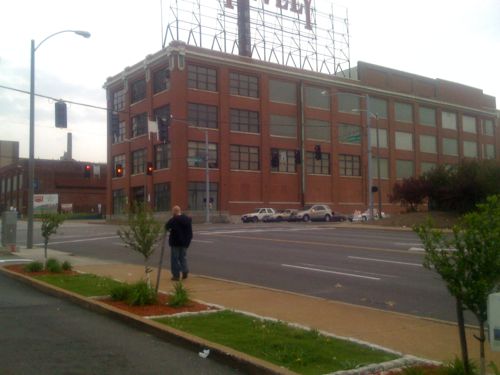
Given the history of Saint Louis University these past two decades the Pevely building and smokestack aren’t in the way of a new building. No, they are where SLU President Fr. Biondi wants  grass and a fountain. Trying very hard not to use a few choice expletives!

ABOVE: SLU's anti-urban research building on the SE corner of Grand & Chouteau

Biondi hates urbanity, or maybe he just doesn’t know what makes a good city. The SLU campus is very pristine and in the center, interesting, But the edges are dead zones due to all the fenced lawns created by Biondi. Intended to make the area safer, SLU policies suck life out of the area to the point the sidewalks are nearly vacant, which isn’t safe. People create safety.

ABOVE: Most of the large site is occupied by non-historic structures

The smokestack and building at the corner, with the rooftop sign, are the two elements that should be saved. The warehouse elements in the foreground (above) should be replaced, just not with lifeless iron fencing with lawn.  New medical buildings can be built around & embracing the old. The smokestack could be the centerpiece of a courtyard. The architectural possibilities were explored during a recent design charrette:

After a thorough discussion of the site’s dimensions, SLU’s extensive landholdings in the area, and the university’s probable needs, participants subdivided into four groups. Each focused on a different approach, including converting the corner building into doctors’ offices with a larger modern addition, adapting it into market-rate housing and ancillary facilities for the medical school, finding additional on-site locations for new buildings, and generating an overall site plan to connect this corner to the rest of the university. (SLU Says It Can’t Reuse the Pevely Buildings; Local Designers Beg to Differ)

I look forward to seeing the many varied solutions these teams developed.

We must resist SLU’s efforts to destroy both Grand & Chouteau corridors. Biondi has already done a number of Grand at the main campus and the medical campus but hope remains for Chouteau and eventually Grand can be urbanized again, largely by  building over Biondi’s lawns.

ABOVE: The historic Pevely Dairy maintains the building line at both Grand & Chouteau

Where SLU has replaced walkable urban buildings with acres of fenced lawn we can build new 1-2 story “liner buildings” to recreate the walls of the urban street. The SW corner shouldn’t be destroyed, liner buildings can fix the anti-urban SE corner but two such corners would be a disaster.

The NE corner is a suburban fast-food chain and the never urban NW corner is being cleared for more dead SLU grass. Yawn.

ABOVE: The NW corner of Grand & Chouteau should be developed in a urban manner, respecting & engaging the sidewalk.

The Grand viaduct is being replaced and the MetroLink station getting rebuilt. The #70 Grand bus is Metro’s busiest and the #32 MLK bus travels up and down Chouteau & Manchester. If developed right, Grand & Chouteau could be a great pedestrian environment. Chouteau is important for connecting Lafayette Square & Downtown  to The Grove.

My guess is Biondi has surrounded himself with yes men that tell him he’s done a great job with the campuses. Well, on the chance he’ll read this post:

Stop it! You are destroying the city! What you’ve done will take decades to undo and it must be undone to create lively sidewalks. It sickens me my tuition helped fund your destructive ways. Retire!

- Steve Patterson

Readers: Saint Louis University Shouldn’t Be Allowed To Raze The Historic Pevely Dairy Complex

College campuses often reflect their location: rural, suburban or urban. Although Saint Louis University is in an urban location, it is doing a great job of destroying all aspects of urban life.

ABOVE: The former Pevely Dairy at Grand & Chouteau (click image for map)

Last week the majority of readers that voted in the poll do not want this to continue:

Q: Should the St. Louis Preservation Board allow SLU to raze the former Pevely Dairy building at Grand & Chouteau?

  1. No 134 [66.34%]
  2. Yes 43 [21.29%]
  3. Maybe 14 [6.93%]
  4. Other: 9 [4.46%]
  5. Unsure/No Opinion 2 [0.99%]

The 43 “Yes” answers must be from those who think they have a rational look at life.

ABOVE: SLU's anti-urban research building on the SE corner of Grand & Chouteau

The reality is each and every time an urban building is replaced with an anti-urban building set behind a green lawn the environment is denigrated, making revitalization that much harder. Wealthy institutions know this will help them but more land, something they couldn’t do if areas thrived with private investment.

Here are the nine other answers provided by readers:

  1. Not the main structure.
  2. Hell no! Apparently SLU thinks its interests are parallel to ours. WRONG!
  3. only if they replace it with a huge fountain or better yet museum of fountains
  4. Yes, SLU doesn’t own enough vacant land for this project.
  5. No, there’s a shortage of university housing, build reasonably price apts
  6. Need to see post-demo land use plans before final determination
  7. SLU has a Center for Sustainability with no real estate–rehab Pevely for that
  8. No, they should renovate it and add on another building if needed
  9. If it can’t be rehabbed

From the nomination (PDF) to the National Register of Historic Places in 2009:

The Pevely Dairy Company Plant sits on an approximately eight-acre site in the Midtown Neighborhood of St. Louis on the west side of South Grand Boulevard between Chouteau and Hickory Avenues. Constructed between 1915 and 1945, the Pevely Dairy Company Plant was designed as the headquarters for the growing company; it remained in service as a dairy until November 2008. It is comprised of three buildings, a smokestack, and two parking lots. The 1915 four-story, red brick office building is located at 1001 South Grand Boulevard. It features a three-bay façade with large display windows in the first level, and retains the original wood door and pedimented entrance surround. A terra cotta cornice with colored tile designs ornaments the flat roofline. Many of the original wood industrial windows have also been retained on this building, as well as the glazed brick walls and floors and intricate woodwork. The 1916 milk plant sits behind the office building at 3626 Chouteau Avenue. This three-story brick and concrete industrial building had additions in 1943, 1945, 1975 and 1997. Featuring metal hopper windows, three loading docks, two metal coolers and two steam tanks, the milk plant’s architecture is primarily functional rather than artistic. The interior retains its glazed brick walls and floors, as well as large, open storage rooms that include concrete mushroom columns. A 1928 garage is located south of the milk plant at 1101 Motard Avenue. This brick, arch-roofed structure retains original glazed glass metal windows, with sliding metal doors and stepped parapet walls on the east and west elevations. The interior consists of an open parking area with a concrete floor. Originally connected to a boiler and powerhouse, the 1943 smokestack now sits across a parking lot from the office building. The brick structure includes a glazed brick design spelling out the Pevely name. The adjacent parking lot and a lot between the milk plant and garage have historically served as open parking and loading space, and are included in the boundary. Though three of the Pevely structures have burned since the period of significance, the factory as a whole retains the industrial structures primarily associated with the company. These buildings are in good condition and continue to reflect their industrial significance.

The issue is said to be on the November 28th Preservation Board agenda, which isn’t available yet. I’m glad to see Mary “One” Johnson is no longer on the board, she consistently voted in favor of demolitions.

Saint Louis University must show the structure(s) cannot be reused — not necessarily for their intended purpose  but for any reasonable use. We’ll see how they try to spin this at the meeting.

- Steve Patterson

Archives

Categories