Car Hit Planters & Scaffolding Outside Condemned Parking Garage

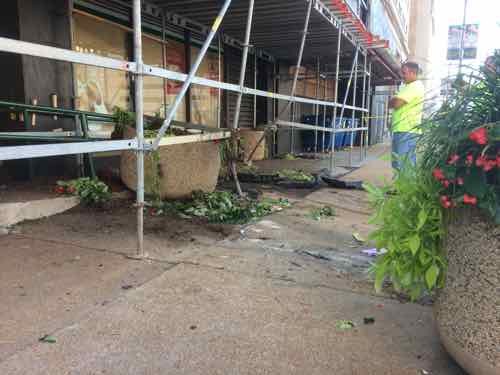
Early Monday morning a car hit planters & scaffolding on the Tucker sidewalk, at Locust.

A car crashed into the side of a downtown building just before 1:00 Monday morning near Tucker Boulevard and Locust Street.  (KMOV)

KMOV’s report says after inspection the building was “deemed safe.” More accurately, the car didn’t damage the building, but it was condemned months ago.
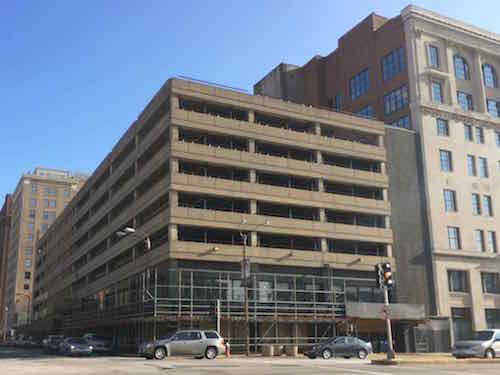
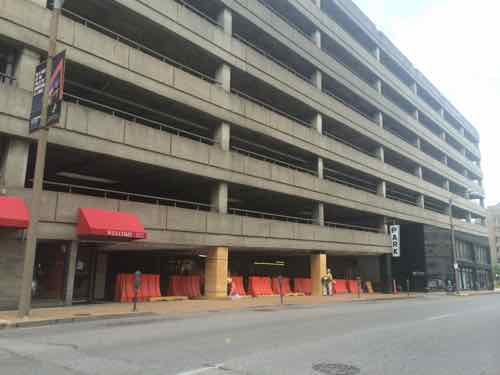
Garage at Tucker & Locust, December 2014. The two planters hit Monday can be seen between the cars
Just before 7am, a worker looks at the damage to the scaffolding.The two planters now shoved back against the previously condemned building

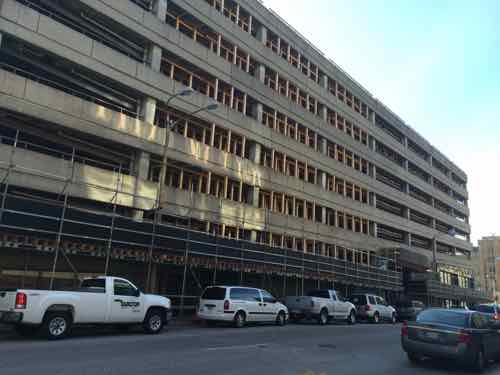
This scaffolding has now been in place for more than a year. All the work had been inside, but that stopped months ago.

Prior posts:

On July 1, 2014 just before the scaffolding went up along the Locust side
December 2014
December 2014

The scaffolding was in place to prevent debris from falling to the public sidewalk below. With work stopped, I have to wonder how long it’ll remain in place? Is there a point where the city will force the owner &/or contractor to remove it from the pubic right-of-way?

— Steve Patterson


Arch Visitors Walk Where Sidewalk Used To Be, Should Be Again

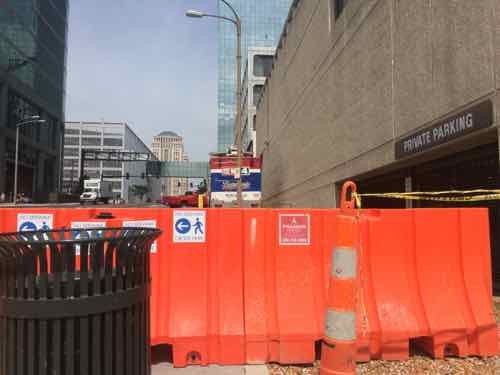
Currently there’s only one way in/out of the Arch grounds — via Walnut Street over I-44 (formerly I-70).  While the new lid at the center is being completed, everyone is routed via the new bridge over the interstate, on the North side of Walnut Street. However, at some point, St. Louis removed the sidewalk on the North side of Walnut St, between Memorial (3rd St) and 4th.

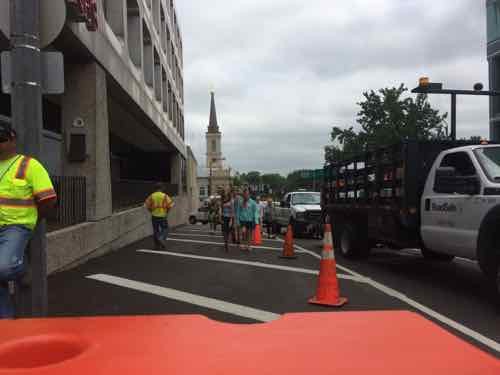
Pedestrians crossing back downtown are directed to not walk straight ahead, to go to the South side of Walnut (left)  or go one block North to Market (right)
Pedestrians crossing back downtown are directed to not walk straight ahead, to go to the South side of Walnut (left) or go one block North to Market (right)
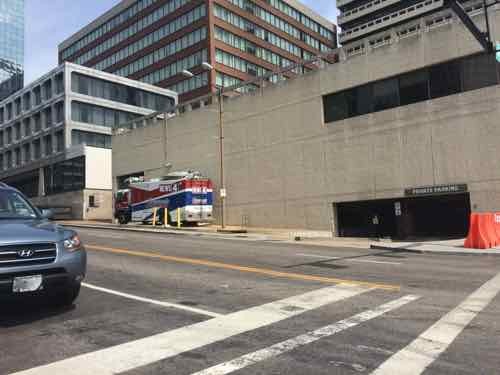
The South side of Gateway Tower, KMOV's truck parks where the public sidewalk should be
The South side of Gateway Tower, KMOV’s truck parks where the public sidewalk should be
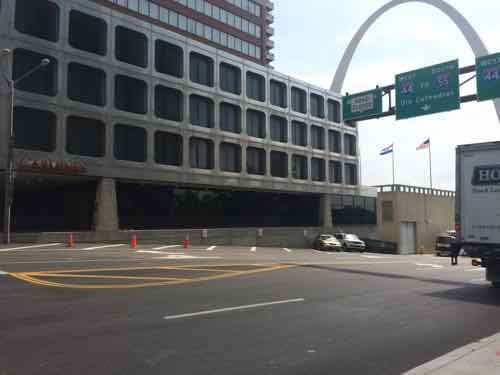
Where the sidewalk used to be next to the former American Zinc building, is  angled parking
Where the sidewalk used to be next to the former American Zinc building, is angled parking. Click image to view the National Register nomination of this building
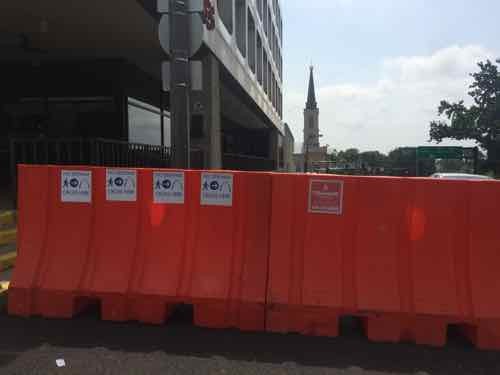
Looking East from 4th the same barricades indicate pedestrians shouldn't walk in a straight line
Looking East from 4th the same barricades indicate pedestrians shouldn’t walk in a straight line
Crowds of people walking West into downtown
Crowds of people walking West into downtown on a Thursday afternoon

Looking at the 1997 National Register nomination of the American Zinc building, the sidewalk was in place. Most likely the sidewalk was removed when Drury Inn combined it with two other buildings, see Drury steps up plans for hotel at Fur Exchange site.

Looking at GEO St. Louis it appears this remains part of the public right-of-way (PROW), not vacated to private interests. The PROW was reallocated to give pedestrian space to automobiles. At the time the Cardinals played in Busch Stadium II and Walnut Street was a major point of vehicular egress after games.

I think we need to examine the Walnut PROW to see if the amount for vehicle travel can be reduced by one lane so that a sidewalk can be replaced. Remember, hundreds of millions of dollars are being spent to connect the Arch ground to downtown. The lack of a sidewalk connecting to the South highway crossing point is a huge disconnect.

People know the shortest distance between two points is a straight line.

— Steve Patterson


Sunday Poll: How effective is “Hot Spot Policing”?


St. Louis Police Chief Sam Dotson is an advocate of “hot spot policing”:

Through hot spots policing strategies, law enforcement agencies can focus limited resources in areas where crime is most likely to occur. The appeal of focusing limited resources on a small number of high-activity crime areas is based on the belief that if crime can be prevented at these hot spots, then total crime across the city might also be reduced. (National Institute of Justice)

This practice also has local critics. For today’s poll I want to see how effective readers think this strategy is.

The poll closes at 8pm.

— Steve Patterson


Hidden Jewels of North St. Louis: Capturing the Beauty Beyond the Delmar Divide

July 10, 2015 Books, Featured, History/Preservation, North City Comments Off on Hidden Jewels of North St. Louis: Capturing the Beauty Beyond the Delmar Divide

My friend, filmmaker Phillip Johnson, has begun an interesting new project:

Hidden Jewels of North St. Louis is a photo book/video project telling the story of North St. Louis through the lens of homeowners living north of the “Delmar Divide” it is also a book that explores the reasons behind the Delmar Divide and projects a vision of a new North Side.

Here’s the video to kickoff the fundraising effort:

To contribute to this project go to gofundme.com/HiddenJewelsofSTL

— Steve Patterson


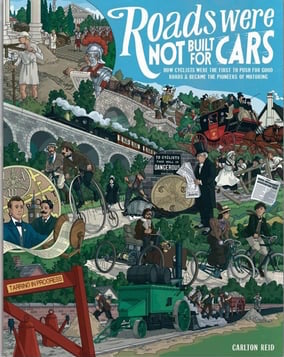
Reading: Roads Were Not Built for Cars: How Cyclists were the First to Push for Good Roads & Became the Pioneers of Motoring by Carlton Reid

Click image to hear a webinar featuring author Carlton Reid

When I had my stroke in February 2008 I owned 5-6 bicycles, the oldest was a very original 1950s Huffy. I kept my bright orange Kronan, a reproduction of a single-speed WWII Swedish Army bike, as art. I love all things bicycle.

My library includes a few coffee table books on bicycles and their history. Those books briefly touch on early dirt roads and how cyclists pushed for better roads on which to ride, but they quickly get into the various bike designs, mechanicals, etc. A new book just out focuses not on bicycles, but on the early cyclist’s push for better roads. In ‘Roads Were Not Built for Cars: How Cyclists were the First to Push for Good Roads & Became the Pioneers of Motoring’ author Carlton Reid goes into great detail, from publisher Island Press:

In Roads Were Not Built for Cars, Carlton Reid reveals the pivotal—and largely unrecognized—role that bicyclists played in the development of modern roadways. Reid introduces readers to cycling personalities, such as Henry Ford, and the cycling advocacy groups that influenced early road improvements, literally paving the way for the motor car. When the bicycle morphed from the vehicle of rich transport progressives in the 1890s to the “poor man’s transport” in the 1920s, some cyclists became ardent motorists and were all too happy to forget their cycling roots. But, Reid explains, many motor pioneers continued cycling, celebrating the shared links between transport modes that are now seen as worlds apart. In this engaging and meticulously researched book, Carlton Reid encourages us all to celebrate those links once again.

The book is available in paperback and iPad formats. See roadswerenotbuiltforcars.com for more information.

I love bikes…I just can’t ride one anymore.

— Steve Patterson


Advertisement


[custom-facebook-feed]

Archives

Categories

Advertisement


Subscribe