Home » Parking » Recent Articles:

Central Valet Zone Now On Tucker

I’ve been writing about valet parking since July 2005. Years ago valets would take every on-street parking space on the block in front of the restaurant that hired them. leaving no spaces for the public to use. They’d place valet signs in bike lanes.

Finally the city to placed signs on the meter of the spaces that were permitted for valet service, including days of the week and hours of operation. The valets continued to take more spaces than given, again inconveniencing the general public. For example, until recently, we had three different valet stands in the two city blocks of Washington Ave between 10th and Tucker (12th), two were directly across the street from each other!

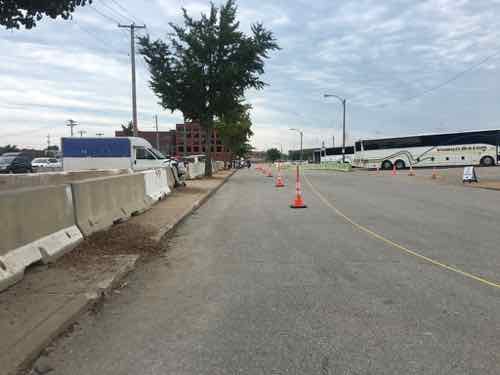
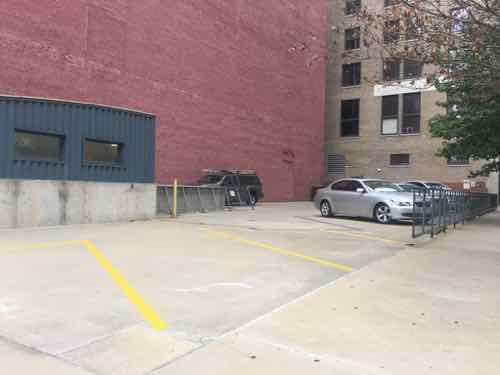
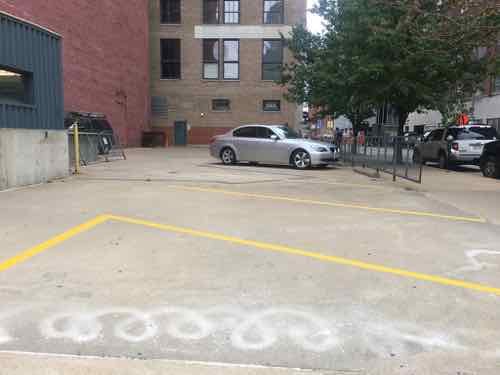
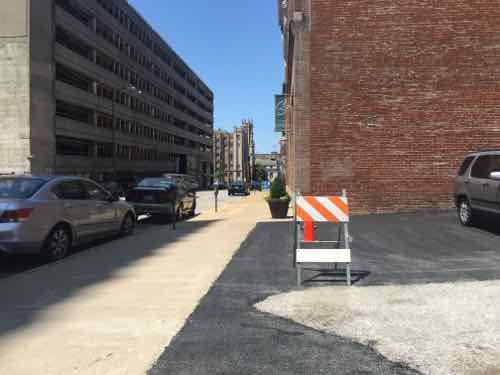
The city has permitted valet on Thursday-Saturday evenings after 6pm. Lately the city did something it should’ve done 8 years ago — created a central valet zone to cover these two blocks. So now on Tucker from St. Charles St to Washington Ave you have a bus stop and a valet zone. This area didn’t have any on-street parking before, it was just excessively wide.

Half the block from St. Charles St to Washington Ave is now designated for valet parking 3 nights per week after 6pm.

Half the block from St. Charles St to Washington Ave is now designated for valet parking 3 nights per week after 6pm. Copia, Prime 1000 & Mosaic customers now valet here.

Valet problems are solved, right? Wrong! The valet companies still feel they have the right to take public parking whenever and where ever they like.

Valets covered two meters in front of Prime 1000 on Monday May 13th, I took this photo at 3:50pm.

Valets covered two meters in front of Prime 1000 on Monday May 13th, I took this photo at 3:50pm.

Empty spaces mean the city isn’t getting revenue to pay off bonds to cover parking garage debt. Since it was before 5pm I was able to email the above pic to the appropriate people so they could come out and tell them they couldn’t do this.

I personally don’t care if valeting happens 7 days a week, as long as it is in the central spot on Tucker so the public spaces remain available for the public to use.

– Steve Patterson
No Parking Means No Parking

Ninth Street in front of Culinaria has many free short-term angled parking spaces, but the area in front of the door is a no parking zone. A driver of a Cadillac found this out recently…

Warning sticker on Cadillac parked in no-parking area

Warning sticker on Cadillac parked in no-parking area

I wonder what the owner of the car thought as s/he tried to remove the sticker? My guess is the city is no good, downtown sucks, etc. Some feel entitled to break rules then blame others when caught.

What’s the big deal about parking here?

Well, my guess is to make sure drivers leaving a space don’t back into the crosswalk or cause congestion problems in the 9th & Olive intersection. Enforcement only goes so far, design also plays a role.

A curb bulb could eliminate this problem, it wouldn’t have cost much when the 9th Street Garage was being built. Now it would be very costly to modify the area. A bulb out would be nice because it would give Culinaria more sidewalk space when they sell food & drink on the sidewalk during games, plus it would provided room near the entrance for bike parking. When the current bike parking is used the sidewalk becomes too narrow.

Don’t expect to see any change though, drivers will see an opportunity and then bad talk the city when called out.

– Steve Patterson
Wheelchair Users Unable To Pay Parking Fee With Credit Card

Just weeks before Tishaura Jones was sworn into the office of St. Louis Treasurer I posted about a problem with a city-owned parking lot on Olive (see Wheelchair Users Unable To Pay Parking Fee In City Parking Lot). In that post I showed how disabled drivers that use wheelchairs would be unable to pay the central machine.

ABOVE: However, those disabled drivers that use a wheelchair are unable to reach the payment machine because no ramp up was provided.

Disabled drivers that use a wheelchair are unable to reach the payment machine because no ramp up was provided.

At the time the city said they planned for the two disabled spaces to be free of charge, so disabled users didn’t need ADA-compliant access to the machine. The other night I noticed the city installed two old fashioned parking meters between the two disabled spaces.

The city's solution was two meters for the disabled spaces.

The city’s solution was two meters for the disabled spaces.

Problem solved, right? Wrong! This means those parking in the two disabled spots must carry coins to feed the parking meter while everyone else gets the option to pay by coin or credit card.

The pay-per-space machine accepts coins and credit cards, but not bills.

The pay-per-space machine accepts coins and credit cards, but not bills.

The city made an error and didn’t consider disabled users. Then in trying to fix their error on the cheap they created a problem of inequality.
– Steve Patterson
Metered Parking Space Ends Unclear To Some Drivers

April 26, 2013 Featured, Parking 12 Comments

It’s been 30+ years since I took driver’s ed in high school so I don’t recall what we learned about parallel parking. My guess is it focused on the mechanics of backing into a space between two cars. I do remember having to parallel park for my driver’s exam, we had to go to Will Rogers World Airport because no where else in south Oklahoma City had parallel parking.

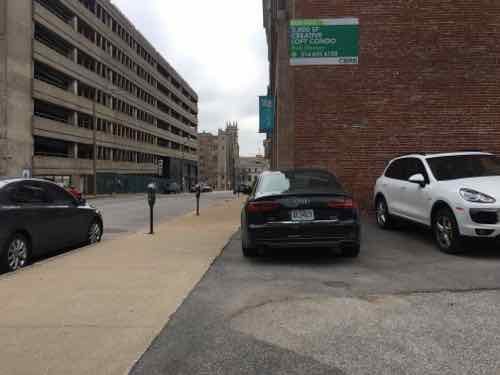
This driver managed to center their car on the meter, halfway in two parking spaces.

This driver managed to center their car on the meter, halfway in two parking spaces.

It seems to me it isn’t common knowledge that spaces exist from meter to meter. When I took the above picture there were no other cars in front of or behind. I’ve seen people drive up and park this way simply because they don’t know any better. Not sure what they do in places like the 12xx-17xx blocks of Washington Ave where two meters are grouped to reduce the number of poles.

The Missouri license exam also focuses on the mechanics, but not identification of what is a space:

2. Park parallel to the curb, in a space 25 feet long and 7 feet wide. You will be tested for:

  • The position of your vehicle before backing.
  • Whether or not you bump into the space markers.
  • Moving into the space smoothly and at the right speed. • Parking no more than 18” from the curb.
  • Parking near the center of the space.
  • Ability to park the vehicle within two minutes.
  • Turning the wheels in the correct direction for parking.
  • Checking traffic and signaling before you leave the parking space.

Testing to make sure you get in the center of the space, the driver above may think they nailed it.

The obvious fix is to do what Clayton does, paint lines on the pavement to indicate the space start and end. But that would require lots of labor since the city has thousands of metered spaces. My preference is to remove the individual meters and go to a pay and display system:

Pay and display systems differ from road-side parking meters in that one machine can service multiple vehicle spaces, resulting in lower set up costs. In addition, this system theoretically prevents drivers from taking advantage of parking meters that have time remaining; this factor alone has doubled parking revenues in cities that have switched to pay and display.(A driver may occasionally take advantage of remaining time should a departing parker give away a ticket with remaining time, however.)

Message reads “This machine will calculate the correct parking period for whatever value of coins you insert subject to a minimum charge of 40p and a maximum of £9.60″

In addition, pay and display machines can also accept a wider variety of coins, and many even accept credit cards, making it unnecessary for drivers to carry large amounts of change. The use of credit cards has another advantage – the machines do not have to be emptied of coins as often, and the costs of counting coin and possible pilfering by employees who empty the parking meters also reduces their overall costs. (Wikipedia)

With pay and display you don’t have designated spaces, sometimes allowing for more cars to fit into a given area. However, you can still end up with drivers that park too far from another vehicle, reducing the number of cars that’ll fit.

In the meantime, I’d like to see these motorists get a warning along with an educational piece explaining how to park at parking meters.

– Steve Patterson
Parking Space Half Into Public Sidewalk

In August 2011 I addressed part of the parking issue at Vito’s on Lindell (see Where is Vito’s Disabled Parking?). Last week I had dinner at Vito’s, going in I spotted another problem with how their parking lot is designed. 

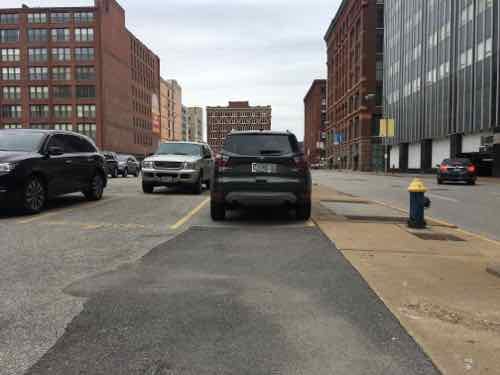
ABOVE: Tail end of a car at Vito's takes up half the public sidewalk

ABOVE: Tail end of a car at Vito’s takes up half the public sidewalk

This car is parked in what appears to be a legitimate parking space in their lot. The problem is the space isn’t even long enough for a smart fourtwo so any car parked in the space sticks out into the public sidewalk.

The city has minimum requirements for the size of parking spaces, and the sidewalk can’t be counted toward the minimum.  Vito’s needs to redesign their parking lot to provide a disabled space and to eliminate this space that extends over the sidewalk.

– Steve Patterson


Unable To Use All MetroBus Stops

I have no problems using most of Metro’s bus stops using my power chair, bus there are exceptions that I can’t.

ABOVE: MetroBus stop on the north side of Market Street between 14th-15th, across from the Peabody Opera House

ABOVE: MetroBus stop on the north side of Market Street between 14th-15th, across from the Peabody Opera House. Taken Thursday January 31, 2013 @ 1:00pm.

I’m a huge fan of on-street parking, the fixed cars provide a nice buffer between pedestrians and moving vehicles. Unfortunately, this buffer becomes a barrier to anyone that can’t just step out into the street when the bus comes.

I’m thinking most days vehicles aren’t parked here and I’d have no problem using this stop. If so, that means an entire lane sits empty except for when a bus has to use it to pickup or drop off a passenger. But when cars are here the stop is useless to disabled riders. The solution?

Allow on-street parking, set up meters and generate revenue. In the space that would have one car build out the sidewalk so disabled riders, seniors and others can reach the bus stopped briefly in the travel lane.

– Steve Patterson

Wheelchair Users Unable To Pay Parking Fee In City Parking Lot

The City of St. Louis Parking Division operated by the Treasurer’s office recently built a surface parking lot at 3019-35 Olive Street to serve Midtown Alley businesses, including Hamburger Mary’s next door. The parking fee must be paid 24 hours per day.

ABOVE: Sign alerts drivers of conditions of parking in this public lot.

ABOVE: It is a short distance from the disabled parking spaces to the area with the central point of payment.

ABOVE: However, those disabled drivers that use a wheelchair are unable to reach the payment machine because no ramp up was provided.

I’ll be interested to find out if the Board of Public Service designed this for the Treasurer or if it was done separately. Regardless, it must be changed to comply with the ADA.

Larry Williams, the current Treasurer, is in his last month in office. Tishaura Jones will be sworn in as Treasurer on New Year’s Day. Jones indicated during the primary she’d work to remove parking as a responsibility of the office.

– Steve Patterson

More Thoughts on Bike Parking

November 30, 2012 Bicycling, Featured, Parking 2 Comments

Tuesday’s post was  about a bike locked to a lamp post while two empty bike were further from the building entry, see: Locate Bike Racks Near Building Entrances. Today is a similar post about trying to find a place to secure your bike.

ABOVE: Three bikes recently spotted locked to the construction fence at Washington Ave & Tucker.

Transportation cyclists are resourceful types for sure and the above is a perfect example. While this makes an interesting visual I’d much rather see our streets lined with bare-bones inverted-U bike racks located on the outer edge of the sidewalks, near the entrances to active spaces.

ABOVE: Bike parking for 22 bikes located around the corner from the nearest entrance to the Laurel Apartments. Architects love this design even though it doesn’t support the bike’s frame in two places when used as designed

Unfortunately too often things like bike parking are on a green checklist and they get checked off as being covered even though functionally few cyclists will ever use the supplied racks, much less 22 at once, opting instead for a sign or lamp post near their destination.  This space should’ve been planted to catch water runoff.

– Steve Patterson

Fixes For Stadium West, Stadium East

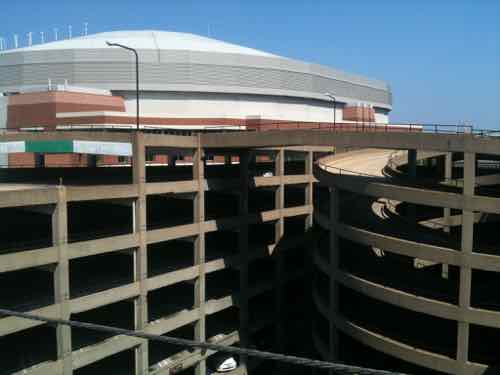
In 2016 the nearly identical parking garages known as “Stadium East” and “Stadium West” will turn 50 years old. Despite the milestone, I don’t expect preservationists to give tours, or oppose the alterations I propose below.

ABOVE: The 8th Street face of the Stadium West garage. The pedestrian ramp to the street crossing isn’t ADA-compliant, Stadium East doesn’t have a similar ramp.

ABOVE: The first thing is repaint the structure to something other than white, or red. White is so bright, it demands attention. Bright colors advance, dark colors recede.

ABOVE: Remove inaccessible walkway, freeing up space for small storefront spaces to be used during games or other special events.

ABOVE: A sidewalk vendor during one of the last Cardinals home games is the type of vender that could occupy a tiny storefront space.

ABOVE: Filling in the center recess with glass-friont retail will help lesson the visual impact of the massive garages facing the future “Ballpark Village”.

ABOVE: The garages will never disappear but they can’t be toned down considerably.

I’ve written before that I’d like to see these garages razed but they’re in good condition and fill a need.  They just need to fade into the background, a color change will accomplish that.

– Steve Patterson

Clemens Mansion Was To Kickoff McKee’s NorthSide Regeneration Project

It was three years ago today that many gathered on the lawn in front of one of the most historic properties in St. Louis: The Clemens Mansion, located at 1849 Cass Ave.

ABOVE: Blueprints for the adoption of the Clemens Mansion to senior apartments was on display on November 17, 2009

ABOVE: St. Louis Mayor Francis Slay signs a bill for Paul McKee’s NorthSide Regeneration project

From The Beacon:

Mayor Francis Slay put his ceremonial seal of approval Tuesday on the first step of the $8.1 billion plan to redevelop a large portion of north St. Louis, but he remained noncommittal on what developer Paul McKee considers a key part of the project.

The signing ceremony for two bills passed by the Board of Aldermen — the bills were actually signed into law by the mayor on Friday — took place under a tent on the front lawn of the Clemens House, one of the most visible properties in the McKee project area. (St. Louis Beacon)

Initial work had begun on the renovation but work stopped when part of the financing fell through, I believe a low-income housing tax credit. Soon much of McKee’s project will have a final airing in court.

The state Supreme Court has set Nov. 28 as the date for oral arguments in the lawsuit that has blocked McKee’s massive NorthSide Regeneration project for more than two years. There’s no telling how long after that a ruling might come down, but that ruling will help the project advance, McKee said. (stltoday.com)

Disclosure: I was a very minor consultant on the Clemen’s Mansion project, assisting with accessibility and starting to look at traffic calming and walkability along a larger stretch of Cass Ave. Hopefully the project can be completed in the future.

– Steve Patterson

Archives

Categories