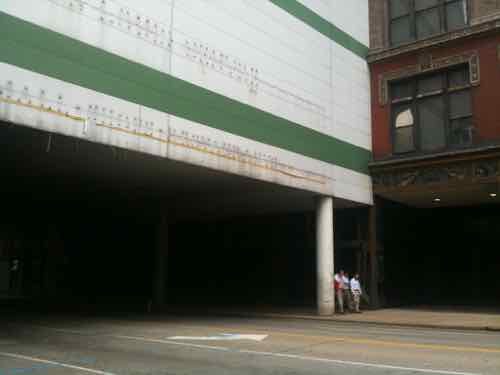
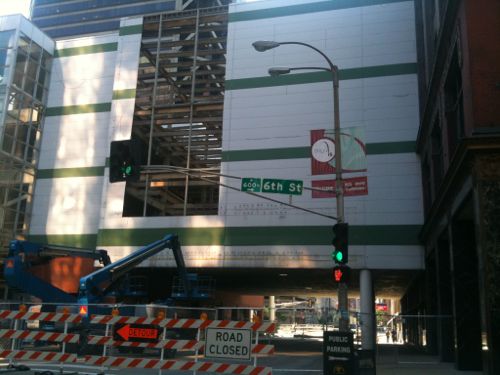
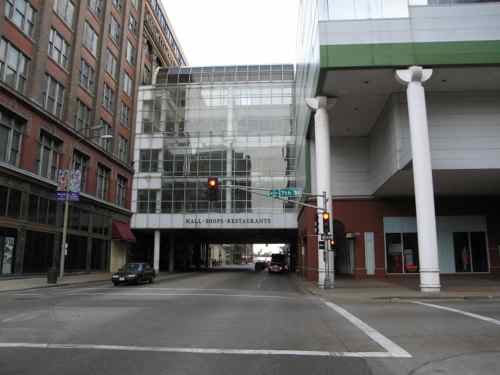
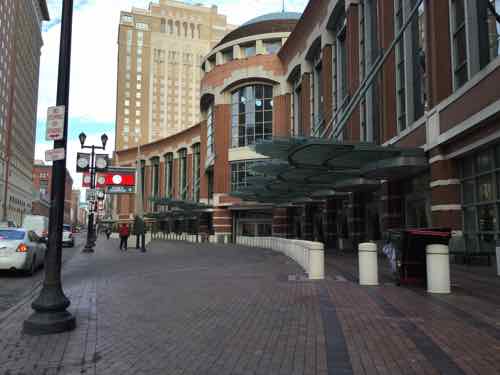
Ten years ago today work began on reversing a mistake that had been in place for 25 years prior — the pedestrian bridge over Washington Ave created a dark environment at the sidewalk level.
Taken two days before the bridge bash you can see how dark it was underneath
The “Bridge Bash” event started with comments from numerous white men, followed by Mayor Slay operating the wrecking ball, pyrotechnics made breaking glass a little more exciting. Here’s the video I uploaded from the scene — the action starts at 8:45.
St. Louis Centre was part of the ‘bring the suburbs to the city’ movement. The inwardly focused mall was a killer to the sidewalks downtown — especially under the Washington & Locust wide bridges connecting to Dillard’s & Famous-Barr, respectively.
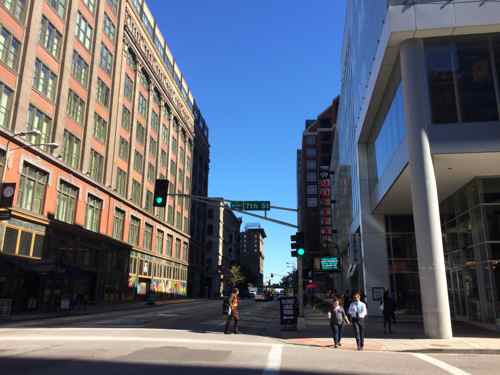
Looking west from 6th Street May 2010Looking east along Washington Ave from 7th, February 2006Same view after the bridge was removed
Removal of this oppressive bridge and facing the ground level retail of the MX (formerly St. Louis Centre) has done wonders for this part of downtown. If only we hadn’t wasted decades trying to be like the burbs.
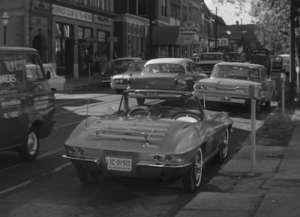
The familiar Corvette from the Route 66 television series parked on Olive in Gaslight Square, from episode that aired November 30, 1962 — click image for more detail at IMDB.
When I moved from Oklahoma City to St. Louis in 1990 our long-time neighbor across the street told me of his visits to Gaslight Square in the 1960s. By the time I’d arrived the buildings on the 2-block stretch of Olive were boarded up. I settled just West of there, on Lindell near Euclid. Euclid Ave, in the 90s, seemed to attract crime. Now it’s the greater downtown area — specifically Washington Ave.
First, a look at Gaslight Square:
By summer 1960, it was the place to be for beats, preppies, well-dressed adults, street troubadours and tourists. Olive pulsed with a happy cacophony wafting from places called the Crystal Palace, Left Bank, Laughing Buddha, and Dark Side. Jack Carl dished pastrami and genial abuse at 2 Cents Plain. A row of columns outside Smokey Joe’s Grecian Terrace anchored the landscape.
On March 24, 1961, the St. Louis Board of Aldermen anointed the obvious by renaming two blocks of Olive as Gaslight Square. Laclede Gas Co. later installed 121 gas streetlights, adding flicker to the buzz.
By summer 1961, Gaslight was noisier with more restaurants, taverns, nightclubs and shops. Some of the antiques dealers were squeezed out by rising rents. “The old gang doesn’t come around anymore, but perhaps it is a necessary evil of growing,” Massucci said as cash registers jingled.
Big and future names in show biz played the square. An 18-year-old singer named Barbra Streisand was warm-up for the Smothers Brothers. Allen Ginsberg recited poetry to mellow jazz. Miles Davis and Singleton Palmer were regulars. Earnest ministers opened the Exit, a coffee shop promising meaningful discussion and “jazz liturgy.”
But the crowds also attracted purse snatchers, car thieves and worse. On Dec. 30, 1964, Lillian Heller was fatally shot in a robbery in the vestibule of her apartment building at 4254 Gaslight, just east of Boyle. Heller, 61, and her husband, John, were artists.
Police added patrols and promised security. Young people flocked to discotheques such as Whisky a Go-Go, where hired dancers gyrated on platforms. But throbbing recorded music was drowning the live clarinet riffs. It became too crass and too much.
The old clubs began closing. Laclede doused some of the gas lights in 1967 for failure to pay. Police made drug arrests and thwarted a desperate bid to save the strip with topless waitresses. The Exit gave up the spirit in 1969, about when cultural pathologists pronounced the end of Gaslight. (Post-Dispatch)
Gaslight Square concentrated a lot into a couple of blocks of Olive. This concentration of money and activity attracted those who wanted some of that money. Rising crime became too much for some so it began to die.
There are parallels to current events, but there’s time to avoid going down the same path. Ever since the Washington Ave streetscape was completed about 15 years ago (Tucker to 18th), so much attention has been focused on a tiny area.
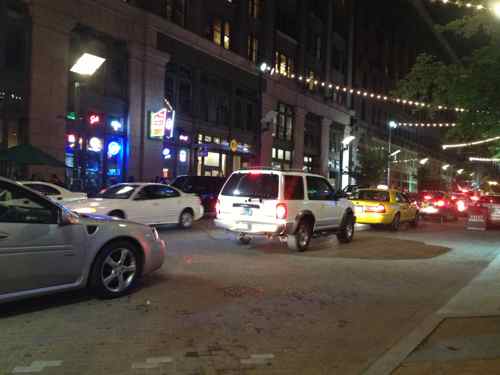
From 2014: Weekend nights traffic gets backed up on Wash Ave between Tucker (12th) and 14th
The solution is to put less focus on Washington Ave, but also do like many cities: divide downtown/downtown west into geographic districts. Examples: Toronto, Oklahoma City, Kansas City. This has been talked about for years but it has never happened.
Some possible districts include:
Garment District
City Museum District
Ballpark Village District
Convention District
Union Station District
Columbus Square District
Library District
Central Business District
Arch District
MX District
None should have “downtown” or Washington Ave” the name. Sure, crime will still happen, but this way an entire area won’t get stigmatized by something that happens 1-2 miles away. Branding districts could help with marketing efforts.
There are some who envision one mile of our Washington Ave (from 4th to 18th) as being a retail street like the Delmar Loop or Chicago’s Magnificent Mile along Michigan Ave. One person even wants to use a proposed form-based code overlay to mandate a retail use on the ground floor. Yes, the idea of using a form-based code to regulate uses is illogical. The whole point of moving from use-based zoning to form-based zoning is to get the form correct.
Recognizing uses change more often than the physical form of buildings.
It was a December announcement that prompted this push for a retail street:
LockerDome, which currently has 45 employees, moved to a 6,800-square-foot storefront on Washington Avenue in 2012 but has outgrown that space, said its chief executive and co-founder Gabe Lozano.
After a 120-day build-out set to begin in the second half of 2016, LockerDome’s employees will move to occupy an 18,000-square-foot building a block away at 1314 Washington. (Post-Dispatch)
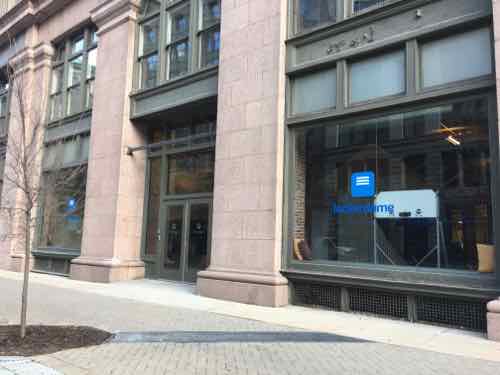
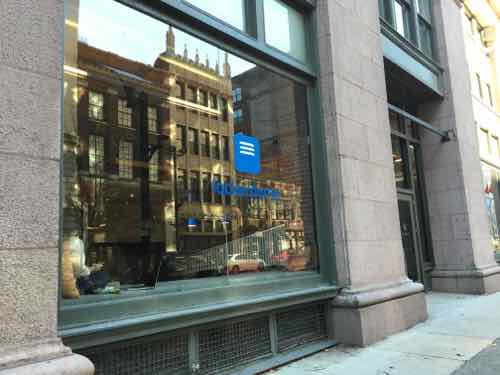
LockerDome has been at 1221 Washington Ave since 2012, the space was previously occupied by an architectural firm. Their windows are never covered,In January I saw a woman, presumably an employee, working and eating lunch in one of the windows.Lockerdome will be moving to 1314 Washington Ave, currently occupied by the gym Fitness Factory. Their windows are never covered.
Both have the form right, both have windows we can see into day & night. Some think a gym is an acceptable use on a retail street — but a high-tech firm is not. I personally don’t care what’s going on behind the facade. I can see into the windows when I pass by.
But one person would prevent LockreDome from occupying the ground floor of this building — he doesn’t want offices on ground floors. Yet, firms want to be located on Washington Ave. because it is the most vibrant part of Downtown/Downtown West. With the upper floors converted into residential there are too few options for large offices. For that matter, there are too few spaces for a larger retailer like a CVS/Walgreen’s.
What makes a credit union/bank lobby ok, but not a creative office?
It’s the non-creative offices that are the buzz kill…
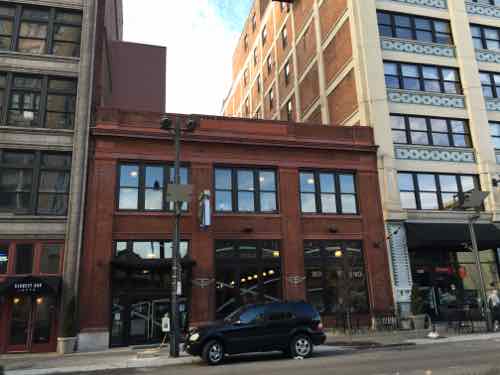
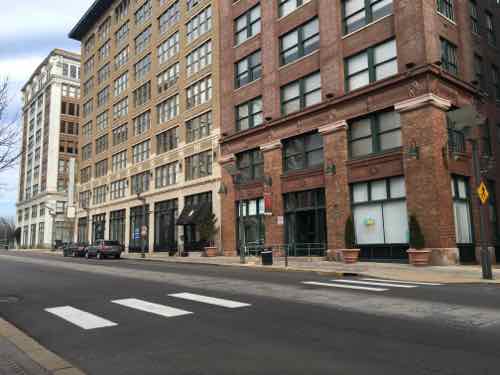
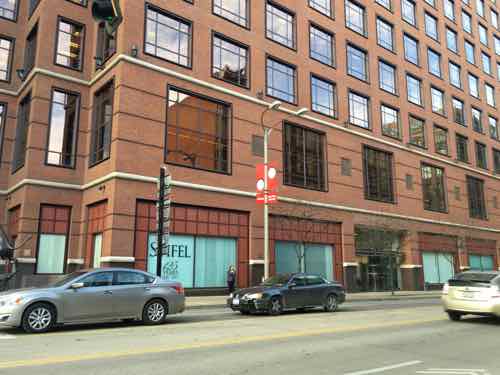
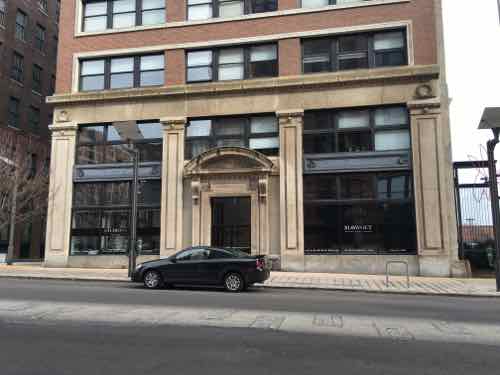
The blinds at Rise Community Development have been closed since they moved intro 1627 Washington Ave, (right). The same space has been used for a clothing reseller and a restaurant,Between Broadway (5th) and 6th the Stifel financial headquarters keeps their ground floor blinds shut.
Regulating uses is arbitrary — which is why I want the city of St. Louis to abandon old-fashioned Euclidean use-based zoning and adopt form-based zoning. Form-based zoning, however, can be used to regulate the form – largely windows & doors at the ground level where pedestrian activity it to be encouraged.
Many ground floor offices downtown keep their blinds closed 24/7 — that’s something a form-based code could/should address. We need uncovered windows where we can see activity going on inside. But could Washington Ave become a retail street like the Delmar Loop or Magnificent Mile?
No — both of those were built for retail purposes.
This mile of Washington Ave has had many uses over the decades — the middle part included sweatshops where immigrants manufactured clothing, shoes, hats, etc. Items sold in stores all over the country, possibly in the Sears catalog. It wasn’t a retail street then.
Today Washington Ave is largely a restaurant street, with the occasional niche retail merchant. Besides bars/restaurants the other common “retail” use is hair salons.
Both storefronts at 1619 Washington Ave are salons.
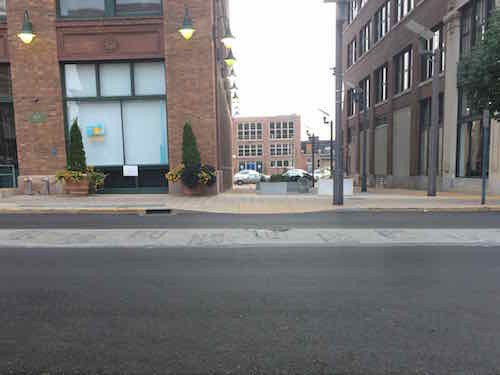
Another problem are the many gaps in continuity.
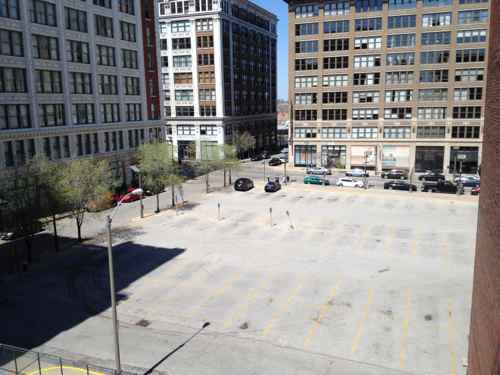
Our convention center occupies two blocks of Washington Ave — from 7th to 9thFormer CPI parking lot between 16th-17th
Get the form right — including being able to look into ground floor spaces. Don’t fret about the users.
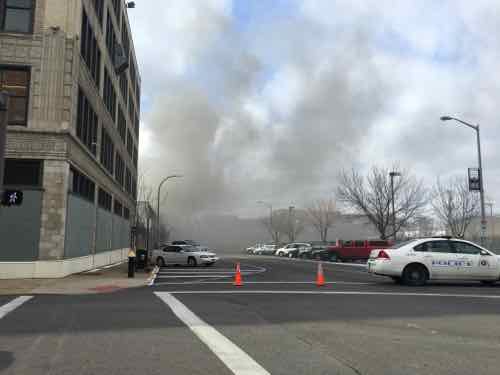
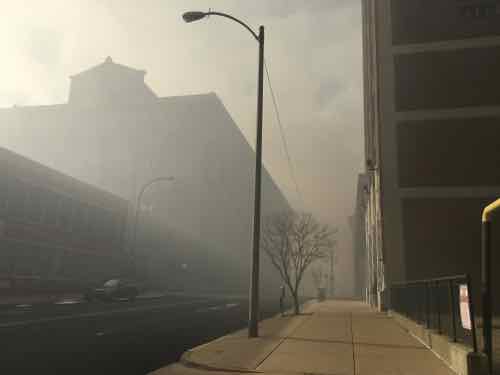
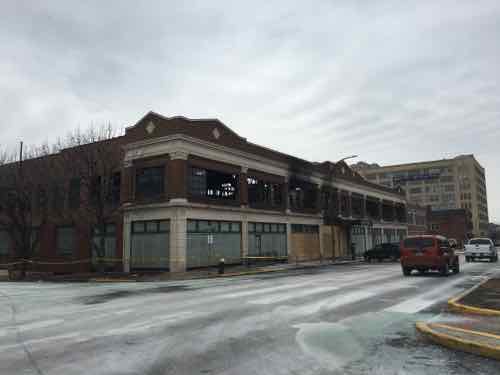
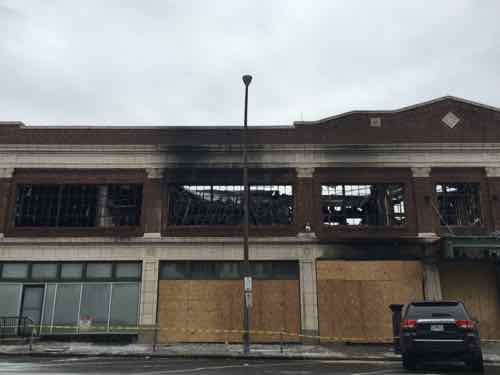
Monday afternoon I was at home writing, looking up from the computer screen it looked foggy outside. A quick check of my email was a Nextdoor.com message from a neighbor asking what was on fire. Ah — smoke — not fog. My first thought was the building at 17th & Locust.
Despite the cold, I decided to have a quick look to see. From 18th & Locust I could see emergency equipment at 19th, the #97 MetroBus, usually on Washington, was rerouted to Locust. So I headed North to see where Washington was blocked.
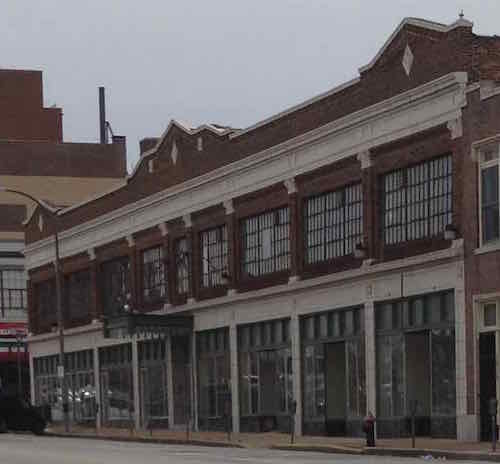
Looking West from 18th & Washington Ave at 2pm on on January 18thSix minutes later looking West toward 17th & LocustThe next morning (10:45am) we drove by for a quick look. Click image for mapThe old layers of the roof are goneThis is how 1900 Washington looked in February 2012
The good news is the walls appear to be sound. Monday afternoon owner Pete Rothschild replied to my earlier email, indicating they’ll know more once the engineers In a followup on Wednesday he said:
The goal and likely outcome is that we’ll still do the project. There are a million moving parts, and it’s going to be quite a while until I really know if that’s possible.
I look forward to the day 1900 Washington is fully renovated and occupied.
Over half of those who voted in the non-scientific Sunday Poll favor retaining the cobblestone zipper design motif in the center of Washington Ave:
Q: Wash Ave’s 12+ year old streetscape includes a cobblestone “zipper” motif down the center, which makes repaving from 14th-18th Streets a challenge. We shou[ld]:
Lose the zipper motif, not important to the well-being of the area 18 [32.14%]
Retain zipper, just don’t resurface the center where cobblestones are located 17 [30.36%]
Retain zipper, incurring extra costs to resurface street 15 [26.79%]
Unsure/No Opinion 5 [8.93%]
Other: 1 [1.79%] “Let the residents decide and let them pay for any extra costs.”
As you can see from the numbers, there isn’t a consensus view.
A recent resurfacing left the center with the cobblestone zipper intact between 14th-18th Streets.
You can count me among those who say rip out the zipper from 14th-18th Streets. The two blocks from Tucker to 14th is different — Washington Ave is brick pavers, not asphalt.
It won’t be long until the new asphalt fades and it’ll be hard to see the difference between the old & new. Setting cobblestones in asphalt was a very poor decision, and as a motif I doubt anyone could guess what it’s supposed to be.
AARP Livibility Index
The Livability Index scores neighborhoods and communities across the U.S. for the services and amenities that impact your life the most
Built St. Louis
historic architecture of St. Louis, Missouri – mourning the losses, celebrating the survivors.
Geo St. Louis
a guide to geospatial data about the City of St. Louis