Home » Pedestrian Mall » Recent Articles:

Successful Pedestrian Malls Kept Cross Streets Open

Pedestrian malls, the closing of a street to vehicles, is an area of great interest to me. Popular in the 1960s & 1970s, very few had long-term success in North America, most failed and have been reversed. St. Louis’ former 14th Street Pedestrian Mall was such a failure.

In September I got to visit two of the successes, both in Colorado: Denver’s 16th Street Mall and Boulder’s Pearl Street Mall.  After visiting these two I’ve identified some key differences that I believe contributed to the success of these two while others failed. The main difference is both of these allow the cross streets to continue through uninterrupted. Most pedestrian mall projects screwed up the street grid in two directions, the closed mall street and all the intersecting streets. Depending on the length of the pedestrian mall this could mean 1-8 cross streets got redirected. In doing so a large area and many streets were cut off from regular traffic.

St. Louis’ 14th Street Pedestrian Mall — 1977

  • Length: 2 blocks
  • Status: removed
  • Map (was 14th from St. Louis Ave to Warren St)
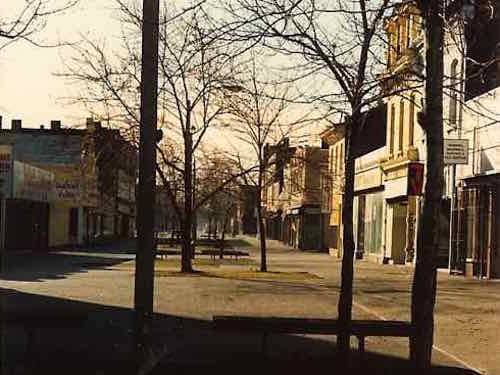
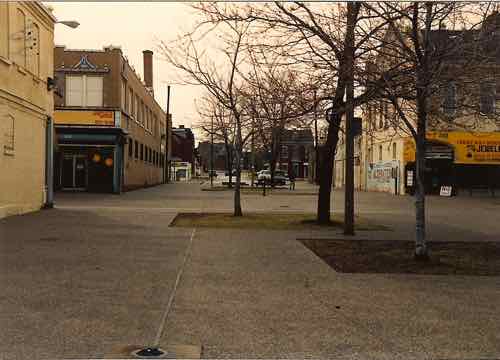
Looking south on 14th, Spring 1991
Looking West on Montgomery St, Spring 1991
Looking West on the one cross street, Montgomery St, Spring 1991

St. Louis’ pedestrian mall was only 13 years old when I first saw it in the Fall of 1990. Long-time residents I talked to said the mall failed very early on, long before I saw it 13 years later.

Boulder’s Pearl Street Mall — 1977

  • Length: 4 blocks
  • Status: active
  • Map
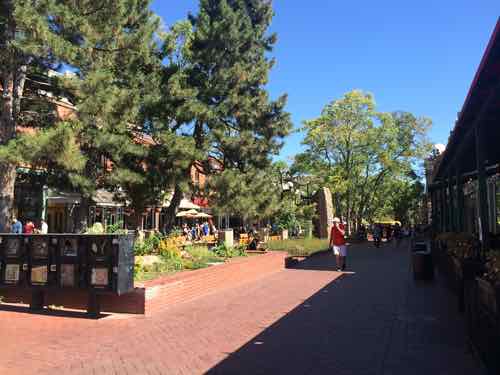
Boulder's Pearl Street Mall
Boulder’s Pearl Street Mall is for pedestrians only
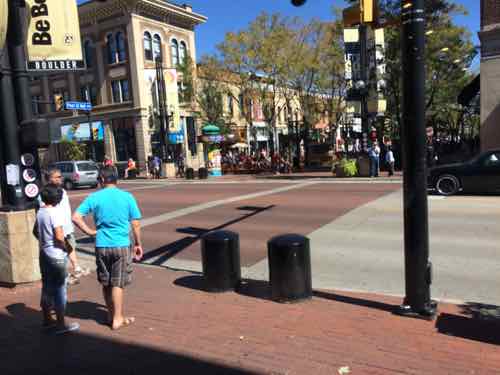
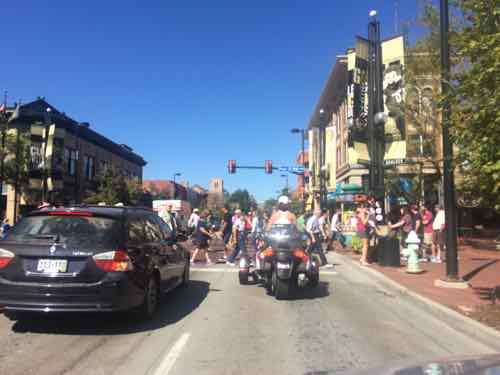
Broadway is only highway 7, one of three streets that continue through the four block mall.
The same intersection
The same intersection as viewed from our rental car
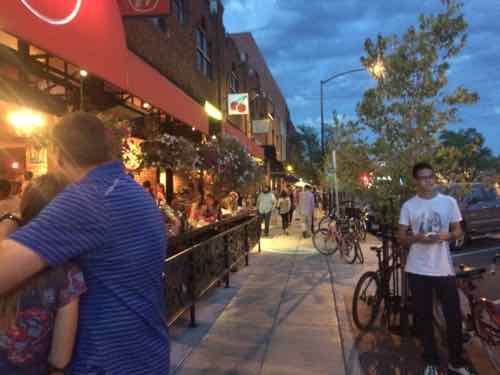
We ate dinner at a popular restaurant on Pearl St, but it was one block West of the mall.

Many small town pedestrian malls were built by malling the main highway that ran through the downtown business district and creating opposite one way streets on either side so highway traffic could continue. Boulder, however, allowed their highway to continue with only a traffic signal like you’d see if Pearl St was still open to cars. They too did the one-way couplet thing on parallel streets, but it and the mall are perpendicular to the main highway through town.

Denver’s 16th Street Mall — 1982

  • Length: 13 blocks
  • Status: active
  • Map
Denver's 16th Street Mall
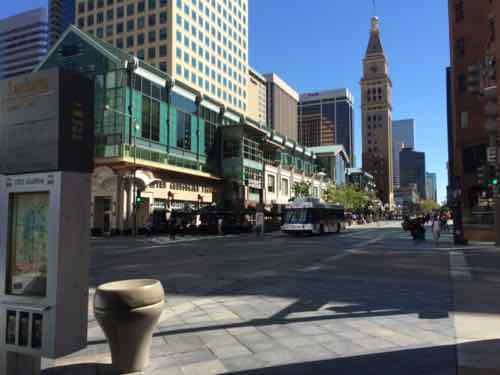
Denver’s 16th Street Mall with mall-only buses, in the center in this block
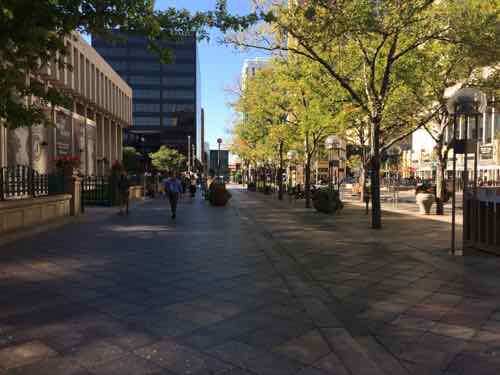
At this point the bus lanes are divided, leaving a center pedestrian area
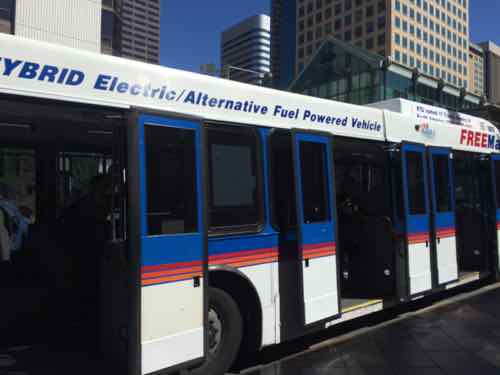
The buses were every few minutes and were non-polluting

Denver was late to get a pedestrian mall, few were built in the 1980s. Perhaps their delay paid off, enabling them to see mistakes made by other cities. Chicago also had a transit mall, but it was for many bus lines. The diesel fumes meant their mall wasn’t a pedestrian paradise. Whereas Denver runs free shuttles to get people up and down the 13 block length, with several points where you can connect to local bus or light rail lines.

It appears Denver, unlike St. Louis, has kept its street grid in tact — with the exception of 16h Street. St. Louis has made it a habit of closing streets, disrupting the grid.

Conclusion

Another successful pedestrian mall is Church Street Marketplace in Burlington VT (map).  Like Boulder & Denver, the cross streets continue uninterrupted. I need to return to my grad school data to see if any of the failed/removed pedestrian malls allowed cross streets to cut through the mall, I don’t recall any.

This is not to say that the many failed pedestrian malls might have succeeded had they kept cross streets open, or a that a remaining mall could be enlivened by opening the cross streets. Both might be the case, I just can’t come to that conclusion — yet.

Still, St. Louis serves as an example of ongoing struggles when the street grid has been repeatedly compromised.

— Steve Patterson


North 14th Street Finally Reopened To Vehicle Traffic

November 6, 2010 North City, Planning & Design, Transportation Comments Off on North 14th Street Finally Reopened To Vehicle Traffic
ABOVE: North 14th Street Pedestrian Mall 1991

In March 1977 the North 14th Street Pedestrian Mall opened with high expectations.  However, the high expectations quickly turned to high vacancy as merchants closed up shop. Retailers have long known the importance of providing some on-street parking in front of their establishments but over 100 pedestrian malls had been built in North America by 1977 and St. Louis didn’t want to be left out of the trend.

ABOVE: 14th & Montgomery, 1972 (pre-mall), photo by Robert Spatz

Just fourteen years later, in 1991, the mall was nearly dead.  It had already been this way for a while.  It had, perhaps, one good year of life.

ABOVE:
ABOVE: Earlier this week the street was opened to auto traffic

In July a celebration was held to mark the completion of the street but delayed streetlights meant the city wouldn’t permit vehicles.  Prior to the mall the sidewalks were narrow and broken.  After the mall there was far more sidewalk than pedestrians.  Today the street offers a balance between pedestrian & motorist. With construction time, North 14th was out of balance for 34 years, a very long time when the failed urban planning experiment prevented organic revitalization of the street.

– Steve Patterson


Locust, Lindell, other streets go car-free Saturday May 1st

Saturday May 1, 2010 from 8am to 1pm several streets in our city will be car-free:

This first of four events opens five miles along Locust and Lindell for you to enjoy. That’s right, car-free City streets!

Open Streets is a FREE community event. You’re invited to take to the streets to walk, bike, visit other neighborhoods, rediscover the City and experience the Great Rivers Greenway’s Bike St. Louis routes.

Three activity hubs located along the length of the route host a variety of fun activities – aerobics, zumba, hula-hooping, yoga, walking tours and safety and health demonstrations.

Open Streets promises to be interesting. I’ll participate –seems silly not to given that I live on the route:

My concern is events like this will lead to calls for the creation of new car-free pedestrian malls.

– Steve Patterson


North America cities that have (or had) a pedestrian mall

Friday I asked for help with information on 60 former pedestrian malls (see post).  Readers responded with helpful information.  Today I’m sharing my complete list of cities that have or had a pedestrian mall built during the period 1959-1984.   A few cities are listed twice because they had two pedestrian malls.

For my purposes a pedestrian mall is the at least partial closure of a commercial street to vehicles.  The “semi” mall permitted traffic but on-street parking was significantly reduced or eliminated.  Most were in the downtown area but in larger cities they could be found on neighborhood commercial streets such as St. Louis’ North 14th Street Pedestrian Mall (currently being removed).

I now have 134 malls in 136 towns and cities.  A couple of sources I have made reference to (nearly/almost/over) 200 malls built.   These sources never document this 200 number.  So part of my research is simply to verify how many malls were actually built during this 25-year period.

Here is the list in alphabetical order by city name (italics = removed; bold = intact; red= need more info)

  1. Allentown Pennsylvania
  2. Ann Arbor Michigan
  3. Ashtabula Ohio
  4. Atchison Kansas
  5. Atlantic City New Jersey
  6. Auburn New York
  7. Baltimore Maryland
  8. Baltimore Maryland
  9. Battle Creek Michigan
  10. Boston Massachusetts
  11. Boulder Colorado
  12. Buffalo New York
  13. Burbank California
  14. Burlington Vermont
  15. Burlington Iowa
  16. Calgary Alberta
  17. Cape May New Jersey
  18. Centrallia Illinois
  19. Champaign Illinois
  20. Charlottesville Virginia
  21. Chicago Illinois
  22. Coos Bay Oregon
  23. Cumberland Maryland
  24. Dallas Texas
  25. Dallas Texas
  26. Danville Illinois
  27. Decatur Illinois
  28. Denver Colorado
  29. Des Moines Iowa
  30. Dubuque Iowa
  31. East Lansing Michigan
  32. Elgin Illinois
  33. Erie Pennsylvania
  34. Eugene Oregon
  35. Evansville Indiana
  36. Fargo North Dakota
  37. Fayetteville North Carolina
  38. Fort Lauderdale Florida
  39. Frankfort Kentucky
  40. Freeport New York
  41. Freeport Illinois
  42. Fresno California
  43. Galveston Texas
  44. Greenville South Carolina
  45. Greenville North Carolina
  46. Hallifax Nova Scotia
  47. Hartford Connecticut
  48. Helena Montana
  49. Honolulu Hawaii
  50. Iowa City Iowa
  51. Ithaca New York
  52. Jackson Michigan
  53. Kalamazoo Michigan
  54. Kansas City Kansas
  55. Knoxville Tennessee
  56. Lake Charles Louisiana
  57. Lansing Michigan
  58. Las Cruces New Mexico
  59. Las Vegas Nevada
  60. Lebanon New Hampshire
  61. Lincoln Nebraska
  62. Little Rock Arkansas
  63. Louisville Kentucky
  64. Madison Wisconsin
  65. Memphis Tennessee
  66. Miami Beach Florida
  67. Michigan City Indiana
  68. Middletown Ohio
  69. Milwaukee Wisconsin
  70. Minneapolis Minnesota
  71. Monroe North Carolina
  72. Muncie Indiana
  73. Napa California
  74. New Bedford Massachusetts
  75. New London Connecticut
  76. New Orleans Louisiana
  77. New Orleans Louisiana
  78. New York City (Brooklyn) New York
  79. Newburyport Massachusetts
  80. Oak Park Illinois
  81. Ottawa Ontario
  82. Oxnard California
  83. Painesville Ohio
  84. Palm Beach Florida
  85. Parsons Kansas
  86. Paterson New Jersey
  87. Philadelphia Pennsylvania
  88. Philadelphia Pennsylvania
  89. Pittsburgh Pennsylvania
  90. Pomona California
  91. Portland Maine
  92. Portland Oregon
  93. Pottsville Pennsylvania
  94. Poughkeepsie New York
  95. Providence Rhode Island
  96. Quebec City Quebec
  97. Reading Pennsylvania
  98. Redding California
  99. Redlands California
  100. Richmond Indiana
  101. Riverside California
  102. Rock Hill South Carolina
  103. Rockford Illinois
  104. Sacramento California
  105. Saint Charles Missouri
  106. Saint Louis Missouri
  107. Salem Massachusetts
  108. Salisbury Maryland
  109. Santa Cruz California
  110. Santa Monica California
  111. Schenectady New York
  112. Scranton Pennsylvania
  113. Seattle Washington
  114. Sheboygan Wisconsin
  115. Sioux Falls South Dakota
  116. Spartanburg South Carolina
  117. Springfield Missouri
  118. Springfield Illinois
  119. St. Cloud Minnesota
  120. St. Joseph Missouri
  121. Tacoma Washington
  122. Tampa Florida
  123. Toccoa Georgia
  124. Toronto Ontario
  125. Trenton New Jersey
  126. Tulsa Oklahoma
  127. Vancouver British Columbia
  128. Vicksburg Mississippi
  129. Washington District of Columbia
  130. West Chester Pennsylvania
  131. Wilkes-Barre Pennsylvania
  132. Williamsport Pennsylvania
  133. Wilmington Delaware
  134. Winona Minnesota
  135. Winston-Salem North Carolina
  136. Youngstown Ohio

I believe most, if not all, of those listed in red have been removed with the street re-opened to traffic.  I may just need the year it was reopened.    I have no doubt that over 200 were proposed.  Built?  At this point I don’t think so. If you know of others that are not on this list please share.

Some cities, such as my home town of Oklahoma City, built pedestrian malls after 1984.  These tended to be very different.  In the case of Oklahoma City they dug out a street in their old warehouse district to create a canal.

– Steve Patterson


Help needed with info on sixty former pedestrian malls

The topic of my capstone (thesis) for my Masters in Urban Planning is the pedestrian mall.  I’ve taken on the ambitious task of documenting every pedestrian mall built in North America between 1959-1984.  So far I have documentation on 135 pedestrian malls created during this 25-year period.  Of those I know the current status of 75.  I believe the 60 that remain on my list have all been removed.  Some of you out there reading this post have knowledge about some of these.

For my purposes a pedestrian mall is a formerly through street that was converted to a pedestrian zone.

I’m looking for the following information:

  • Year opened (if not listed below)
  • Length (measured in blocks)
  • Width of right-of-way (measured in feet)
  • Street that was closed for the mall (from street to street)
  • Did the mall have fixed canopies
  • Year street reopened

Although you are all very knowledgeable, for academic purposes I could use links to sources such as newspaper articles, organization/city websites and such that have the information I seek.

Alphabetical listing by city (mall name, city, state, year opened):

  1. Hamilton Mall Allentown Pennsylvania 1973
  2. Ann Arbor Michigan
  3. Lexington Mall Baltimore Maryland 1974
  4. Downtown Mall Centrallia Illinois 1970
  5. Neil Street Champaign Illinois
  6. City Center Mall Coos Bay Oregon 1969
  7. Stoneplace Mall Dallas Texas 1965
  8. Vermillion Park Mall Danville Illinois 1967
  9. Landmark Mall Decatur Illinois 1970
  10. Town Clock Plaza Dubuque Iowa 1971
  11. Elgin Illinois
  12. Downtown Mall Erie Pennsylvania 1974
  13. Fargo North Dakota
  14. Franklin Commons Fayetteville North Carolina
  15. Las Olas Boulevard Fort Lauderdale Florida
  16. St. Clair Mall Frankfort Kentucky 1974
  17. Downtown Plaza Freeport Illinois 1968
  18. Central Plaza Galveston Texas 1971
  19. Downtown Greenville Mall Greenville North Carolina 1975
  20. Coffee Street Mall Greenville South Carolina 1975
  21. Pratt Street Hartford Connecticut
  22. Progress Place Jackson Michigan 1965
  23. Downtown Mall Lake Charles Louisiana 1970
  24. Milwaukee Wisconsin
  25. Courthouse Plaza Monroe North Carolina 1973
  26. Walnut Plaza Muncie Indiana 1975
  27. Parkway Mall Napa California 1974
  28. Downtown Mall New Bedford Massachusetts 1974
  29. Captain’s Walk New London Connecticut 1973
  30. Plaza Park Mall Oxnard California 1969
  31. Main Street Mall Painesville Ohio 1973
  32. Worth Avenue Palm Beach Florida
  33. Parsons Plaza Parsons Kansas 1971
  34. Main Street Mall Paterson New Jersey 1975
  35. Chestnut Street Transitway Philadelphia Pennsylvania 1975
  36. Maplewood Mall Philadelphia Pennsylvania 1974
  37. Pomona Mall Pomona California 1963
  38. Centre Street Mall Pottsville Pennsylvania 1977
  39. Westchester Mall Providence Rhode Island 1965
  40. St. Roch Mall Quebec City Quebec 1974
  41. Penn Square Reading Pennsylvania 1975
  42. Redlands Mall Redlands California 1977
  43. Rock Hill South Carolina
  44. Main Street Saint Charles Missouri
  45. Wyoming Avenue Mini-Mall Scranton Pennsylvania 1978
  46. Plaza 8 Sheboygan Wisconsin 1976
  47. Main Street Mall Spartanburg South Carolina 1974
  48. Springfield Missouri
  49. Old Capitol Plaza Springfield Illinois 1971
  50. Mall Germain St. Cloud Minnesota 1972
  51. Broadway Plaza Tacoma Washington 1974
  52. Franklin Mall Tampa Florida 1974
  53. Yonge Street Toronto Ontario
  54. Trenton Commons Trenton New Jersey 1974
  55. Main Street Mall Vicksburg Mississippi 1970s
  56. Gay Street Mall West Chester Pennsylvania
  57. Center City Mall Williamsport Pennsylvania 1976
  58. Market Street Mall Wilmington Delaware 1976
  59. Levee Plaza Winona Minnesota 1969
  60. Liberty Place/Gallery Place Washington District of Columbia 1976

Complicating matters is how a pedestrian mall was defined.  A full mall was completely closed to all vehicles except emergency vehicles.  A transit mall, like Denver’s 16th Street, allows transit vehicles.  But then we have the murky waters of the “semi” mall – vehicles are allowed but little to no on-street parking is.

East Park Central East Springfield MO (from Google Street View)

For example it is possible that East Park Central East in Springfield, MO (above, map) was considered to be a semi-mall at the time.  Or Springfield had a completely closed street that was their pedestrian mall?  Given the fact that Lawrence Halprin did the adjacent Park Central Square I’d say they did label the above a mall.

Park Central Square Springfield MO, April 2008

I’ve been here several times.  The most recent was last year.

Me with two of my nieces, April 2008

OK, 59 left. Wait, not so fast.  I found a document (PDF) from the City of Springfield that indicates the original plan was all four streets entering the square would be pedestrian malls and in 1979 they were reopened.  But other evidence suggests traffic was never barred from the Square.  So it is 60 — I’m still unsure how to classify Springfield, MO.

I’ve visited other places on the above list, such as Parsons, KS.

Parsons, KS, July 2009

Parsons, KS had a “full” mall on Main Street and concrete canopies over the sidewalks.  Today they once again have a more traditional street design.  The canopies were partially destroyed by a tornado – I just don’t know the year.

I’ve sent out requests for information on many of the above but only a few have responded.  I got an email back from one town in the Northeast that said their mall remains — a 24 foot wide alley behind their main shopping street where vehicles were banned.  Not sure I get the point of that one.  A car-free alley is better than a street with cars?

It is too early in my research to talk findings or conclusions.  I have been surprised by the number of these malls that remain.  If you have knowledge of these please share in the comments below or email me.  My graduation is 3-weeks from today.

– Steve Patterson


Advertisement


[custom-facebook-feed]

Archives

Categories

Advertisement


Subscribe