Home » MetroLink » Recent Articles:

Potential North-South & County Light Rail Line Should Include ‘Green Track’

June 30, 2022 Environment, Featured, North City, Planning & Design, Public Transit, Transportation Comments Off on Potential North-South & County Light Rail Line Should Include ‘Green Track’

No, I don’t want the rails to be painted green. Instead I want the space between the rails to be green with vegetation, where possible.

Why? Aesthetics, cooler temperatures, management of stormwater runoff, etc.
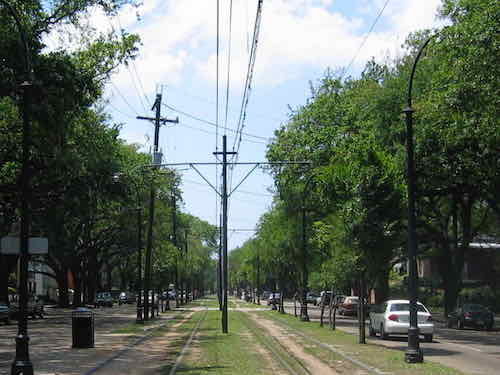
Pre-Katrina you could see natural green track in New Orleans LA, April 2004

Green track isn’t limited to only historic lines, it’s increasingly common in Europe with some limited use in North America.

Over more than 6 (six) decades Green Tracks are popular through out Europe in dense urban areas. They are a fantastic tool to mitigate stormwater issues, to reduce noise and certainly to beautify their integration. Green light rail tracks demonstrate environmental responsibility and they value their customers by making things nice, green and beautiful. Today there are over 500 miles of Green light-rail tracks in Europe.

The living green layers within and around the tracks reduces the noiseand absorbs stormwater. Thus, reducing combined sewer overflow. Modern track systems are typically Ballastless Tracks or Slab Track systems. Basically, a traditional elastic combination of ties/sleepers and ballast is replaced by a rigid construction of concrete or asphalt. Because such systems are ideal for greenery, it is even possible to create additional stormwater retention and detention from surrounding impervious areas with the system.

Already, in 1995 Green Roof Technology filed patents for greening systems on Ballastless Track systems. Currently there are around 300 miles of green tracks in Germany alone. As a result, these tracks eliminate at least 150,000 gallons of water per years from entering the combined sewer system.

In North America, Baltimore started with some experimental Green Light-rail Tracks in 2011 insisting on Sedum mats. The testing was less promising because Sedum mono-cultures are not a good choice for most green light-rail track system. Unfortunately the advice from Green Roof Technology using a smart mixtures of grasses, herbs and wildflowers was not heard. Some call it learning by doing – well – they just don’t do it. (Green Roof Technology).

Typically rails are supported by ballasts, treated wood or concrete pieces set into the ground perpendicular to the rail. Our original 1993 light rail line used wood ballast, the 2006 Shrewsbury extension (aka Blue) line was constructed with longer-lasting concrete ballasts.

Our current lines are Red & Blue so naturally I’d like this new line to be the Green Line. Green track for the Green Line!

It can’t be everywhere, but in many places it can be. A lot of the new line would be in the center of Natural Bridge, which recently went through a quick traffic calming project that reduced vehicle travel lanes to one per direction. Adjacent to Fairgrounds Park the center is green — would be greener if not on top of asphalt.
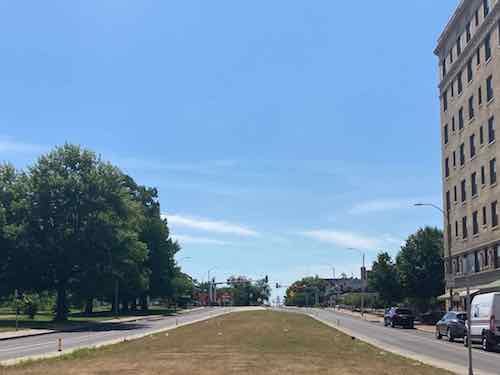
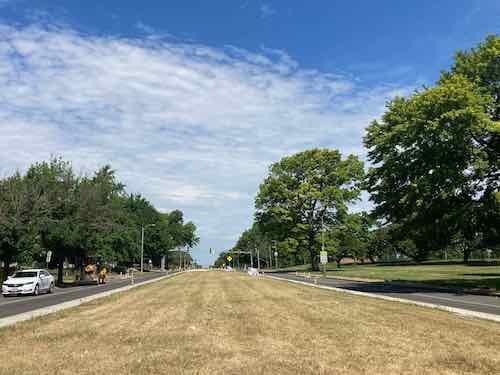
Looking east toward Grand
Looking west from the same location.

I think the green looks nice, helps keep the area slightly cooler.

While we’re on the subject of alternatives to impervious concrete, another would be water — yes, wet track! Rail going through a fountain…

Not sure if or where this might work, but I think it’s very interesting. Perhaps on Jefferson near the stop near Olive or Market? Guests in new hotels could look down from their rooms and see transit & water converge.

I’d just like us to consider something other than boring ordinary impervious paving.

— Steve Patterson
 

North-South MetroLink Study Update Looking To Stay On Jefferson Avenue, Avoid Previously Planned Circuitous Route

June 16, 2022 Environment, Featured, Planning & Design, Public Transit, Transportation Comments Off on North-South MetroLink Study Update Looking To Stay On Jefferson Avenue, Avoid Previously Planned Circuitous Route

The idea of a North-South MetroLink light rail line has been discussed for many years — too many. We’ve had a couple of studies and locally preferred alternatives over the 15+ year period. Currently Metro is looking at the most recent and “tweaking” it to make it work financially with the city funds from our transit tax. So when I heard this would be included in the Citizens for Modern Transit (CMT) June “Talking Transit” online event I immediately registered. It took place a week ago, but it’s online — link in a moment.

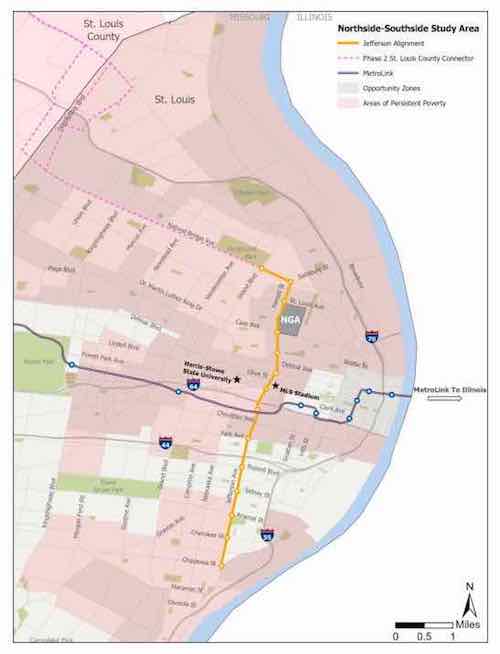
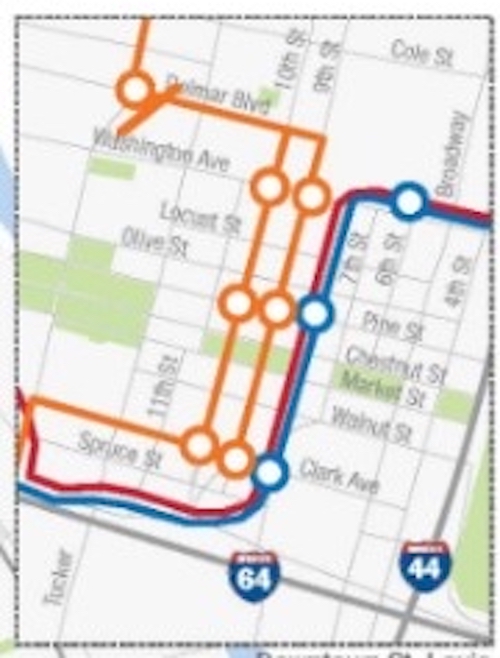
The last alternative was eastbound on Natural Bridge, coming south on Parnell/Jefferson to Cass (to include the large NGA workforce), east to 14th, eventually to 10th, back over to 14th, west on Chouteau, south on Jefferson.

2018 detail map showing the North-South MetroLink in orange. This is no longer possible because of the convention center expansion project closing 9th street.

So basically on Jefferson north of Cass and south of Chouteau, but taking a highly circuitous detour to go through downtown — and briefly east of Tucker.  The distance between those two points on Jefferson is 1.6 miles — in basically a straight line that would require no left or right turns.m

In a 2006 post I suggested a modern tram route on Jefferson, with a new MetroLink station where Jefferson crosses over the existing light rail line, so riders could transfer between lines. Well 16 years later they’re looking at doing basically just that — run in-street light rail on Jefferson with the addition of a MetroLink station at Jefferson. This was disclosed by Bi-State Development President & CEO Taulby Roach at 3:23 in CMT’s event a week ago (watch 0n YouTube).

Bi-State graphic, the orange-yellow mostly vertical line in the center shows the initial phase being evaluated now.  The pink sections are “areas of persistent poverty.”


With the NGA, Centene Stadium (MLS) and planned new hotels (Jefferson & Market) this a hot corridor.

The rail wouldn’t be a tram in mixed traffic, it would be in a separate dedicated center section, still low-floor though. The vehicles for both are nearly identical. In-street light rail vs tram basically means dedicated right-of-way and fewer stops, to improve overall speed.

Obviously I’ve long thought a stop at Jefferson on the original MetroLink was a good idea — the distance between the Union Station & Grand stations is just so excessive. I often talk about focusing on corridors, not circuitous routes, and Jefferson is an obvious corridor for a transit project.  It’s not a perfectly straight line, but it would eliminate a huge amount of turns.

Like previous North-South studies, the idea of going out west on Natural Bridge allows a future phase to connect into North County. This could help get county residents to employment opportunities at NGA, and in Downtown West/Midtown.

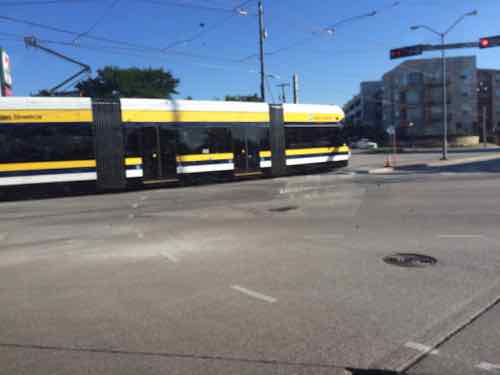
The American-made Brookville Liberty vehicle can go off-wire for short distances. Dallas TX April 2015

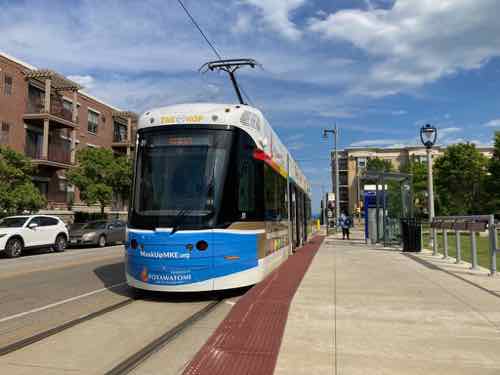
The study update is looking at the latest low-floor vehicles to use. Because of some tight points they’re looking at vehicles that could run for short distances on battery, with the usual catenary most of the distance. This is called off-wire. An example is the Brookville Liberty, in use in cities like Dallas, Milwaukee, and Oklahoma City.  I have no idea which specific vehicles Metro is considering, but the technology to go without a catenary for a short distance is proven.

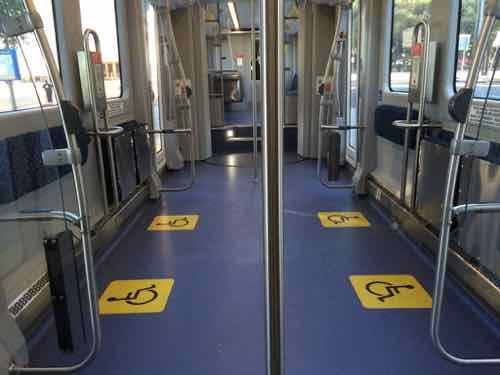
Interior of Brookville Liberty with low center section and step up seating at each end. Dallas TX, April 2015.
Brookville Liberty at a stop in Milwaukee WI, June 2021
Low-floor center section of Brookville Liberty makes boarding easy. June 2021.

I’d hoped to have visited Oklahoma City by now and ride their Brookville Liberty vehicles., but rental cars & flights have just been too expensive. Again, I’m not sure what vehicles Metro is considering, this is the only off-grid vehicle I’ve ever ridden before.

In the CMT event on Zoom Taulby Roach indicated they’re planning on closed platforms  — having to pass through a fare gate to reach the platform.  This coincides with Metro’s platform project to install fare gates at all MetroLink stations in Missouri & Illinois.

Hopefully Metro’s latest look at North-South rail will result in actual construction, eventual operations.

Steve Patterson


MetroLink Escalators “Temporarily Closed” For Years

April 18, 2022 Accessibility, Downtown, Featured, Public Transit, Transportation Comments Off on MetroLink Escalators “Temporarily Closed” For Years

Escalators are great, very helpful to those who find stairs difficult.  However, like elevators, they’re expensive to install and maintain. Escalators exposed to the elements are even more challenging to keep in operation.

When our original light rail line opened in 1993 two stations were located within an old freight tunnel under the central business district (CBD). The Convention Center and 8th & Pine stations were designed with stairs, elevators, and escalators. Because the tunnel is narrow the tracks are in the center, the passenger platforms are on both sides — one per direction of travel, east or west. This meant a total of four elevators and four pairs of escalators — all exposed to elements to a degree.

When the Shrewsbury (Blue) expansion line opened in 2006 its three underground stations had stairs, elevators/ramps — no escalators.

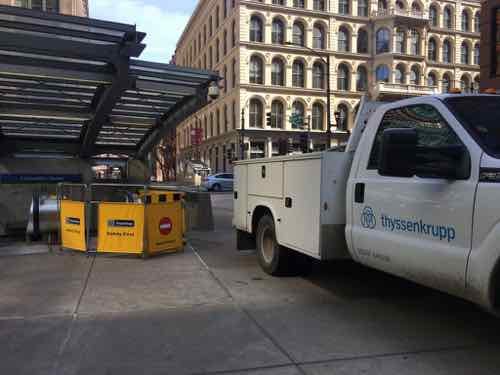
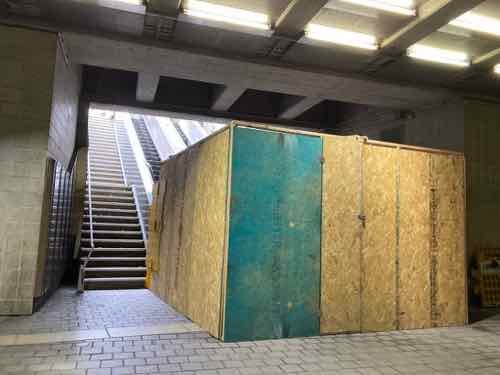
In 2018 & 2019 I’d frequently see ThyssenKrupp maintenance people working on the Convention Center escalators, or at least their service truck on the public sidewalk near the westbound entrance/exit. April 1, 2019
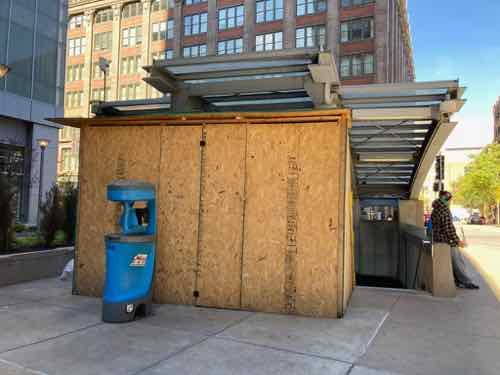
Here’s the same location on November 2, 2020
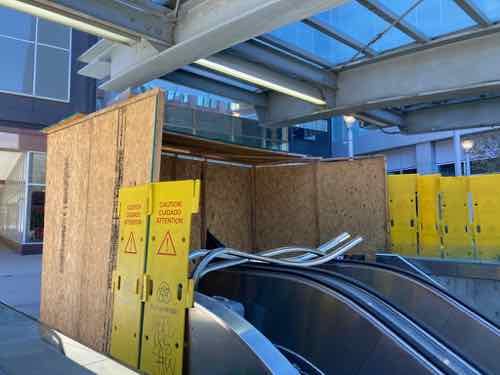
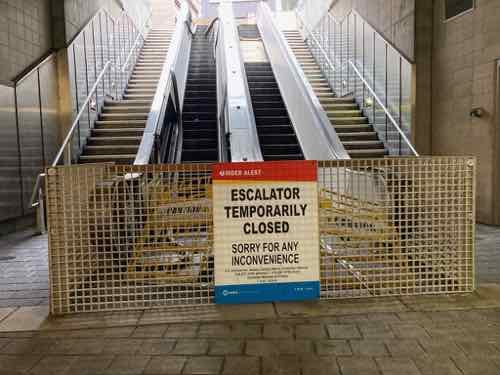
Another view, with parts visible. November 2, 2020
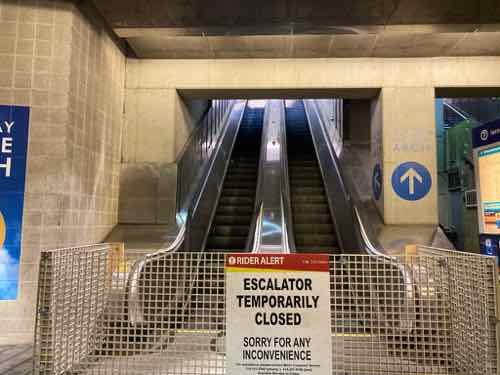
View from the platform level. November 2, 2020
The big plywood barricade has been gone for quite a while, but the escalators remain out of service. March 7, 2022
The eastbound escalators at 8th & Pine have been a similar story. Note access to the elevator is on the right, back — between the escalators and stair. April 21, 2021.
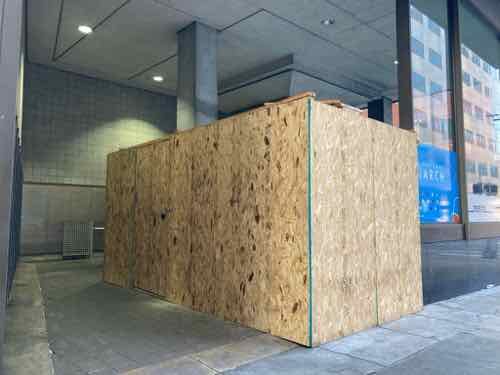
The street entrance of the eastbound 8th & Pine station after the plywood construction barricade was constructed, steps & elevator are accessible. March 1, 2022

I search all Metro press releases from 2019 through the present, only one mentioned escalators in the subject/summary.

From May 3, 2021:

Rehabilitation work on the westbound escalator at the 8th & Pine MetroLink Station in downtown St. Louis begins on Tuesday, May 4. During this project, the station’s westbound elevator will remain in service, however, the accessible pathway to the westbound side of the 8th & Pine Station (near Pine Street) will have to be closed temporarily.

MetroLink riders who are traveling to or from the 8th & Pine Station and use a wheelchair or mobility device may need to make adjustments to their commute, as it will be necessary for riders to use stairs (located near Chestnut Street) when entering or departing the westbound side of the 8th & Pine Station.

The escalator rehabilitation work is expected to take approximately three months to complete. (Source: Metro)

The above press release was issued a week after I followed up with Metro again since I hadn’t received any specifics from my inquiry on December 28, 2020. Receipt of my original inquiry was acknowledged but I never received anything. Just the one press release, above.

Since I use my power wheelchair when using transit why do I care if the escalators aren’t working?

Well, it looks bad to have something temporarily non-functional for days, weeks, months..years.

What do I hope to accomplish with this post?  I want all the escalators either in good working condition — or I want them removed and replaced with fixed stairs (I can’t speak to concerns of those who have a hard time with stairs). It obviously won’t happen quickly, but steady progress needs to be demonstrated.

It looks very bad for visitors to see out of service signs, but it’s even worse when returning visitors say “oh yeah they were out the last two years I’ve visited.”

— Steve Patterson


Auto-Centric Pandemic, Vaccine Site Adjacent To Light Rail Station Didn’t Mention Using Transit

March 25, 2021 Central West End, Featured, Public Transit, STL Region, Transportation Comments Off on Auto-Centric Pandemic, Vaccine Site Adjacent To Light Rail Station Didn’t Mention Using Transit

The previous 12 months have highlighted how auto-centric the United States is. So far during this pandemic we’ve seen drive through food banks, and COVID-19 testing. Each with cars backed up for miles. To keep the cars on the road there were also lines at licensing offices.

From May 28, 2020:

On Friday, May 29 CVS Health will open 22 new COVID-19 drive-thru test sites across Missouri, including locations in St. Louis.

CVS Health expects to have up to 1,000 locations across the country offering this service by the end of May.

The testing will be by appointment only. You won’t go into the store, but sit in your car and administer the test. (Fox2)

From June 11, 2020:

Many St. Louis-area residents endured long lines and waiting times at licensing offices Thursday, which recently re-opened due to COVID-19 worries.

Thursday, a News 4 crew found some people who waited several hours at two licensing offices in west St. Louis County, where only a few people are allowed inside at one time to due to COVID-19 restrictions. (KMOV)

From November 25, 2020:

From California to New York, pictures have emerged of thousands of people waiting to receive groceries from their local food banks ahead of the Thanksgiving holiday.

It’s one side effect that has cropped up as a result of the coronavirus pandemic that continues to sweep the nation. Experts say the problem is rooted in high unemployment and low cash flow. (CNBC)

So it was no surprise when it came time for vaccinations that many sites weren’t accessible by foot or public transit. As with food & testing, people in their cars were backed up for miles to get a shot.

Last Thursday:

Traffic was backed up for more than a mile in both directions entering the county’s drive-thru mass vaccination site. The event, put on by the St. Charles County Health Department with support from the Missouri National Guard, was expected to vaccinate 4,000 people by the time it wrapped up Thursday evening. (KMOV)

Monday I got my first shot. I’d been on a waiting list at BJC only, as I knew I’d be able to take transit. Many people signed up for multiple lists with the expectation they’ll drive wherever they need to.

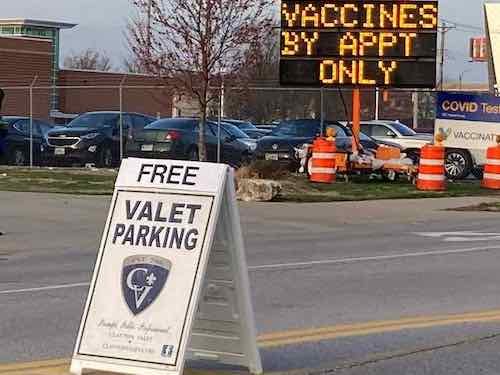
Valet parking makes sense, especially for those who can’t walk far.

I was given a choice of vaccination sites, but I picked the 4353 Clayton location because I knew it was adjacent to the Cortex MetroLink station. The instructions from BJC, however, didn’t mention transit at all.

  • Due to social distancing restrictions, do not arrive before your scheduled time.
    • If you arrive earlier, please remain in your vehicle until it’s time to enter the building.
  • Please park in the lot at the front of the building, labeled “30 minute visitor,” or the lot west of the building, labeled “2 hour visitor.”
    • Free valet parking is also available at the front of the building.
    • Click here for a parking map.

Despite my criticism of their lack of mentioning transit, the entire process was very well orchestrated. Outside they had signs & people to direct drivers. At the building they had people stationed at every step to keep the flow going. I was in and out in under a half hour!

– Steve Patterson


Metro’s Blue Color Scheme A Welcomed Change

December 24, 2020 Featured, Public Transit Comments Off on Metro’s Blue Color Scheme A Welcomed Change

A year ago Metro announced that a new color scheme was being phased in.

You will continue to see the red-white-and-blue trains and buses for a long time. There are currently three MetroLink trains featuring the new look, as well as 26 new MetroBus vehicles. These new 30-foot Gillig buses have improved emissions and a much smaller turning radius than other buses in the fleet, making them more flexible in the types of service they can provide and in the locations where they can better operate.

The new paint scheme will only be applied to new vehicles being added to the Metro fleet as they replace older trains, buses and vans that are being retired out of service. All of these updates are part of the normal maintenance and replacement cycle for transit vehicles, signs and materials, and no additional funds are being used or needed to make these changes.

It took a while but I think most vehicles have now received the new design. Train vehicles haven’t actually been replaced, but individual cars gets updated and the livery changes from the standard to advertising, etc. Buses also get a change of livery based on advertising wraps.

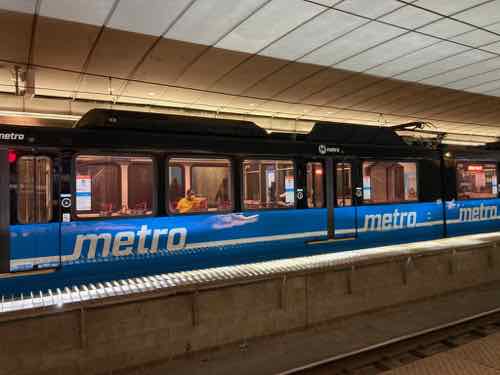
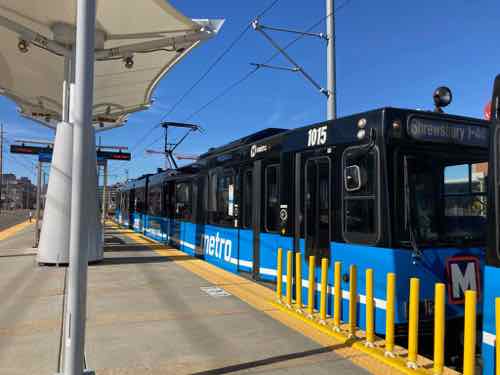
The new blue design in July 2020
New blue design last month

MetroLink trains & buses have been white for decades.

The old blue & red design on a white background, 2014.
The old blue & red on a white background on August 26, 2006 — the opening of the Shrewsbury line.

I’ve been here 30 years and I couldn’t think of a different color scheme, but a friend reminded me prior to the 2003 Bi-State to Metro change to blue & red on white they had a red/orange/yellow scheme.

Red, orange, & yellow strip on white background. 1996 photo by Ron Walker.

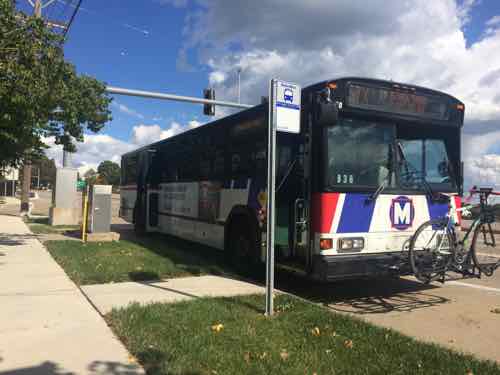
I personally love the new design. The bold blue design stands out, at least for now. In time it’ll get old and tired. It’s refreshing to no longer have the white background. I’ve seen the new blue design on buses, but haven’t gotten a photo yet.

— Steve Patterson


Advertisement


[custom-facebook-feed]

Archives

Categories

Advertisement


Subscribe