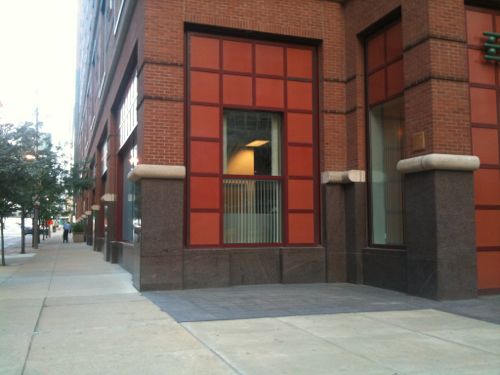
Nothing is getting built because of the economy, right? Wrong. Seems there are renovation & new construction projects popping up in neighborhoods throughout the city.
ABOVE: New construction in Lafayette Square
The following is a combination of an educated guess based on demographic forecasts, trends and wishful thinking.
I see the 21st century as a mirror of the 20th century. The first half of the last century started with the earliest suburbs as a means of escaping the industrial city. The initial movement was limited to the wealthy but as time passed the growing middle class sought residences in the new suburbs.
This century I see the wealthy locating in walkable neighborhoods closer to the center and near mass transit. But more and more people want to experience real places and they realize suburbia (driveable, not walkable) don’t offer the lifestyle they seek. By 2050 I see the general public seeking to live & work in walkable locations with the option to use mass transit.
Those parts of our region, and other regions, which do not adopt a pedestrian-friendly form will be increasingly viewed as undesirable by most of the population. The secluded residential subdivision of today that requires a 5-mile drive to reach the grocery store will be the slum of 2075.
During the second half of the 20th century walkable urban centers tried to remake themselves in a way to retain population. The attempts, which made the core less walkable, failed to retain those who desired life in the new suburbs. But this century the efforts to retrofit suburbia.
Before my 2008 stroke I got around on a 49cc Honda Metropolitan scooter. Because of the small displacement engine it did not need to be licensed by the Missouri (some states require registering all scooters regardless of engine size). I’d park in out of the way places but at times I’d get notes from officers suggesting I park in a metered parking spot. My scooter was tiny and would be lost in a space.
ABOVE: Scooter at parking meter, wasting space
Recently I noticed a much larger scooter parked at a meter on Lindell Blvd near Grand Ave. What I don’t know is if the space was empty when the scooter was parked or if the owner slipped in front of a car that left before I took the photo. Either way you can see the ridiculousness of having fixed-length parking – the one-size-fits-all formula that wastes lots of space.
In high demand areas we need to have motorcycle & scooter parking. In the space of one car you can fit in parking for 3-6 motorcycles/scooters. For payment you use pay-per-space machines:
ABOVE: Motorcycle parking, San Francisco 2/2004
You pay for the number for the slot you park in. Regular meters can also be used where you have 2-3 spaces. By creating the spaces perpendicular to the curb line you can fit in many motorcycles & scooters. Motorists will be less frustrated by not having a scooter taking a full space. Riders will be happy having a designated space for their compact tw0-wheeled vehicles. The city will collect additional revenue.
July 14, 2010NorthSide Project, Politics/PolicyComments Off on Many readers pleased with Judge Dierker’s ruling on the NorthSide TIF
Last week there were 314 votes in the weekly poll.
Q: How do you feel about Judge Dierker tossing out the $390m TIF for Paul McKee’s $8.1b NorthSide project?
Great, now voters need to toss out the Aldermen that voted in favor of the TIF 113 35.99%
Bad, the area needs redevelopment 56 17.83%
Mixed feelings 53 16.88%
Good, too much public subsidy 49 15.61%
Horrible, TIF is a good way for the public to partner in such a project 32 10.19%
Other answer… 8 2.55%
Unsure/no opinion 3 0.96%
Other Responses were:
the area needs the development but Mckee could have gotten a sum thru investors
The idea was a bold and positive one. The TIF was too large of an area, however.
Great, plan wasn’t concrete enough; not enough guarantee of financial succe
New ordinances needed
Paul McKee had not an ounce of good intentions for the area in question, greed.
Good – a new plan w/ more community-based redevelopment needs to be made.
We need the north side redevelope.
Good: Needs more details
So what to make of these votes? I personally fall into the “mixed feelings” group, although I wouldn’t mind seeing many of our elected officials replaced with some fresh faces. The city stopped setting a vision for much of the area in the large TIF boundary, something had to be done. I share the feeling that the community should have input into the planning of such a large area of the city. McKee says the project will move forward:
In his 51-page ruling, Dierker raised questions about the development’s economic projections, the city’s approval process, city officials’ reliance on market studies provided by the developer and McKee’s ability to pull off the project and deliver on his promises to transform 1,500 acres. McKee wants to partner with homebuilders and other developers to build up to 4.5 million square feet of office space, 1 million square feet of retail space, 2,200 new single-family homes and 7,800 apartments over the next two decades – a plan that Dierker said puts the “idea of rosy scenarios to shame.” Full story: Paul McKee: ‘I’m too German and too Irish to walk away from it’ – St. Louis Business Journal
Maggie Campbell came to St. Louis from the Dallas-Ft. Worth area, where she held a similar role. Campbell replaced Jim Cloar, who retired, in late 2009.
Topics for discussion include:
what is The Partnership for Downtown St. Louis?
parking/valet issues
Downtown Next
The City + Arch + River competition
Gateway Mall
The Old Post Office Plaza
Downtown’s strengths and weaknesses
Stalled projects: Ballpark Village & The Bottle District
CID (Community Improvement District) renewal
The show will air live tonight between 7-8pm CST and will be available for playback about a half an hour later. You can also subscribe to the iTunes podcast via the show page.
List questions you have for Maggie Campbell in the comments below or just call in to ask her yourself.
Now that the old St. Louis Centre pedestrian bridge over Washington Ave is gone (Washington Ave is now flooded with light) it is time to talk about what needs to be done to improve it from 10th Street East to the Eads Bridge by continuing the positives from West of 10th Street. I’ll start by talking about those positives and working East block by block.
Washington Ave 10th to 20th:
ABOVE: Washington Ave looking West from 10th St
With some exceptions, the ten blocks between 10th and 20th are very nice for pedestrians. One common element is these blocks have two traffic lanes with on-street parking on both sides. Sure there are other factors but reducing traffic from four lanes to two and adding on-street parking is critical to success. You might have the same volume of cars passing by, but it feels different when it is two lanes verses four lanes. Parked cars serve as a fixed buffer between the pedestrian and passing cars. At sidewalk cafes the row of parked cars is an important physical barrier. Additionally having available on-street parking reduces the perception of a lack of parking. Someone may have to walk two blocks to their destination but they don’t mind doing so along an active street.
The other element between 10th and 20th streets is the buildings have fairly active facades — numerous doors, interesting window displays, etc. East of 10th the quality of the building facades fronting the sidewalk drops considerably.
So these are the two things needed to extend the active street further to the east — the street configuration can be done by the city but the active facades requires the adjacent property owners to be on board. Of course, without the on-street parking, there is no need for active facades. Let’s head to the river!
Washington Ave 10th to 9th:
ABOVE: The Renaissance Ballrooms occupies the entire south face in this block
The south face of Washington Ave in this block is occupied by the bland Renaissance Ballrooms. The ballroom entrance is in the center of the block and one retail space is at the corner at 10th Street (above). Several retail stores have occupied the retail space. Retail space without prime on-street parking out front is soon vacant retail space.
For those driving eastbound the block before has only one lane in this direction so the need to suddenly expand to two eastbound lanes just doesn’t exist.
ABOVE: NE corner of 10th & Washington Ave
A gap does exist at 10th — a small parking lot on the west side of the Lammert Building. A year ago the restaurant Over/Under opened in the Lammert and they took away a few parking spaces for a very nice patio. This is a simple and very effective way to enliven a corner killed with a parking lot.
ABOVE: the patio at Over/Under was once parkingABOVE: The Lammert (left) and Banker’s Lofts
The north face of the block has two very handsome buildings, Banker’s Lofts and the Lammert. Retail shops exist in both buildings and these could be helped by taking a travel lane for some on-street parking.
When driving westbound in the outside lane you cannot turn right because 10th is one-way heading south. You can’t go straight ahead because of on-street parking in the next block west of 10th — so this lane basically ends, forcing motorists into the other lane. With the exception of space for a bus near 10th, this side should have on-street parking.
Washington Ave 9th to 7th:
I’m grouping these two blocks because of the super-block created when 8th was closed for the convention center on the north face.
ABOVE: Convention Center on the left and Renaissance Hotel on the right
The hotel is a busy place. The traffic jamb pictured about was caused by the arrival of people to a weekend convention, the jamb was gone in under an hour. The hotel includes several entrances onto the sidewalk, including to a restaurant and a Starbucks. The building is fine but on-street parking would definitely help the sidewalk. The line of cars waiting to turn onto 8th helped greatly. For those days when a convention is arriving the on-street parking could be marked as no-parking for a couple of hours. The rest of the time the city would get additional revenue from meters.
It is very important to make this section from 8th to 10th as friendly as possible so visitors will be willing to leave their hotel room and start walking.
ABOVE: US Bank’s parking garage at 8th & Washington Ave
The US Bank parking garage cannot be made acceptable on an active street — it must be replaced with a structure with spaces occupied by human, not parked cars. While on-street parking reduces the street width, calms traffic provides prime spaces and buffers pedestrians a garage detracts from the sidewalk. A new garage with street-level retail space would be better that what exists.
ABOVE: useless plaza in front of the US Bank tower
The plaza in front of the US Bank tower is in good condition but it is a dead space, totally lifeless. There is no seating and no reason for anyone to be there. A street vendor selling food and beverages to pedestrians who could use some new movable tables, chairs and umbrellas would totally transform this plaza. The cost would be minimal and the benefit to the street would be excellent. I’d also add on-street parking, of course.
This completes the south side of Washington Ave so let’s go back to 10th to look at the north face of these two blocks.
Above: Renaissance Suites at 9th & Washington Ave.
The Renaissance Suites are on the NE corner of Washington Ave and 9th Street. The building is fine and they have a drive to the east for customers to stop and drop off luggage & passengers. The question is if on-street parking should be added in the space in front. There is only room for a single car if you meter a specific space, or two if we go to a pay-n-display system. One argument for not having parking here is the lane could be a dedicated right turn lane. Due to the disastrous buildings fronting onto 9th Street few do turn right. I say make it parking, a single space until we get pay-n-display.
ABOVE: tour buses taxis outside America’s Center
Except for a space in front of the Renaissance Suites I don’t see any public on-street parking on the north side of Washington between 7th and 9th. But I don’t see the outside lane being open for through traffic either.  As I’ve written about numerous times, the taxi stand is placed dead center on the pedestrian sidewalk — pedestrians must go around the cabs in an area that is not clear where pedestrians should be walking — the feeling you get is that pedestrians don’t belong. So the outside lane should be reserved for cabs, pedicabs, carriages and local & tour buses. This reclaims the sidewalk for — wait for it — pedestrians! I know I’m an idealist to think we’d use sidewalks for pedestrians but a guy can dream can’t he? I also see food service vendors from the convention center selling food & beverages at busy times. A few tables & chairs would be nice.
Washington Ave 7th to 6th:
ABOVE: Former Dillard’s to be mixed use with street level retail
This is the once dark block as a result of the St. Louis Centre pedestrian bridge (1985-2010). Both sides of the street will be retail and restaurants so on-street parking is a must. At 6th is a MetroLink light rail station so pedestrian amenities are important.
ABOVE: Former St. Louis Centre is being gutted. The ground floor will have retail.
Washington Ave 6th to Broadway (5th):
ABOVE: Facades on the west half of the north side of the blockface are outstanding
The large retail space at the NE corner of Washington & 6th has been vacant for a long time — long cut off from the action further west. Reducing the traffic from four to two lanes by adding on-street parking will do the trick. One of these spaces is already a gallery occupied by Art St. Louis.
ABOVE: Washington Ave looking west from Broadway (5th)
Imagine the above with one less travel lane and a row of parked cars to buffer pedestrians. Just the presence of the parked cars would make it look like something worth seeing exists on this block.
ABOVE: 505 Washington is a former state office building
The modern building on the NW corner of Broadway and Washington Ave has potential. I’d like to see one of the sections between the columns become a new set of doors so to directly access the ground floor space. I picture a modern restaurant that would take advantage of the unique ceiling pattern created by the structure. Sidewalk dining would be great.
One Financial
On the south side of Washington Ave one building occupies the entire block face. At the 6th Street corner the interior floor is at the sidewalk level so this space could be opened out by replacing the fixed windows with doors. Office cubicles is not a good use of sidewalk level space — this corner needs a restaurant with outdoor seating.
Washington Ave Broadway (5th) to 4th:
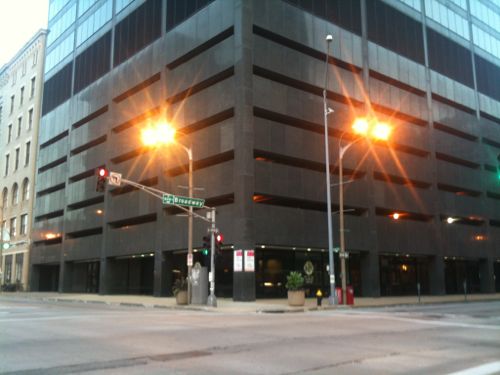
ABOVE: prison-like office building
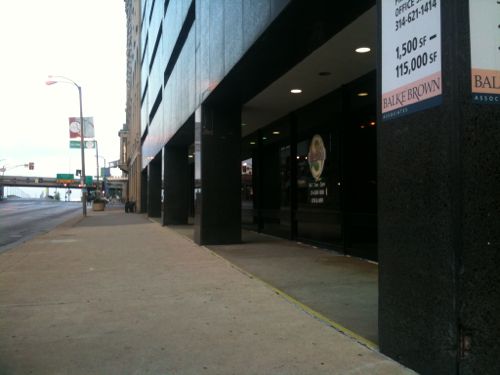
Staying on the south side of Washington Ave but east of Broadway (5th) we have the above. Is it a prison? Nope, just an office building with numerous floors of parking before the office floors start higher up. At the sidewalk level you have black polished stones walls (left) and retail (right. But the recessed wall and all the dark stone make this building unwelcoming.
ABOVE: retail is set back from the building line
The solution here is to bring out the wall for the retail space. Use clear glass rather than the dark glass. I’m not a fan of awnings but a few modern awnings might help break up the cold exterior. As with the prior blocks, on-street parking is necessary to reduce the number of lanes and to create a buffer between pedestrians and traffic.
ABOVE: SW corner of 4th & Washington Ave
The building at 4th & Washington Ave holds the corner nicely. Just continue the on-street parking and the vacant retail spaces will fill.
ABOVE: Parking for the Missouri Athletic Club on the NE corner of Broadway & Washington
Remember the patio for Over/Under back at 10th Street? The similar solution here is to build a new building at the corner facing onto both Washington and Broadway. The location is actually ideal — office workers, transit, Arch, Edward Jones Dome and convention center are all close. It build a two-story structure with the 2nd floor as additional seating or perhaps space that can be reserved. That would give the corner some needed massing. Then have a patio along Washington between the new restaurant and the Missouri Athletic Club.
I’m not a fan of chain restaurants but this is an opportunity for a chain to build new in their common look — granted the layout would be unique because of the urban context. A local restaurant would be better but my goal is 2-story building on the corner with entrance off the sidewalks, patio in between there and the MAC. Besides giving massing at the corner it would provide something lively and conceal the large surface parking lot. The addition of on-street parking on Washington & Broadway would make up for many of the off-street spaces taken by the restaurant and patio.
ABOVE: The beautiful Missouri Athletic Club
The MAC is perfect so this completes the block up to 4th Street.
ABOVE: Hampton Inn at 4th & Washington
The last building on the north side of the street before the elevated highway lanes and the Eads Bridge is the Hampton Inn. The best thing about this building is it has a Tigin Irish Pub on the ground floor with al fresco dining out front. Just allow parking on the street.
ABOVE: Gentry’s Landing (right) and the elevated highway lanes
This leaves the south face of this last block and the elevated highway lanes to address. The building is part of Gentry’s Landing and like the dark building one block west, the retail is set back under the upper floors. Again the glass retail wall needs to be brought out to the edge of the building to make the spaces more inviting. Too many lanes here so once again a bit of on-street parking will reduce the visual width of the street.
After 2015 I hope the highway lanes can be replaced with an at-grade boulevard, as envisioned by City to River.
Now just imagine arriving in St. Louis from this new boulevard and turning onto Washington Ave with all the improvements I’ve outlined. This would be impressive and successful.
The main tasks are:
Reduce the four lane road to two lanes by adding on-street parking. The city can do this with minimal cost.
Create active facades rather than black walls and holes with surface parking. Use carts, chairs and tables where needed. This is up to the private property owners.
Hopefully those who think we must keep all lanes open to through traffic will realize that kills life along the street.
AARP Livibility Index
The Livability Index scores neighborhoods and communities across the U.S. for the services and amenities that impact your life the most
Built St. Louis
historic architecture of St. Louis, Missouri – mourning the losses, celebrating the survivors.
Geo St. Louis
a guide to geospatial data about the City of St. Louis