ADVERTISEMENT

Archive for the 'Scooters' Category

Motorcycle & scooter parking needed in our region

Steve Patterson July 15th, 2010

Before my 2008 stroke I got around on a 49cc Honda Metropolitan scooter.  Because of the small displacement engine it did not need to be licensed by the Missouri (some states require registering all scooters regardless of engine size).  I’d park in out of the way places but at times I’d get notes from officers suggesting I park in a metered parking spot.  My scooter was tiny and would be lost in a space.

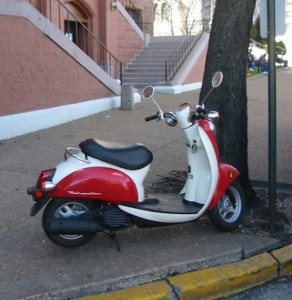
scooter at parking meter

ABOVE: Scooter at parking meter, wasting space

Recently I noticed a much larger scooter parked at a meter on Lindell Blvd near Grand Ave. What I don’t know is if the space was empty when the scooter was parked or if the owner slipped in front of a car that left before I took the photo.  Either way you can see the ridiculousness of having fixed-length parking - the one-size-fits-all formula that wastes lots of space.

In high demand areas we need to have motorcycle & scooter parking. In the space of one car you can fit in parking for 3-6 motorcycles/scooters.  For payment you use pay-per-space machines:

ABOVE: Motorcycle parking, San Francisco 2/2004

ABOVE: Motorcycle parking, San Francisco 2/2004

You pay for the number for the slot you park in. Regular meters can also be used where you have 2-3 spaces.  By creating the spaces perpendicular to the curb line you can fit in many motorcycles & scooters.  Motorists will be less frustrated by not having a scooter taking a full space.  Riders will be happy having a designated space for their compact tw0-wheeled vehicles. The city will collect additional revenue.

- Steve Patterson

Post to Twitter Post to Facebook

A Year of Driving

Steve Patterson July 14th, 2009

A year ago today I bought my first post-stroke tank of gas. The 9 months prior to my stroke I did not have a car — my motorized transportation was a 49cc Honda Metropolitan scooter that got around 90 miles per gallon.  A year ago I felt guilty about going back to driving a car. I’m over the guilt although I want to, someday, go back to not having a car.

So the day I buy gas for the first time in nearly six months just happens to have been the day gas prices peaked in St. Louis.  I paid $3.979/gallon for basic unleaded. By December 30th I paid a low of $1.339/gallon - a 66% drop. I tracked each fuel purchase and my mpg on an application on my iPhone:

Cold winters and recent a/c use took a toll on my average MPG.  My last fill-up was on a return trip from Chicago - 70mph with a/c.  Pretty good numbers.

During the year I drove 7,200 miles which included a trip to Oklahoma and the recent one to Chicago.  Take out those two road trips and I drove about 5,500 miles around town.  Admittedly I have a big advantage of working from home.  But I also have a compact life shopping locally as well as combining trips. Even as the price of gas dropped I continued to conserve.

The above chart shows the price per gallon that I paid over the last year.  Yes, I’m a nerd by charting this but I’m a visual person.  As we seen the price per gallon has steadily increased in 2009.  It is still a long way from where it was a year ago - the climb up is much slower than the drop off.  But the prices from last summer will return at some point.  There will be a point in a year or two where $4/gallon seems low.

By the end of 2010 I hope to have another scooter — perhaps a hybrid or all-electric scooter.  Like before, I’ll go a couple of years having a car and a scooter before going to scooter-only.  This time I will be able to join Enterprise’s WeCar car-sharing program for those times when I need/want a car.

- Steve Patterson

Post to Twitter Post to Facebook

I’m on Google Streetview

Steve Patterson February 6th, 2009

If you love Google maps then you probably love streetview — the ability to see what an actual street looks like.

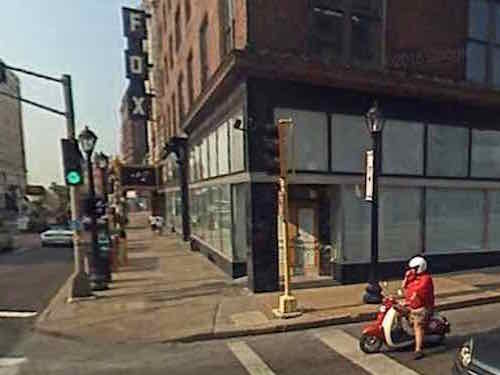
Friends of mine, planning students from St. Louis living in New Orleans, recently blogged about spotting me on my former Honda Metropolitan scooter in a streetview at Washington & Grand (link).

Steve Patterson on Googles Streetview taken before 2/1/08.

Steve Patterson on Google's Streetview taken before 2/1/08.

Thankfully I wasn’t over the stop line!  Thank you to Matt Mourning and Michael Powers!  I’ll be back on a scooter by Spring 2010.

Post to Twitter Post to Facebook

A Scooter For Graduation?

Steve Patterson September 24th, 2008

One of the most disappointing results of my February 1st stroke was of course the loss of function on my left side. I was left handed. But the big disappointment was selling my Honda Metropolitan and getting a car. I love having the car but it is just not the same as riding a scooter in the open air. Granted when it is raining the car keeps me dry whereas the scooter would not. Riding a scooter, however, was far cheaper transportation. Even with the windows down and the sunroof open the feeling of enclosure in the car is much greater than I prefer.

Goal setting is an important function to move individuals and organizations forward. Throughout my recovery I’ve set goals for myself. As I achieve them I set new ones. Resuming work on my Masters degree was an important milestone. I’m now on a schedule to graduate in December 2009. I think being able to scooter by that time is a goal worth striving for. That is a little more long term than my prior goals have been. Others in the same vein would be being able to type two-handed again, write with my left hand again, and to walk without a cane. Short term goals are mostly subtle at this point — largely improving my walking speed. But riding my bikes and getting a new scooter is real motivation for me.

I’ll graduate in just over a year and hopefully I can afford a new scooter at that time. This gives me time to research the myriad of new scooters on the market and coming to market. The Honda Metropolitan was excellent transportation, providing me with 9,000 cheap & trouble-free miles of fun transportation. So a new Metropolitan is certainly at the top up my list.  New hybrid & electric scooters are hitting the market.

I’ll probably do like I did before — have both a car and scooter at the same time until I’m ready to sell the car. Once I have reliable use of my left arm/hand I’ll be able to join Enterprise’s car sharing program, WeCar, for local trips and be able to rent a car for longer trips.

But a cute scooter for the spring of 2010 sounds good for now.

Post to Twitter Post to Facebook

An Older Post is the Most Popular of Late

Steve Patterson August 12th, 2008

In the nearly four years that I’ve been writing Urban Review STL I’ve published over 1,500 articles — most written by me. So it came as a surprise to me that after installing a new “stats” program a week ago that my most actively read post is not current but from a year ago. The post My Honda Metropolitan Scooter, Two Years and Six Thousand Miles Later from September 4, 2007 is consistently read more than any other individual post (the main page is still more read). Why is this?

Google search.

It seems that many many people out there are searching for “Honda Metropolitan” and after Honda they get my post from last year.  More and more people are considering a scooter — if they can find one for sale.  If there was ever a time to be selling scooters 2008 is the right time.  We might be back to Hummers in 2009 but for now the scooter (and bicycle) reign supreme for personal transportation.

Post to Twitter Post to Facebook

My Beloved Honda Metropolitan Scooter Has Been Sold

Steve Patterson June 19th, 2008

It was September 5th 2005 and I was so excited — I had just purchased a 2004 Honda Metropolitan that was only slightly used with 235.5 miles on the odometer (see, My Way of Dealing with Rising Gas Prices). Today I sold the scooter with just over 9,000 miles on it. Even in the cold & rain those were some very fun miles. I didn’t want to sell the scooter, it’s just that since my stroke I could not safely ride it with only one hand on the handlebar. As more time passes and I can once again ride a scooter I will certainly buy another.
With our gas prices now at $4/gallon more people should consider a scooter. On my first scooter post (link above) I was thinking about saving on gas. The timing was just after Katrina hit New Orleans but before Rita hit Texas. Gas prices spiked to over $3/gallon for this week but they quickly fell below $3/gallon but not below $2/gallon. At the time I wrote:

I estimate that given current fuel prices every 5,000 miles I can put on the scooter rather than my car I’ll save at least $600. As fuel prices rise the savings will be even greater. In less than 3 years the scooter will pay for itself in fuel savings.

Keep in mind that at the time I had a thirsty AWD Audi. So it turns out I didn’t do 5K per year on the scooter. I do think that by thinking more locally and combining trips I did manage to save nearly that many miles each year.

A year ago I sold my car (by that point I had a more efficient Scion xA). I made it through the hot summer and most of the cold winter on the scooter (I was in the hospital during some of the worst winter weather). There were a few days in December where the snow and ice forced me to stay in, but only a few days. There was this great high from getting around town on single gallon of gas (the scooter managed 85-90mpg but only held 1.1 gallons). Each passing month without a car payment or insurance bill I knew I had made the right decision.

My current set of wheels is the ultimate in green transportation — a plug-in electric, um, wheelchair. It gets me most places I need to go — I took it on MetroLink today (it was “Dump the Pump” day so I had a free day pass). My morning started with an 8:30am meeting on Delmar in the Loop and before the trip was done I was leaving Trader Joe’s and heading back to the Eager Rd. station. Again the chair, combined with mass transit, does a great job of getting me around.

Former St. Louisan, Chris Balish, author of “How to Live Well Without Owning a Car: Save Money, Breath Easier and Get More Mileage out of Life”, was right — you can live well without owning a car! Having said that, I’m reluctantly buying a used car.

I can do my job as a REALTOR® from a scooter but not from the #70 Grand bus and a wheelchair, so a car I must purchase. And yes I’ll be able to drive. I have to get a car with an automatic transmission as I can’t rely on my left leg being able to operate a clutch. The only two modifications will be a knob on the steering wheel (so I can turn the wheel with a single hand) and a device that connects to the turn signal stalk so that I can activate the turn signals with my right hand.

Going from not owning a car to buying one when gas is $4/gal. is not good timing on my part but it was not like I planned the stroke. So I’m focusing on two of the most fuel efficient & reliable non-hybrid used cars: Honda Civic & Toyota Corolla. Buying an efficient sedan is the best I can do to hedge my bets against rising gasoline prices. That and continuing to use the wheelchair and mass transit for as many trips as possible. Plus working on my walking too. Tonight I just walked around the block (for the third night in a row).

Except for those of you that regularly ride a bike for transportation, each of you could benefit from riding a scooter. Those little trips to the grocery store are just so much more fun on a scooter. Using a scooter for shopping is great too — you tend to not buy things you don’t need because you don’t have the space to lug a bunch of crap home.

So hopefully in another year I’ll be writing about the new scooter I bought and in a couple of years I’ll be back to not owning a car. At that point hopefully the WeCar car sharing plan will have a vehicle within a few blocks of my place (all are east of Tucker at this time). In the meantime I’ll still get to see my old scooter as I sold it to a neighbor in my building.

Post to Twitter Post to Facebook

Missouri’s Helmet Law a Good Thing

Steve Patterson April 18th, 2008

Once again there is chatter about repealing Missouri’s helmet law. To do so would be foolish. Like seatbelt laws for adults, I get the freedom of choice argument.

However, in these last few months I’ve also been around so many people with severe head injuries and therefore I know more clearly than others how devastating such an injury can be. It doesn’t take much of an impact to cause brain damage which can result in the loss of speech, ability to walk, etc…

The question is if the government has a compelling enough case to mandate the use of a helmet. First, the use of the road is not a right. In the interest of safety for all, the government mandates safety equipment such as lights. A motorcycle helmet is a natural extension of this.

So why should the government care if you split your head open for not wearing a helmet? Well when you are dead or a vegetable you are no longer contributing to society.

When I can return to my scooter I will wear a helmet regardless of the law — it is simple common sense. Still many motorcycle advocacy groups are working hard to remove helmet requirements in Missouri and 19 other states that require helmets for all riders regardless of age. Another 19 states require riders up to a certain age (18 to 21 depending upon the state) to wear helmets (see list).

There are many types oh helmets on the market and critics of these laws correctly point out that the laws don’t define what constitutes a helmet per the law. Fine, let’s work on a definition but not toss out the requirement all together.

If you are bicycling or riding a scooter.motorcycle please wear a helmet regardless of the law.

Post to Twitter Post to Facebook

Bill Would Permit Segway Use in Forest Park

Steve Patterson January 23rd, 2008

Last Friday Ald. Lyda Krewson (D-28th) introduced Board Bill 449 which would allow, with restrictions enforced through a permit process, the use of a Segway in Forest Park. Currently the Segway is legally allowed to use the street, along with cars, trucks, bicycles and scooters. They are also allowed, per state law, to use sidewalks and bike paths:

Defined–requirements for operation.

307.205. 1. For the purposes of sections 307.205 to 307.211, “electric personal assistive mobility device” (EPAMD) shall mean a self-balancing, two nontandem wheeled device, designed to transport only one person, with an electric propulsion system with an average power of seven hundred fifty watts (one horsepower), whose maximum speed on a paved level surface, when powered solely by such a propulsion system while ridden by an operator who weighs one hundred seventy pounds, is less than twenty miles per hour.

2. An electric personal assistive mobility device may be operated upon a street, highway, sidewalk, and bicycle path. Every person operating such a device shall be granted all of the rights and be subject to all of the duties applicable to a pedestrian pursuant to chapter 304, RSMo.

3. Persons under sixteen years of age shall not operate an electric personal assistive mobility device, except for an operator with a mobility-related disability.

4. An electric personal assistive mobility device shall be operated only on roadways with a speed limit of forty-five miles per hour or less. This shall not prohibit the use of such device when crossing roadways with speed limits in excess of forty-five miles per hour.

5. A city or town shall have the authority to impose additional regulations on the operation of an electric personal assistive mobility device within its city or town limits.

The last section above does allow cities to place restrictions. In the City of St. Louis it has been interpreted by the City Counselor’s office that the Segway is a vehicle and is not allowed to use sidewalks and/or bike paths. The current applicable definition comes from ordinance 65138 which was signed by the Mayor in January 2001 — before the introduction of the Segway:

For purposes of this ordinance a “motorized scooter” shall mean any two-wheeled device that has handlebars, is designed to be stood upon by the operator, and is powered by a motor that is capable of propelling the device with or without human propulsion at a speed of not more than 25 miles per hour.

The above ordinance was originally targeted to those motorized skateboards that were popular at the time — hence the ’stand upon part’ of the definition. The city cites the following as reasons for a Segway being a vehicle and thus banned from use on sidewalks:

Every person operating a motorized scooter shall have all the rights and is subject to all the provisions applicable to the driver of any other vehicle as established by ordinance, including, but not limited to, ordinances concerning driving under the influence of alcoholic beverages or drugs, except those provisions which, by their very nature, can have no application.

Well, OK, but what about this section from the same ordinance:

A person operating a motorized scooter is not subject to the provisions of this code relating to registration, and license plate requirements, and, for those purposes, a motorized scooter is not a motor vehicle.

If we stroll over to the “revised code” for the city and look at the Chapter 17.16 Miscellaneous Traffic Rules we can see all sorts of, well, miscellaneous rules. These include rules on many topics such as crossing fire hoses, boarding in motion, transporting animals, and allowing police officers to ride bicycles on any sidewalk in the city. The city considers the Segway a vehicle and references the following as reasons why it is banned on all sidewalks:

17.16.040 Driving upon sidewalk or bicycle/ pedestrian right-of-way.

A. No person shall drive any vehicle upon a sidewalk except upon a permanent or duly authorized temporary driveway.

B. No person shall drive any vehicle upon any bicycle/pedestrian right-of-way. The provisions of this subsection shall not apply to persons driving emergency vehicles or maintenance vehicles, persons who drive upon any bicycle/pedestrian right-of-way as a means of ingress or egress to a place of business or a residence or persons crossing any bicycle/pedestrian right-of-way at a point designated by Grace Hill Americorp as river access crossing site. (Ord. 64952 § 2, 2000: prior: Ord. 57831 § 1 (part), 1979: 1960 C. § 827.040.)

So is the Segway a “vehicle” or not? The state of Missouri considers a bicycle a vehicle as well with the operator is subject to the same rights and rules as a motor vehicle operator but we don’t ban bicycles from operating on bike paths.

So Ald. Krewson’s bill is not looking to examine the bigger issue from a city-wide perspective. BB#449 is geared only at Forest Park and mainly at institutions within Forest Park. Basically the Science Center owns (16) Segways they like to use for groups to show how they work — you know, the science behind them. Legally they should be permitted to use them on roadways in Forest Park but it seems they want to use them on sidewalks and paths. This bill, if passed in its current form, would permit the Director of Parks to formulate rules, an application process and issue permits to those seeking to use a Segway in Forest Park.  To receive a permit you’d need to own the Segway.  Institutions in Forest Park, such as the Science Center, could allow others to use their Segways after the person signed a waiver form.  Anyone riding a Segway in the park would need to wear a prominent plackard — making them look even dorkier.

So all this brings up several questions.  First, does the current laws on the books limit the use of Segways or not?   If yes, do we keep it as is or do we consider where and how we’d like to permit Segways on sidewalks/paths.  For example, besides Forest Park perhaps on the North Riverfront Trail?  If the current laws do not ban the use of Segways on sidewalks/paths, do we want to limit their use.  At nearly $6,000 a pop it is pretty rare to see one out and about except for tour groups.

One time, a few years ago, I crossed the street heading to the Chicago Art Institute and a group on Segways had blocked the entire corner on the sidewalk — making it difficult for me as a pedestrian to get through.  Like my scooter, I have no issues with someone locking up a Segway to a bike rack on the public sidewalk, but I have to wonder about mixing Segway users with walkers, joggers, rollerbladers, and cyclists on paths in Forest Park.  This seemingly non-issue gets complicated pretty quickly.  For more information on the Segway see Wiki and Segway.com.

Post to Twitter Post to Facebook

Book Review; How to Live Well Without Owning a Car

Steve Patterson January 7th, 2008

When I went car-free in the first half of 2007 I didn’t know exactly what I was getting myself into (see post). Sure, I had owned the scooter for a while but I still had my car for shopping trips and other errands. One of my first purchases after going car-free was the book by former St. Louisan, Chris Balish, titled How to Live Well Without Owning a Car: Save Money, Breath Easier and Get More Mileage out of Life.

Balish’s book is not a preachy save the planet from doom type of book. Instead, it is a personal finance book, showing the reader how to save thousands of dollars each year simply by not owning a car. Instead of focusing on the environmental impacts of cars he narrows in on the toll car ownership can take on personal finances and how it often dictates much about your lifestyle. Balish argues, convincingly, that you can get rid of the car and improve your standard of living. Having lived it now for six months, he is so right.

Balish acknowledges that car-free living is not for everyone. The outside salesperson or carpenter that hauls many heavy tools around, likely needs a car. For many others, however, Balish lays out all the issues he faced when going car-free while living in St. Louis and later in Los Angeles. Throughout the book are personal testimonies from people from North America that are also car-free.

He is quick to point out that car-free does not mean you will never rent or ride in a vehicle ever again. Car-free, to Balish, is about not owning a car. Car-lite applies to say the family that reduces their ownership of cars (from 3 to 2, from 2 to 1), basically owning less cars than you have licensed drivers.

The book is full of great tips to help you plan your new life without a car. Rather than having transportation at the ready as with a car, going car-free requires doing some planning ahead, changing buying patterns and potentially changing the location of where you live and/or work.

The notion of place, where you live or work, is where the book falls short. When Balish lived in St. Louis he lived in the Central West End which afforded him many opportunities to walk to local stores as well as access to bus and light rail mass transit. Had Balish lived in say O’Fallon (Missouri or Illinois, doesn’t really matter) he would have had a difficult time being car-free. Chapter 9, ‘Should You Move Closer to Work?’, suggests that moving to within 2-3 miles of work will “change your life.” Well, that heavily depends upon the context of where you work. Someone might live behind the Galleria and work at the Hanley Industrial Court only a few miles away but getting back and forth between the two was a challenge even before the reconstruction of highway 40.

This is not to say that suburbs are bad and the inner core city is good. For example, a person that works in say Webster Groves or Ferguson and works nearby could likely function quite well without a car. With all the basic services within walking distance to adjacent residential neighborhoods (which are connected via a good network of streets) a person could live well without owning a car.

When Balish does a 2nd edition I’d like to see him have a chapter on things to look for when deciding where to live. Does the area have good sidewalks and curb cuts (for pushing the baby stroller)? How far away is the nearest market (not necessarily a ’supermarket’, just market)? In the book he does devote a good amount of ink to suggesting that you look for local churches, schools, dry cleaners and so on when going car free. If someone doesn’t live in such an environment, they need to know what to look for and what to avoid. He does suggest locating near a transit stop when possible.

Balish breaks the chapters up into four basic sections: 1) Why you’re better off not owning a car, 2) getting to work without a car, 3) non-work transportation and 4) living well without a car. It is within this framework that Balish basically covers all the issues that a person will face going car free — from basics to getting to and from work, to handling social functions to dating.

Again, the book isn’t remotely preachy except that car ownership costs more than we all think — often twice the price paid for a vehicle after 5 years of ownership. The $25,000 car will likely run you about fifty grand after five years. Balish does the math for you showing how if you invested that same money instead you could save money for a kid’s education, a down payment on a house or retirement.

Another area the book falls short is with respect to families. He, like me, is single and therefore says a family can be car-free but he doesn’t really offer tips on the best types of strollers or other items a car-free family might need. The volume of toys, diaper bags and other items being toted around in a car for junior now is amazing. Without the SUV to permit the relatively easy transport of such items, parents would need to think on a smaller scale of what items do they need for a particular outing.
However, Balish does suggest that families consider going from two cars to one — shifting schedules and making other changes to permit eliminating one of the cars. I know many couples in the St. Louis area that have only a single car.

To me this is a great resource of easy to understand concepts about taking taxis, using transit, bicycling short distances and so on. The car is a wonderful tool that has given Americans mobility for years. As expenses rise and many now go into debate for 60 months or more to finance a car this mobility has turned into a requirement. Getting rid of the car does allow you live well as Balish describes and it gives you a new sense of freedom that no car can match. Highly recommended for anyone looking to be car-free, car-lite or perhaps just head that direction.
Resources:

Post to Twitter Post to Facebook

Scooters Vs. Minis on 9th Street, October 2006

Steve Patterson October 25th, 2007

A year ago I took some video from a fun event held last October by Espresso Mod on 9th Street —- a scooter vs. mini contest.  I thought I’d use this video to test out some new video editing software (Apple’s iMovie ‘08).  Enjoy:

[youtube]http://youtube.com/watch?v=TZKbk28993E[/youtube]

Post to Twitter Post to Facebook

Next »