ADVERTISEMENT

Archive for the 'NorthSide Project' Category

Many readers pleased with Judge Dierker’s ruling on the NorthSide TIF

Steve Patterson July 14th, 2010

Last week there were 314 votes in the weekly poll.
Q: How do you feel about Judge Dierker tossing out the $390m TIF for Paul McKee’s $8.1b NorthSide project?

  1. Great, now voters need to toss out the Aldermen that voted in favor of the TIF 113 35.99%
  2. Bad, the area needs redevelopment 56 17.83%
  3. Mixed feelings 53 16.88%
  4. Good, too much public subsidy 49 15.61%
  5. Horrible, TIF is a good way for the public to partner in such a project 32 10.19%
  6. Other answer… 8 2.55%
  7. Unsure/no opinion 3 0.96%

Other Responses were:

  1. the area needs the development but Mckee could have gotten a sum thru investors
  2. The idea was a bold and positive one. The TIF was too large of an area, however.
  3. Great, plan wasn’t concrete enough; not enough guarantee of financial succe
  4. New ordinances needed
  5. Paul McKee had not an ounce of good intentions for the area in question, greed.
  6. Good - a new plan w/ more community-based redevelopment needs to be made.
  7. We need the north side redevelope.
  8. Good: Needs more details

So what to make of these votes? I personally fall into the “mixed feelings” group, although I wouldn’t mind seeing many of our elected officials replaced with some fresh faces. The city stopped setting a vision for much of the area in the large TIF boundary, something had to be done.  I share the feeling that the community should have input into the planning of such a large area of the city.  McKee says the project will move forward:

In his 51-page ruling, Dierker raised questions about the development’s economic projections, the city’s approval process, city officials’ reliance on market studies provided by the developer and McKee’s ability to pull off the project and deliver on his promises to transform 1,500 acres. McKee wants to partner with homebuilders and other developers to build up to 4.5 million square feet of office space, 1 million square feet of retail space, 2,200 new single-family homes and 7,800 apartments over the next two decades - a plan that Dierker said puts the “idea of rosy scenarios to shame.”  Full story: Paul McKee: ‘I’m too German and too Irish to walk away from it’ - St. Louis Business Journal

Stay tuned!

- Steve Patterson

Post to Twitter Post to Facebook

Poll: thoughts on Judge Dierker’s ruling on the NorthSide TIF

Steve Patterson July 4th, 2010

You’ve probably heard the news by now:

“A St. Louis judge threw out a city ordinance Friday that authorized $390 million in tax increment financing — the largest in the city’s history — for Paul McKee Jr.’s $8.1 billion NorthSide redevelopment.”

The poll this week is about the decision of Judge Dierker with respect to the TIF ordinance.  The provided answers give you two levels of positive and negative as well as a neutral — they are presented in a random order. You can also provide your own answer and add your comment below.
Happy 234th Birthday America!
- Steve Patterson

Post to Twitter Post to Facebook

Successful Northside Job Growth

Kevin J. McGuire II October 17th, 2009

The first phase of the Northside redevelopment project as proposed by Paul McKee is to focus on the “job centers” and mixed use areas. Numbers are being thrown around as to imply thousands of jobs will be created by this project. I wonder what measure will be used to declare the project a success with respect to jobs by those proposing the plan.

The project will require a lot of construction jobs, which is a fact. These are people that would not have been needed otherwise. The time frame of twenty years implies the jobs will be needed for an extended duration compared to most construction projects. Despite that scope and time frame, do construction jobs truly help grow the area? Even with such a long time frame the jobs are only temporary. It is unreasonable to assume that someone could graduate, make a career of the project, and retire when it is done. Based on retirement accounts requirements they would still have another twenty years of work.  Shouldn’t the expectation for jobs created be that the jobs are permanent? Yes,t his economy has shown that no job is truly permanent, But no matter the time frame  construction jobs are by nature temporary. The 40/64 concrete river project demonstrates that. When 40 is complete construction will continue in the region, but will all those workers stay in St Louis? I doubt it. Some of them will return when the new Mississippi bridge starts up in full. There will probably be projects after that, but I don’t want the fate of the region’s job growth to depend on never ending highway work.  Local restaurants can’t move around the region at will to follow the construction.  They need permanent customers to keep open.

Looking at the McKee track record for development makes me wary, too. He touts his Winghaven and NorthPark projects as examples of what he and his associates can accomplish. The two projects boast two of the regions larger employers in Express Scripts and MasterCard. Unfortunately both these employers were already in the region before they moved into their new offices.  More specifically, they were in the same city. Sorry, Maryland Heights, I hope you didn’t need those taxes. True, Express Scripts was threatening to leave the area and NorthPark help keep them here, along with some tax incentives. Also, MasterCard had outgrown its offices in Maryland Heights and needed new digs. But in the end, McKee merely helped keep jobs from leaving. Preventing negative growth is not the same thing as creating new growth. Who does McKee plan on luring into the north city for this new project? I doubt Edward Jones is going to give up all their brand new buildings along 270.  Do you think InBev is tired of the historic brewery yet?

Additionally, there is the dilemma of existing projects already in work to compete with. Winghaven still has space available for development. NorthPark is basically a field with nice streets. Express Scripts isn’t even in the development, instead choosing to be south of I-70 next to UMSL. The old Ford Plant has been wiped out of existence and Hazelwood is dieing to get some tax base back on that land. The current economy has opened up business space in areas like Earth City and Westport. The occupancy rate downtown offices are not that great. And these are just some examples of places in the region vying for new jobs. What if the Northside development center gets all the new jobs in the coming years and every where else in the metro area remains stagnant?

Finally, the current economic conditions do not bode well for new jobs. Every region of the country is going to fight to keep what they have. Other cities are constantly offering huge incentives to attract growth. Just look at what it took to keep Express Scripts. What exactly does Paul McKee have to offer to convince a company to move to St Louis when it is hard to keep the ones already here? St Louis will be wrangling with every other city in the country for each new job. Not to imply it is a contest St Louis cannot win, but it won’t be as easy as some people are implying. The Lou is not the only place that will be offering new buildings and tax incentives in the coming years. That still leaves the possibility of start-ups as the source of new jobs. Might the next Google or Facebook start up in north St Louis? A future global company setting up roots in the new development could be the pinnacle of the project. Unfortunately, as many failed businessmen will tell you, there are more failures than success with new companies.

How will you measure the success of the project with respect to jobs:

  • For just having jobs associated with it?
  • Having low end retail jobs new to the city?
  • Pulling jobs into the city from around the metro area?
  • Preventing jobs from leaving the metro area?
  • Getting new jobs at the cost of other developments in the metro area?
  • Being the founding location of a future Fortune 500 company?

Permanent new to the region jobs, while not sucking up all growth in the metro area, will be my measure of success.

- Kevin McGuire

Post to Twitter Post to Facebook

Farmers’ Markets: How they benefit an urban community

Tim Brinkmann October 14th, 2009

Since the middle of May, I have supervised an organic produce stand at the Tower Grove Park Farmers’ Market on Saturday mornings. I can’t tell you how many people have walked in front of our stand, wandered in to look at the produce, and bought produce from my co-workers and I. While there are occasional newcomers to the market, I usually find myself greeting a familiar face who is holding a canvas bag, ready to fill it with our organic produce. The newbies who shop at the market are greeted with a chaotic scene: dozens of people walking up and down the market paths, searching for that “perfect” peach, apple, radish, cucumber or bundle of Swiss Chard. There are people of all shapes, sizes, ethnicity, religions and creeds who shop at the market, and they usually bring their kids, dogs and significant others with them. That’s why I feel that a farmers’ market is an excellent way to tie a community together. Citizens from all walks of life can interact with each other in a comfortable setting and learn about each other and locally grown produce as well. I know that I have learned alot about the fabric of urban life in St. Louis, especially South City, while I have been at the market.

Tower Grove Farmers Market, May 2006

Tower Grove Farmers' Market, May 2006

The engine behind the farmers’ market is the farm that supplies the market with fresh produce. Tower Grove Park’s Farmers’ Market has a variety of suppliers and a few of them are local urban farms. Our farm, City Seeds,  is in downtown St. Louis, a couple of blocks east of Jefferson Ave close to Union Station. Consequently, we have had produce stolen from the property, we find people sleeping there on occasion, and we normally have to walk around the farm each morning and pick up trash, but the farm continues to prosper and inspire people who visit it and volunteer with us. I feel that our farm makes a positive difference in the downtown St. Louis community but our location may be compromised by Paul McKee’s Northside plan. But, that day is hopefully a way off and until Mr. McKee’s bulldozer destroys our property, we’re going to keep farming on it.

Finally, I pose a question to you, the loyal Urban Review STL reader: do you shop at local farmers’ markets (and I’m not talking about Soulard. 75% of the produce there is trucked in from California. Shocking, isn’t it?)? If so, which ones and why? Also, how could your favorite farmers’ market better serve you? More variety, perhaps?

Thanks.

-Tim Brinkmann

Post to Twitter Post to Facebook

Chicken or the Egg? Business or the home?

Kevin J. McGuire II October 6th, 2009

Which came first, the chicken or the egg?  People with too much time on their hands have laid out a detailed argument here. For this post I am more interested in a question similar in nature.  Which came first, the home or the business?

The reason I pose the query is because a recent news story on my favorite radio station once again mentioned “job centers” with regards to the NorthSide development.  From what I have heard and read, McKee and associates plan on concentrating on job centers to begin the massive project and work on residential in the future.   I do not understand why.  If their goal is truly to redevelop north city, I do not believe job centers are where to begin.  Residential is where they should start, because to answer my own question, I believe the home came first.

I base my view on what I have observed spending a lifetime in suburbia.  A look back at the history of the region sees that the homes almost always come before businesses.  North county grew in the post war years due to massive amounts of housing developments.  The businesses moved in after.  Just compare north Lindbergh between now and twenty years ago. The migration of the suburbanites to St Charles county preceded the explosion in retail.  To understand what I am talking about, try driving down Highway K, which was a two lane road fifteen years ago.  West County filled in with soccer moms and SUVs before Target and Best Buy decided they needed stores in a flood plain.

There is easy explanation for why businesses will always follow homes.  In the words of Mr. Gekko, “Greed is good.”  Businesses are for all intent and purposes greedy entities.  They are only open of the pursuit of money.  Otherwise they are called non-profits.  Stores want to be where the people are located so they can make as much money as possible.  Which is they Home Depot has a store on Highway K and not Cass ave.  Businesses do not need tax incentives to open in locations where there is significant money to be taken from consumers.  Entrepreneurs know that if they don’t open a store in prime locations, their competitors will.

A perfect example of my theory in work in an urban environment is downtown.  Union Station and St Louis Center are illustrations of business development of the past that failed to revitalize the area.  They lead to no growth in the city.  On the other hand, the Washington Loft district exemplifies how businesses move in once there is a critical residential mass.  Downtown even has a grocery store for the first time in decades.  (author’s note:  I know of the now defunct City Grocers.  Just rubbing some loft residents.)

This view of the world leads me to conclude that the starting point for the NorthSide needs to be massive residential development.  I am well aware that homes currently exist in the area.  Obviously these are not homes a majority of people want to live in.  If they were, they would have premium pricing, not rock bottom.  However, an immense fill-in of new family housing would be impossible for greedy businessmen to ignore.  Job/retail centers would be easy to develop without much government assistance when Trader Joe’s wants a store in the area.   Set those areas aside for future development when it is needed.

I assume that the residential development would be an urban style and walkable, but those details are moot.  What is important is the size.  Repeat the example set forth by the suburban subdivisions and build hundreds of homes at once in an urban setting.  View it as a giant planned community.  Few people want to be the first on the street staring at overgrown lots with a promise of more to come.  Seeing homes being built all around would ease some of those fears.  This would only help the existing residents as they see their home values rise.  (In my world it is done the right way, without taking peoples homes, but rather building around them.)  An example of this done on a small scale with success can be seen in the West End just north of Delmar on Enright and accompanying streets.  Now I don’t agree with some of the design choices that were made, but a group of new homes were built and sold for a premium price.  This demonstrates that there is some demand for new housing in the city.

I am aware that the planned job centers are intended to have mixed residential sprinkled in the plans.  However, from everything I have heard and read I get the feeling that the mixed use areas are not Paul’s prime concern at the outset.  Lets just ignore that city schools are currently a hindrance to any residential growth and concentrate on whether McKee should spend time building job centers or homes.

- Kevin McGuire

Post to Twitter Post to Facebook

Pruitt-Igoe’s Foundations Have Not Prevented Development

Steve Patterson September 30th, 2009

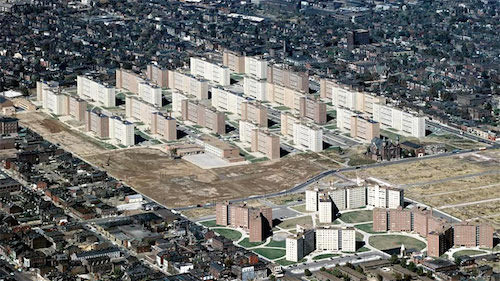
For less than 20 years 33 towers stood on 57 acres on the city’s near-north side (map).  Pruitt-Igoe was a failure of massive proportions. The reasons are numerous and complex.  The towers were razed over a two-year period starting in 1972.  Since then the site remained (mostly) vacant.

I continually hear people make the false claim the site has remained vacant because of the old foundations that were left in place.  To debunk this often repeated myth I turned to the person that would know best: Martin Braeske.

Braeske, a planner formerly with St. Louis County, was working in the planning office for the St. Louis Public Schools in February 1994 when they broke ground on the Gateway Middle School for Science and Technology to be built on a portion of the former Pruitt-Igoe site.  Braeske, now retired, is an Adjunct Professor at Saint Louis University.  So I emailed my one-time instructor and asked him his thoughts on the foundations preventing site development:

Each tower had a partial basement for boiler and mechanical systems equipment. The ones we found were intact and simple filled in with dirt. We dug them out, punched holes in the bottom to equalize the water table and demolished the walls to about eight feet below the finished ground level. While this did cost a bit, it is not a major deterrent to redevelopment of the site.

The old foundations are not a big deal.  If anything has prevented development of the Pruitt-Igoe site it has been the city’s fragmented politics over the decades.  Late December 1992:

The federal judge overseeing the area’s school desegregation program is giving the St. Louis Housing Authority two weeks to hand over part of the old Pruitt-Igoe tract as the site for a $30 million magnet school.

U.S. District Judge George F. Gunn Jr. noted in his order that the federal court last year had approved the Pruitt-Igoe location as the site for the Gateway School.

In May, the St. Louis School Board filed an application with the Housing Authority to acquire 18 acres at Pruitt-Igoe, a public housing complex demolished in the 1970s.

The authority owns the property and the U.S. Department of Housing and Urban Development has a lien on the tract.

The Tenant Affairs Board, which represents public housing tenants, opposed the deal. It contended that under federal law it has the “first right of refusal” in land transactions that affect public housing tenants.

Gunn disagreed, at least regarding the Gateway case. In an order late Wednesday, he said the tenants’ board cannot block the Pruitt-Igoe deal. He pointed out that the site is a “vacant debris-strewn area” that has had no residents for more than 15 years.

He ordered the Housing Authority to disregard the tenant board’s intent to develop the site the School Board wants for Gateway School.
(Source: St. Louis Post-Dispatch 12/25/1992)

The remaining 39 acres are still vacant 15 years after the school opened, becoming an urban forest.  Interest in Pruitt-Igoe remains as strong as ever.  Local filmmakers are hard at work on a documentary on the project.  See their site at Pruitt-Igoe.com (under construction) or follow them on Twitter @PruittIgoe.

Pruitt-Igoe is known around the world.  I recently received this email:

My name is Phil Bosch. I’m an artist based in Holland who is coming this Oktober and November to St. Louis to work on a special video documentary project.  I would like to investigate the memories of former residents of the now defunct Pruitt-Igoe housing complex. For the citizens of St. Louis this place is still an open space in the city, like an inverted monument of a history that seems to be forgotten.

Slowly this housing complex seems to have taken on a mythological status.   My film will be a study on its mythological status on the one side and the realm of experiences of the former residents on the other. The goal of my project is to enter, imaginatively, this huge building complex, even though its physical appearance is no longer there to be seen. While the Pruitt-Igoe no longer exists physically, it still exists in the memory of the former residents. It appears that despite the negative aura of the complex (the death of Modernism, the site’s history of crime and vandalism), there is still a coherent social group in the area who meet regularly. Thus, my goal would be to search for memories of a place where many lives were connected by this architecture that no longer exists.

I would like to document these memories. First of all, I would like to video the site of Pruitt-Igoe, which now has been taken back by nature. Next, I would like to contact people who had lived there or who otherwise have memories of the buildings.

If you can help Mr. Bosch email him.

- Steve Patterson

Post to Twitter Post to Facebook

St. Louis’ Planning a Mess on so Many Levels

Steve Patterson September 23rd, 2009

Paul McKee’s NorthSide project may, eventually, be a good thing for the City of St. Louis and the entire St. Louis region.  But by that time most of us won’t be around.  We’ve had a 60+ year decline (1940-2000) and it will take at least 60 more to recover (2010-2070) from numerous past mistakes.

Looking at unused land (Pruitt-Igoe, 22nd Street Interchange, etc) as potential job centers connected by tree-lined boulevards and transit is sound urban planning.  But good urban planning in the community is best done by the community, not the private sector.

Famed planner (engineer actually) Harland Bartholomew guided much of the destruction of the city during his tenure, 1916-1950.  He rejected everything Jane Jacobs valued in cities.

The destruction continued after he retired his city job in 1950, guided by his 1947 Comprehensive City Plan.  Big picture planning basically stopped after he left.  Planning became seeking federal Urban Renewal & Model Cities money. In 1973 the Rand Corporation issued the report St. Louis: A City and Its Suburbs:

A summary statement of the research findings and policy implications of a series of studies conducted under the St. Louis project of the RAND Urban Policy Analysis Program. Three possible futures for the city are posed: continued decline; stabilization in a new role as an increasingly black suburb; and return to a former role as the center of economic activity in the metropolitan area. The analysis argues that without major policy changes beyond the local level, the city will most likely continue to decline, and suggests that, among the alternatives open to the city, promoting a new role for St. Louis as one of many large suburban centers of economic and residential life holds more promise than reviving the traditional central city functions. However, new resources, available to the city from sources outside the city, are essential to any improvement. Several mechanisms are offered for consideration: (1) a more substantial federal revenue-sharing program; (2) a state revenue-sharing program to support selected public goods; (3) a metropolitan revenue program, sharing revenue generated by industry in the metropolitan area; and (4) a metropolitan earnings tax.

This report shocked city leaders. The planning commission hired a consulting firm to update the 1947 Plan and to reverse the decline cited in the Rand Report.  The draft 1975 INTERIM COMPREHENSIVE PLAN was the city’s response.

The Interim Comprehensive Plan was introduced to the public as a replacement of the 1947 Comprehensive Plan . The City Planning Commission claims that the planning needs of St. Louis had changed over a period of thirty years and therefore the comprehensive plan for the City should change as well. This draft document was written for citizen review. The overall focus of this comprehensive plan was to provide citizens with the highest quality of life, socially, economically, and physically. The plan contains policies and recommendations for land use, transportation, public facilities and housing, all of which are aimed at establishing a quality residential environment, job opportunities, economic development, and expanded opportunities for the disadvantaged.

This never adopted draft plan is best known for the firm the wrote it, Team Four. The Team Four plan was urban triage — cutting off municipal services to those areas deemed too far gone.  Save what can still be saved.  Today this approach is applied to shrinking cities.   Back in the day it was viewed as a plot to drive black citizens out of the city. Many still feel that was the intent or would have been the result if the plan would have been officially adopted.

After the backlash against the Team Four plan the City of St. Louis got out of the big picture planning business kicking off the second 30 year period without a plan.

We look to the government to provide services where the private market has failed or those for the common good, such as fire protection.  But three decades of government being out of planning the primate market reversed the roles and developed their own plan.  Of course the private market’s main goal is profit.

Today’s residents, many not born when the city gave up on planning, are not willing to turn over community planning to a private business.  I don’t blame them.  So the first part of the mess is the city’s abandonment of planning.  Next is the realization that a businessman from St. Charles County wants to do the planning the city should have been doing.  Of course, the city has a poor track record of planning.

But the citizenry had an ideal of community planning so when McKee purchased thousands of properties people naturally got suspicious of his intentions.  Numerous meetings this year announced those intentions but poor community & media relations has made a bad situation even worse.  Myself and others of the media were barred from a meeting, a discussion board was set up by McKee’s company only to be taken down due to a mountain of criticism.  Uh, duh.

Tonight McKee is asking for public TIF funds to help finance his project yet a few days ago, at a public meeting, he objected to his statements being recorded on video.  In decades earlier deals could get done without such documentation by the public.  But it is 2009, not 1959.  Cameras are a fact today and public meetings are subject to being recorded.  Holding meetings in private to circumvent this reality is even worse.  Our elected leadership is not equipped to manage the conflict.

Parts of McKee’s plan are sound: developing the vacant Pruitt-Igoe site, using wasted land at the 22nd Street Interchange, planning for jobs at the landing of the new Mississippi River bridge, narrowing Jefferson Ave, and building a streetcar to tie the near North side into downtown, filling in gaps in the urban fabric.  Had these ideas come out of a community planning process most would be on board today.  Instead we have a huge mess with a substantial section of the city hanging in the balance.

I’m not sure which is worse; Harland Bartholomew’s highly planned destruction of 19th century neighborhoods, a 30-60 year gap in planning, or planning serving private interests.  None will lead to the city I envision St. Louis becoming.

See Matt Mourning’s excellent post With NorthSide Project, the Villain is in the Process for more thoughts on process (this sentence added 9/23/2009 at 7am.)

- Steve Patterson

Post to Twitter Post to Facebook

Sullivan Place Still Horribly Suburban/Disconnected

Steve Patterson June 10th, 2009

With details of Paul McKee’s NorthSide emerging there is concern he will bring suburban design to the city.  But developers have been doing that for years — often encouraged by elected officials that don’t get urbanity.  Three years ago I reported on one such suburban project — Sullivan Place.  I started the piece:

Pyramid, the company proposing a highly suburban McDonald’s for South Grand, has dumped an atrocious housing project on the city’s north side. Forget the high-profile loft projects downtown, Pyramid is making a name for themselves with suburban rubbish throughout our once urban neighborhoods.

Full post from March 18, 2006: Pyramid’s Sullivan Place Senior Housing An Anti-Urban Monstrosity.

Nothing much has changed except the fact that Pyramid collapsed in April 2008.   Oh yeah, the project can now be seen in satellite views via Google Maps:

[From Google Maps]

Gee, can you figure out which structure is Sullivan Place?

March 2006

Makes me cringe.   It borders 3 streets but doesn’t relate to any of them.  I’d love to see McKee’s project take this heep and restore the street grid.  The project gets its name from the street that was closed — Sullivan.  We are likely stuck with this place until it falls apart.  See my 20+ photos of Sullivan Place from March 2006 here.

Update 6/10/09 @ 9:10am — Headline alaborated.

Post to Twitter Post to Facebook

NothSide Project Has Potential to Transform St. Louis

Steve Patterson May 27th, 2009

For five years now Paul McKee of McEagle Properties has been acquiring properties in a large swath of land in the near North side of St. Louis.  These were purchased through a long list of holding companies such as Blairmont Associates LLC.  The first few years this was under the radar. But people, notably Michael Allen, began to notice the properties and their common ownership.

Many are upset about how events transpired.  Quietly buying property, little to no maintenance, and so on.  These issues have been hashed out here, on other sites and in the meeting on the 21st when a guy stood and called McKee a f-ing liar.  I’m not going to rehash it all again.  Instead I’m going to jump into the proposal.

McKee wants to partner with other developers to transform about 40 percent of the land inside a 2,100-acre redevelopment area over 15 years. McKee said he owns roughly 130 acres of the 430 acres he’d like to see redeveloped. Twelve new residential areas would be created and four new business campuses,  bringing 22,000 jobs.

The plan would include about 5.5 million square feet of office, retail and warehouse space, 10,000 new homes, 250 hotel rooms and developers would welcome improved or new schools. McKee said his business does not build homes, and would work with other developers on that and other aspects.

He’ll pursue federal economic stimulus money, state tax credits and tax increment financing, where he said a portion of the increased taxes resulting from the development would be used to pay for infrastructure improvement costs.  (Source: The Associated Press via Forbes.com, see Developer has $5.4B vision for north St. Louis)

Keep in mind I will graduate in December 2009 from Saint Louis University with a Master of Arts in Urban Planning & Real Estate Development.  In our course of study we look at policies, their cause-effect and the full complexity of issues surrounding planning & development.  I think because of this academic background I’m able to step aside from my anger at the loss of the warehouse at Cass & Tucker and the many other reasons so many are angry.  Three years ago my reaction would have been quite different.   So what do I think of the plan now that I’ve had a chance to see the proposal?

I like it.  I don’t like how we got to this point (Urban Renewal trashing North St. Louis, city dropping the ball, McKee coming in).  Typically we expect government to do what the private market fails to do.  Here we turn this around, the private market is stepping in where the public sector has failed:  planning. I like what it has the long-term potential of doing for the city.

To start let’s look at the project area so we know where we are talking about:

20090522_city_developmentboundary

Source: McEagle Development

Here is the same image cropped to give you a close up of the proposed redevelopment area:

20090522_city_developmentboundarycrop

The carefully drawn boundary line includes some property but excludes others.   Here is the boundary laid on top of an aerial image:

20090522_devbound_aerial

20090522_devbound_aerial_crop

For at least a couple of decades now the city should have been doing some big picture planning (beyond a single ward) to figure out how to bring new life to this part of North St. Louis.  But they didn’t.  The Pruitt-Igoe site has sat vacant for 35 years.  Old North St. Louis, adjacent to the project area, has taken decades ( and plenty of tax credits) to get where it is today.  Same for downtown and much of the city.

McKee’s plan calls for four job centers — large sites suitable for one or more companies to have a new campus setting.  No surprise here, this is what McEagle does in suburban areas.  This is a chance to get these jobs (and taxes) in the city.  I was not able to obtain the image with the four marked sites so I have indicated them in blue below:

Starting in the upper left and going clockwise we have Jefferson @ Parnell, where the new Mississippi  bridge will land near Cass, the 22nd street interchange and finally in the middle left, the long-vacant Pruitt-Igoe site.

If we think about the process of redeveloping a large area you can do what Richmond Heights did with the Hadley Township area.  Draw a boundary and put all the properties inside up for development proposals.  Not surprisingly the residents there who’ve lived in flux while proposals came in picked not the best plan but the plan that would give them the most for their homes.  After being in play for several years the owners were told the developer couldn’t come through.  Same thing happened in Sunset Hills and elsewhere throughout the country.  Often municipalities put areas up for development not because they are distressed but because they are chasing limited sales tax dollars.  McKee has gone a different route.  One based not on Ward boundaries but on where development potential exists.

While I love the rebirth happening in Old North St. Louis, without some serious infrastructure investment we’d not see much happening in the outlined development area.

“A tax credit for one man” is often heard about the Missouri Land Assembly tax credit written by McKee’s attorney.  To be precise it is a tax credit for one company.  But many companies will be involved.  Others own land within and adjacent to the development area, including individual owners.

TIF financing will be used, no doubt, to fund massive improvements in public infrastructure, bridges, roads, sidewalks, sewers, etc.  Will McKee & company make money?  Yes, of course.  We all need to make money.  The question is if the outcome will justify the level of public investment.  I hope so.  I’m waiting to review the financing proposals. Remember that a “TIF” is tax increment financing.  As property taxes rise due to the development that increment of increase is paid by the owner — yes, they pay the higher tax.  That increment is used to pay off bonds used to build public infrastructure.  Development & infrastructure are both needed here.  The city doesn’t have the money to build the infrastructure to attract the development.  McKee’s proposal may be the only way to redevelop this section of our region.

I am excited about the potential this project brings to the city & region.  A chance to get some large new employers — or to retain the ones we’ve got.  A chance to change perceptions about North St. Louis.   A chance to fill in the many gaps in our building stock.  A chance to add needed population.  A chance to get a modern streetcar/trolley line connecting the project area to downtown.  A chance to get thousands of parcels of land out of city ownership.

Before someone suggests I was bought off I can assure you I’m still a struggling grad student.  I’ve met Paul McKee twice — the 1st time 3-4 years ago at a meeting of the Dardenne Prairie Board of Aldermen.  The 2nd time was at McKee’s presentation last Thursday.  This 2nd time he knew who I was and he offered his card.  After a couple of emails I got the above images out of him, nothing else.

But while I like the big picture planning involved I have reservations about the follow through on the project.  Paul McKee promised New Urbanism at WingHaven but delivered a half-assed cartoon version.  The St. Louis Board of Aldermen, as a general rule with a few exceptions, do not get what compromises walkable urbanism.  How will they know what to require of McKee? To be sure our old 1947 zoning needs to be tossed aside for this area.  A new form-based code needs to be laid over the project area to guide future development to ensure we get what we are promised.

I want this project to succeed — financially & urbanisticly.  I want to live along the trolley line.  I want St. Louis to be a city of 500,000 people again in 20-25 years.

Selected articles for further reading:

Post to Twitter Post to Facebook

The History of Problems in North St. Louis

Steve Patterson May 26th, 2009

My intent for today was to summarize Paul McKee’s development proposal being dubbed ‘NorthSide.’  In starting to write that piece it became clear I needed to build a foundation on the origins of the current problems in North St. Louis. So today I take you through decisions from the 20th century that got us to where we are and tomorrow I’ll give you my thoughts on McKee’s proposal.

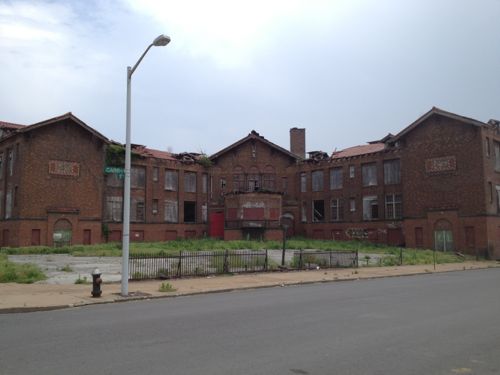
North St. Louis has many great streets, buildings and people.  But it has as many streets that are largely abandoned, buildings barely standing, vacant lots and criminally minded youth.   It is known more for the latter than the former.

Above: North St. Louis property in August 2007

Above: North St. Louis property in August 2007

When I moved to St. Louis in August 1990. at age 23, I was told not to go North of Delmar Blvd. — the long dividing line between white and black St. Louis.  I ignored the advice, however well-intentioned,  from the 50-something apartment manager and went North of Delmar.  The following year I moved to the Old North St. Louis neighborhood.  But how did this dividing line come to exist?  For the answer we need to start way back in 1917.

Harland Bartholomew came to St. Louis in 1916, at age 27, after working briefly in Newark, NJ as an employee of civil engineers E.P. Goodrich & George Ford.  Bartholomew was the first municipal planner in the country.  Yes, St. Louis was the leading edge for planning at the time.  Of course, planning as a profession was just getting started.  The 1910 Census was 557,238.

Upon his arrival Bartholomew located his family in a relatively new house on Goodfellow near Page (map).  Although within the city’s limits, it was very suburban relative to the older parts of the city near the Mississippi River.  His 1917 report, The Problems of St. Louis, shows his dislike of the older sections of the city surrounding downtown.

problems_of_st__louis_cover1

Above: 1917 book, click to view book

From the above:

The problems of St. Louis are briefly as follows :

(1) Restoration of districts wherein values and occupancy are at a low ebb to a greater degree of usefulness and productivity.

(2) Perfection of transportation and transit systems to make possible the use of property within the zone of the city’s influence, now inaccessible,

(3) Extension of the city limits, or power of the city, to secure greater uniformity and permanency of  development.

(4) Provision for public works and service sufficiently far in advance to preclude undue delay and excessive expense.

The problems then are still the problems today.  Bartholomew spent the next 30 years telling the city how bad the older areas are.  Bartholomew, for example, convinced voters to approve fund measures to widen many streets which involved cutting off the fronts of many buildings, see The History of the Ubiquitous Building Setback Line.   Jane Jacobs in her 1961 classic The Death and Life of Great American Cities called such funds “cataclysmic money.”  The Census count was 772,897 by 1920, 821,960 by 1930 and, a down a bit to 816,048 in 1940.

In 1947 Harland Bartholomew, now nearly 60, authored the Comprehensive City Plan which considered much of the city, North & South, “obsolete” or “blighted:”

1947 "Obsolete" (black) & "Blighted" (red) map.

In the above image North St. Louis is on the right.  Delmar runs top to bottom a bit right of center.  Clearly much of the city, mostly white, was labeled obsolete & blighted.  But what did that mean?

Obsolete Areas

Present obsolete areas must be cleared and reconstructed. This is a social necessity as well as an economic essential. The City of St. Louis cannot continue to thrive and prosper where there is nothing but progressive decadence in its housing supply, any more than is could with polluted water supply or smoke laden air.

The unit area for reconstruction must be the neighborhood. It is necessary to create a new environment. This can be accomplished only by large scale operations. Obsolete neighborhoods must be rebuilt, not merely with houses of good design and construction, but with more open space, more park and playground facilities, a good school and community center.

The new Constitution of Missouri authorizes cities to clear obsolete areas and to sell or otherwise dispose of the property, as well as to replan, reconstruct, or redevelop such cleared areas. The new Constitution also authorizes the General Assembly to provide by law for partial relief from taxation for not to exceed 25 years for projects designed for the reconstruction or redevelopment of obsolete areas. A newly enacted Urban Redevelopment Corporation Act now provides for substantial tax relief for reconstruction projects. It should make possible considerable large scale reconstruction.

The Legislature has not enacted legislation which will permit St. Louis to undertake public housing projects of the type heretofore financed with Federal funds. Such legislation is imperative if St.Louis is to participate, as do other American cities in any future Federal public housing programs.

Present high costs of building construction together with rent controls preclude immediate reconstruction of obsolete areas, either for public or for private housing. As construction costs become lower the city must be in a position to encourage wholesale reconstruction of these obsolete areas. This can be achieved by public acquisition of land so that it could be made available for housing and other needed purposes if private acquisition and construction fails to accomplish the needed results. The total cost of clearance would scarcely exceed public expenditure during the past 25 years for other types of public work such as streets, sewers and airports. Unlike these, however, ownership of the land would be a sound investment. The land could be leased or sold, and much if not all of the expense involved could be recovered by (1) elimination of the present $4,000,000 annual deficit, (2) a long-term increment in taxable revenues on private housing projects, and (3) participation in Federal subsidy programs.

Plate Number 15 is a suggested plan for reconstruction of two extremely obsolete neighborhoods-DeSoto and Carr Neighborhoods. This plan calls for reconstruction of these neighborhoods, except for the present Carr Square Village, into super residential blocks with a revised street system that would recognize this block type of development and discourage through traffic; Fourteenth Street, Eighteenth Street, Twentieth Street and Jefferson Avenue would be widened while Cass and Franklin Avenues would remain as they are. Further proposals call for the grouping of commercial areas into designated shopping centers; the erection of two or three story row type apartment buildings generally except for a few multi-story apartment buildings; the erection of two new schools one east of Jefferson and the other between 18th and 20th at O’Fallon; the continuance of certain unobjectionable industries, the enlargement of Carr Park adjacent to Carr School; the development of DeSoto Park for active sports, swimming and as a community center; the enlargement of Murphy Playfield adjacent to the Carr Neighborhood on the north and the provision for landscaped areas throughout the community for passive recreation.

The effectuation of this plan would result in a good standard of housing with ample open space, freedom from multiplicity of small streets, attractive environment, small concentrated shopping areas, and a large neighborhood park and community center would replace one of the worst slums in the city. This is an area occupied by low-income families, many of whom should be rehoused here.

Plate Number 16 is a plan for the reconstruction of the Soulard Neighborhood. Some of the more important features of the plan are: the extension of Gravois Avenue from Twelfth Street to the proposed Third Street Interstate Highway, providing a direct route to the central business district; the widening of 18th Street, the widening and extension of 14th Street, the widening of Park and Lafayette Avenues; underground garages in the multi-storied apartment area between 12th and 14th; a neighborhood part of 10 acres or more complete with spray pool, community facilities and game courts; the extension of Lafayette Park to serve this as well as other neighborhoods; landscaped areas throughout the community for passive recreation; enlargement of the City Hospital area; grouping of commercial areas into orderly shopping centers and the complete reconstruction of the neighborhood into super residential blocks with a new street pattern to serve these blocks and to discourage through traffic.

Such a plan would transform an obsolete area into a fine residential neighborhood with a good standard of housing, enlarged open areas, greatly improved environment, small concentrated shop centers, and much needed park and recreation space. The new interstate highway passes diagonally through this neighborhood and could be most advantageously undertaken simultaneously with the reconstruction. This is an area well suited for families of medium incomes.

The plan sought to clear and reconstruct a vast area.  It had nothing to do with race - these areas were largely white.  It had everything to do with Bartholomew’s inability to see any value in these older areas.   Blighted districts, Bartholomew thought, didn’t need clearing but he clearly wasn’t a fan:

Blighted Districts

The blighted districts should be extensively rehabilitated before they degenerate into obsolete areas. This is both a social need and an economic essential because of high rates of juvenile delinquency, crime, and disease found in areas of poor housing.

Rehabilitation of blighted districts must be undertaken on a neighborhood basis also in order to protect environment and to create improved living standards. Because of the larger areas involved, special planning and experimentation is required. Obsolete buildings should be removed, some streets should be closed, new park, playground and recreation areas created, small concentrated shop areas established, and individual buildings should be repaired and brought up to a good minimum standard. The new Constitution of Missouri specifically provides for this type of rehabilitation. There is fully as much opportunity for private enterprise in this field as in the more spectacular large scale reconstruction housing projects.

The most important single requisite for the improvement of housing in St. Louis is the enactment of a Minimum Standards Housing Ordinance. The City Plan Commission, the Building Commissioner and the Health Department with the aid and assistance of the American Public Health Association, have collaborated in the preparation of such an ordinance which provides for:

1. Elimination of overcrowding by prescribing minimum standards of space per family and per person.
2. The number, area, and openness of windows permitting entrance of fresh air and natural light.
3. Screens on doors and windows to restrict flies and mosquitoes.
4. Elimination of basement rooms as dwelling units unless they comply with the provisions set forth in the ordinance.
5. Improvement of sanitary conditions by elimination of hopper water closets and privies in sewered areas within six years of effective date of ordinance.
6. The location of water closets and the number of persons using them.
7. Keeping dwelling units in a clean, sanitary, habitable condition and free from infestation.
8. Maintenance and repair of dwellings necessary to provide tightness to the weather and reasonable possibilities of heating.
9. Installation of flues which would permit the operation of heating equipment to maintain adequate temperature in each habitable room.
10. Adequate daylight or fixtures for artificial illumination in public halls bath rooms and other habitable rooms.

Unless and until such an ordinance has been adopted and enforced, most housing areas in St. Louis will continue to deteriorate and blighted districts and obsolete areas will reach much greater proportions than at present.

The rehabilitation of blighted areas is the No Man’s Land of housing. It is more important than reconstruction of obsolete areas. It is a field that has been completely neglected partly because it is less spectacular than large scale reconstruction and partly because the opportunities for profitable investment are presumably less than in a new development. Without a definite plan for the rehabilitation of the present blighted areas new obsolete areas will develop faster than present areas can be reconstructed. Plate Number 17 illustrates the manner in which neighborhood rehabilitation should be undertaken.

So the message was clear in 1947, these areas were going to change.  The 1947 plan added to the pressure for whites to move to the suburbs. Soon race would be another.

At the time most of these areas were off limits to non-whites.  Blacks had few choices about where to live.  One choice was The Ville, located in North St. Louis:

The Ville is not St. Louis’ earliest Black community, but it is certainly the most cherished. When elder Black folks talk of their old St. Louis they remember the area bounded by Taylor Avenue, St. Louis Avenue, Sarah Street and what is today called Dr. Martin Luther King Drive. Though embattled with middle-class flight to the suburbs, underemployment, and other ills, it remains a close-knit community of churches, schools, social institutions and residences. Fortunately, the Ville was never dominated by high-rise public housing.  (Source: Soul of America)

At the same time much of the city, where blacks still couldn’t live, was being set up to be cleared or rebuilt.  But soon blacks would be able to move beyond a few areas like The Ville:

In 1945, a black family by the name of Shelley purchased a house in St. Louis, Missouri. At the time of purchase, they were unaware that a restrictive covenant had been in place on the property since 1911. The restrictive covenant barred “people of the Negro or Mongolian Race” from owning the property. Neighbors sued to restrain the Shelleys from taking possession of the property they had purchased. The Supreme Court of Missouri held that the covenant was enforceable against the purchasers because the covenant was a purely private agreement between the original parties thereto, which “ran with the land” and was enforceable against subsequent owners. A materially similar scenario took place in the companion case McGhee v. Sipes from Detroit, Michigan, where the McGhees purchased land subject to a similar restrictive covenant. The Supreme Court consolidated the two cases for oral arguments.  (Source: Wikipedia)

The Shelley house is in the 4600 Block of Labadie (map), just a block outside of The Ville.  In 1948 the U.S. Supreme Court, in Shelley v. Kraemer, agreed that restrictive covenants are private agreements but state enforcement of them violated the 14th Amendment to the Constitution.   Blacks were now legally free to buy where they pleased. Easier said than done.  More on that in a bit.

By 1949 Congress passed the Housing Act of 1949 that funded large scale “Urban Renewal” schemes like those envisioned by St. Louis’ Bartholomew and New York’s Robert Moses.

Bartholomew predicted by 1970 St. Louis' population would pass one million and we'd live in newly rebuilt high density housing.

The 1950 Census was St. Louis’ peak at 856,796.  In  the next 20 years (1950-1970) the population didn’t pass the million mark as Bartholomew had predicted.  Instead it fell 25% to 622,236.  Real Estate agents in these decades engaged in blockbusting and steering.  They determined which streets, blocks and neighborhoods would quickly shift from all white to all black.  And although some whites live North of Delmar and some blacks lived South of Delmar the dividing line was established.   North St. Louis has come to be viewed by all as black.  As time marched on white flight was followed by black flight, leaving North St. Louis with fewer total residents, more and more who were poor & black.

Many public housing projects were built on the near South side & near North side.  The most well known was Pruitt-Igoe, which opened in 1955.  In 1956 the Pruitt (black) - Igoe (white) project became integrated.

Above: Pruitt-Igoe (click to view Wikipedia article)

Above: Pruitt-Igoe (click to view Wikipedia article)

Within a decade the 2,870 apartments were only 2/3rd occupied.  In March 1972 the first of the 33 buildings were imploded with all being demolished within two years.  Planned as the type of project to rebuild a former Polish slum, Pruitt-Igoe didn’t last 20 years.

The RAND Urban Policy Analysis Program released 3 reports on St. Louis in 1973 including St. Louis: A City and Its Suburbs: By: Barbara R. Williams.  The following is the official summary:

A summary statement of the research findings and policy implications of a series of studies conducted under the St. Louis project of the RAND Urban Policy Analysis Program. Three possible futures for the city are posed: continued decline; stabilization in a new role as an increasingly black suburb; and return to a former role as the center of economic activity in the metropolitan area. The analysis argues that without major policy changes beyond the local level, the city will most likely continue to decline, and suggests that, among the alternatives open to the city, promoting a new role for St. Louis as one of many large suburban centers of economic and residential life holds more promise than reviving the traditional central city functions. However, new resources, available to the city from sources outside the city, are essential to any improvement. Several mechanisms are offered for consideration: (1) a more substantial federal revenue-sharing program; (2) a state revenue-sharing program to support selected public goods; (3) a metropolitan revenue program, sharing revenue generated by industry in the metropolitan area; and (4) a metropolitan earnings tax.

In response local firm Team Four was hired to look at the problems facing the city:

1976 CITY WIDE IMPLEMENTATION STRATEGIES: THE DRAFT COMPREHENSIVE PLAN

This document contains the technical memorandum that was submitted to the Plan Commission by Team Four, Inc. in 1975. This memorandum proposed public policy guidelines and strategies for implementing the Draft Comprehensive Plan that was prepared by others. It offered a series of considerations concerning the process of adopting, staging, budgeting and ultimately implementing the Draft Comprehensive Plan. In addition, this document contains a preface dated 1976 that attempts to clean up any inconsistencies and or controversies surrounding the proposed implementation strategies and a bibliography or annotated listing of Technical Memoranda and Appendixes. Part I of this document focused on strategies for three generic area types: conservation, redevelopment, and depletion areas; and Part II of this document discussed major urban issues and their solutions. (Source: Summaries of Historical Planning Documents, City of St. Louis)

This last document will forever be known as the “Team Four” plan.  It called for a triage approach to the city.  Letting areas that are too far gone to die, focusing resources on areas that could be saved.  Increasingly this meant white areas would get help and black areas would not.  The Team Four plan was never officially adopted but many feel it became the unofficial policy of the city.  Bartholomew’s 1947 Comprehensive Plan was the last city-wide plan adopted.

The city basically stopped trying to any planning.  People continued to leave.  By 1980 the Census count452,801.  In 1990, the year I moved to St. Louis, the Census count dropped below 400K to 396,685.

In the late 1990s the city embarked on the 5th Ward Comprehensive Master Plan.

By the time the plan was adopted by the Planning Commission in March 2002 the boundaries of the 5th Ward had changed as a result of the 2000 Census (now at 348,189).  No regulatory changes were made in the planning area to ensure the plan would be followed.

In 2005 the city adopted a new Strategic Land Use Plan.  But the old zoning and land use designations remained unchanged.  New more thoughtful & appropriate ideas alluded to in this new land use plan never materialized.  We remain stuck in 1947.

Developers have been free to build just about anything anywhere they pleased.  In 2006 I reported on the project by the now-defunct Pyramid Construction, Sullivan Place (see, Pyramid’s Sullivan Place Senior Housing An Anti-Urban Monstrosity).

The decline of North St. Louis goes back farther than anyone reading this blog post.  St. Louis basically stopped trying to plan their way out of decline — perhaps the best option.  Tomorrow I’ll look at the plan by Paul McKee to reverse this long trend.

Post to Twitter Post to Facebook

Next »