Poll: Should Driver’s Retake The Driving Test When They Get Older?

I have friends now dealing with elderly parents, including facing the difficult decision to take away their keys or at least convince them to not drive at night. My brothers and I were getting close to this dilemma after our our father had a few minor accidents, and one that totaled his car.  He bought a replacement car but shortly thereafter he became ill and passed away at age 78, saving us from what would have been a very difficult discussion. My father had expressed to me his fear of not being able to drive.

I also have close relatives & friends at or quickly approaching 65 years of age. With people living longer and Baby Boomers now turning 65 this become an increasing issue. Neither of my grandmothers drove — ever — but they were born in 1902 & 1905. Today’s seniors likely have been driving since they were teens.

Letters like the following letter to the editor in a Pennsylvania paper will be increasingly common:

Editor, the Record:

In regard to the article stating that older drivers are more to blame for auto acidents, it doesn’t sit too well with me and other senior citizens in the area.

First of all, we’re not in any hurry to get anywhere, so we don’t speed. We don’t gander, looking out the window while driving — we’ve already seen it all. Very few us us drive at night. So I don’t think the privilege of driving a car should be denied us. We don’t all have family members at our disposal to take us to the doctor, grocery shopping, etc.

And I’m sure you won’t find any bags of heroin or other illegal articles in our trunks.

I drive back and forth the the Loder Senior Center five days a week to have lunch and visit with other folks my age. Without my car, this wouldn’t be possible.

LAURA (mcwilliams) kappes

East Stroudsburg

But senior drivers are a cause for concern:

While traffic fatalities are down across the country, older drivers still account for a “disproportionately high share” of the casualties.

[snip]

Consider this: One in every five drivers will be 65 or older by the year 2025, the report found. (STLtoday.com)

The report mentioned above  was released this month from the American Association of State Highway and Transportation Officials:

With the first wave of the Baby Boom Generation turning 65 in 2011, the number of older Americans and their share of the population will begin to grow significantly in the coming years. And as this generation continues to age and grow, it will demand a level of mobility and an active lifestyle that far outpaces any of America’s previous generations. This aging population will both create and face significant transportation challenges, including a transportation system that lacks many features that would accommodate the level of mobility and safety older Americans desire and expect. Transportation innovations to accommodate the Baby Boom Generation’s need for improved safety and mobility will benefit users of all ages. (Full report: Keeping Baby Boomers Mobile: Preserving Mobility and Safety for Older Americans)

Regular readers know I advocate making our regions more pedestrian & transit friendly, partly to help out our aging population. Regardless of that, many seniors will want to keep driving so the issue of testing comes up:

There was strong support for testing senior drivers, with 76% favoring drivers over the age of 75 to take a driving test every two years. A majority of American drivers also indicated they would support requiring expanded road testing of already licensed drivers. Nationwide, 56% said drivers should be required to take a road test every 10 years, and 76% said those who have their license suspended or revoked as the result of a moving violation should have to take a driving test to get it reinstated. (Source)

The poll this week asks your thoughts on retesting drivers. The poll is in the right sidebar — mobile users need to switch to the desktop layout to vote in the poll.

– Steve Patterson
 

Transit Union Seeks Input From Riders

Over the next two weeks The Transit Riders Union of St. Louis is hosting three “transit talks” to discuss with actual riders what we’d like to see done to improve local public transit. I’m on the steering committee. Here was our post:
In March we’re hosting a series of discussions focusing in the needs & issues of regular transit riders. Please come and tell us the areas you want your Transit Riders Union to work on improving.

We want everyone that uses Metro to join us so come as you are.

Monday March 12, 2012 (evening)

Tuesday March 20, 2012 (lunch hour)

Wednesday March 21, 2012 (evening)

Please plan to attend at least one of these discussions!

Everyone is welcome too attend and all are free. Again, we want to hear from actual transit riders.

– Steve Patterson


2617 Olive Older Than It Looks

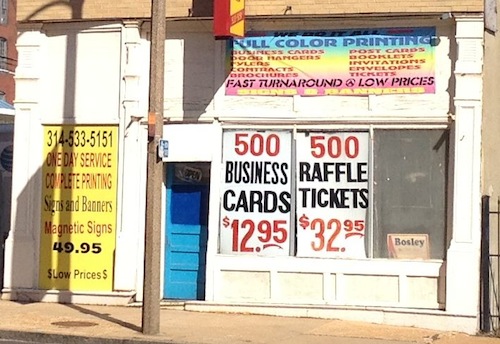
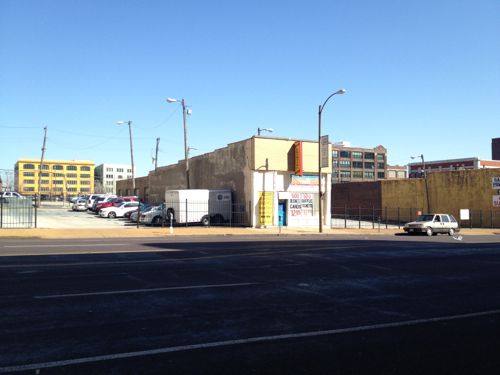
The other day I noticed a nondescript little building I’d driven past hundreds of times but never payed attention to before. This day I was a pedestrian and it caught my eye.

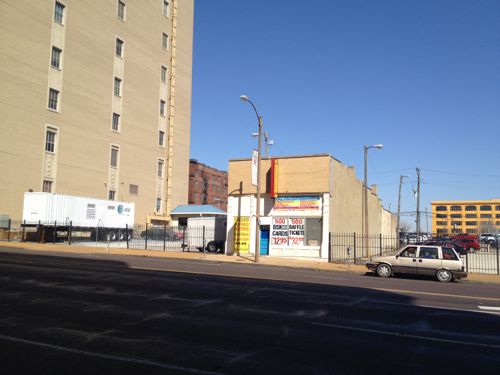
The one story building at 2617 Olive is easy to overlook, halfway between Sam Light Loans and AT&T, it just disappears. From across Olive the storefront caught my eye.

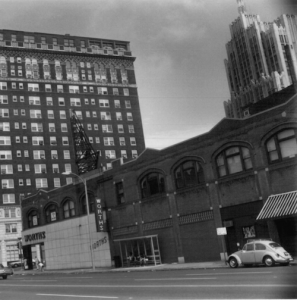
Cast iron? At home I looked it up on city records and it says it was built in 1883! A 1907 Sanborn Fire Insurance map shows the building as being 3-stories in height and having a stone front, one of a group of eight such storefronts.
The point? None other than I found it interesting.

– Steve Patterson


Walkability Impacts Number of Pedestrians Using Sidewalks & Transit

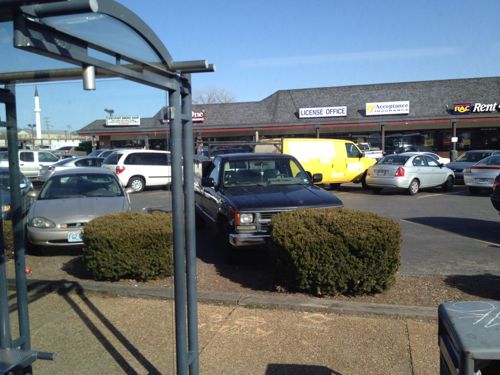
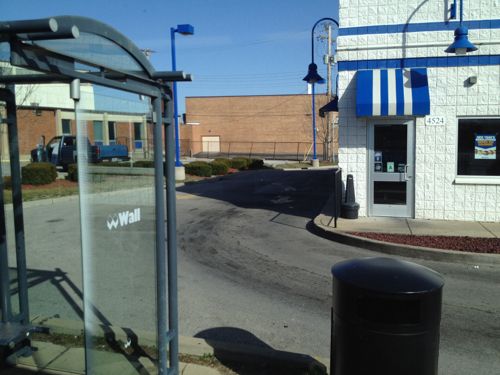
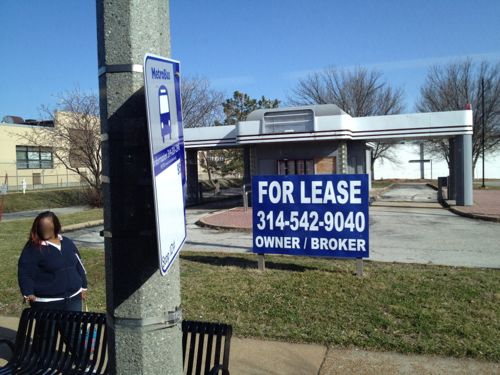
The form our buildings take has a direct connection to the number of pedestrians on the sidewalk: streats lined with urban buildings will see more pedestrians than those with anti-urban buildings (read: suburban). Transit riders are pedestrians on part of their journey, but many of us have no choice but to be pedestrians in unfriendly places where few pedestrians are spotted. On a recent ride on a packed #95 (Kingshighway) MetroBus this became clear.

ABOVE: Car storage separates pedestrians at the bus stop from numerous businesses.
ABOVE: The able-bodied can get inside but not everyone can
ABOVE: Eventually this building will get reused or replaced, but will pedestrians have access?

We don’t design buildings to be used by pedestrians. Sure, some will say there are no pedestrians so why should we? I say there are few pedestrians in many places because that is the result of decades of anti-urban policy.

 – Steve Patterson


Readers Agree: Biondi Destroyed The Formerly Urban Midtown Area Around Saint Louis University

March 7, 2012 Featured, Midtown, SLU 63 Comments
ABOVE: SLU bought and razed the urban Marina building

The majority of the readers that voted last week agreed that Saint Louis University President Biondi has destroyed midtown since 1987 — a decade after it became a historic district on the National Register of Historic Places. Here were the final results:

Biondi has destroyed the formerly urban midtown area around the Saint Louis University campus:

  1. Strongly agree 78 [40.41%]
  2. Somewhat agree 48 [24.87%]
  3. Strongly disagree 41 [21.24%]
  4. Somewhat disagree 12 [6.22%]
  5. Neutral 7 [3.63%]
  6. Other: 7 [3.63%]

The “other” comments were:

  1. It was destroyed long before he got there; he hasn’t done enough to renew it.
  2. By Urban do you mean the drug infested Laclede Town?
  3. responding to his market,suburban parents wont send kids to school in “the hood”
  4. I don’t know.
  5. He isn’t responsible for all of it, but he most certainly has made it worse.
  6. I wasn’t here back then.
  7. Biondi could have done so much better … so much better.

The original post (Agree or Disagree: Biondi has destroyed the formerly urban midtown area around the Saint Louis University campus) generated many comments on both sides of the issue.  I’ve pulled some of my favorite comments of the more than 60:

  1. In an architecturally signigicant urban district, there is a great difference between demolition for re-purpose and demolition for grassy lots and parking.
  2. Soulard hardly had critical mass when people started rehabbing it in the 70s. it was a slum with a 50% vacancy rate, and city “leaders” had designated it as blighted and marked it for wholesale demolition. It had even been gashed in half by the highway, just as Midtown is gashed by the train yard. moreover, people DO live and/or work in Midtown. and more people COULD live there if SLU would stop demolishing homes and buildings that could be converted to residential (like the Metropolitan and Pevely). how are people supposed to live in fountains and sculpture parks?
  3. Midtown Alley has been developing over the last decade arguable independent of SLU, and on some levels in spite of SLU’s intervention.
  4. I attended SLU from 1970 to 1974. I lived in Laclede Town my junior and senior years in college. Many a night I walked or rode my bike home from Piux XII libary to my apartment on Ewing Avenue. I also worked evenings at 3800 Lindell, which was occupied by IBM at the time. I was never afraid for my safety because there were always people about, either on campus or walking up Lawton Place in Laclede Town. Would I do that same walk today? Absolutely not. Why: Because after 5:00PM, the entire stretch of land from what used to be Channing Avenue to Ewing is totally deserted most nights, the perfect setting for a crime. The last time I was in St. Louis, on a beautiful summer afternoon, the entire area was completely deserted with no pedestrians in sight and little, if any vehicular traffic. What is wrong with this picture?The City of St. Louis SLU conspired to get rid of Laclede Town, and once again both institutions were extremely short sighted. Having lived there and visited all sections, Park, Town, East and West, all 1000+ of those apartments could have been rehabbed and adapted to today’s modern standards and once again made a viable, walkable urban communhity. But once again, the slash and burn attitudes of SLU and the complete dysfunction at St. Louis City Hall prevailed and what you have today is the veritable no man’s land 2/3 of the time. And don’t tell me AG Edwards couldn’t have expanded the way it did if Laclede Town was still there. God knows there’s is still enough vacant, underutilized land in that area with plenty of room for AG Edwards and a lot of other companies to grow and expand. This slash and burn tactic is now being used to isolate the medical center from the greater city.

    I expressed my feelings about this destruction of the city to Biondi via email, and surprisingly, he responded. Not surprisingly, he was a total, arrogant tool in his response, basically telling me I didn’t know what I was talking about. I have news for Biondi and his supporters in STL: if he were at St. Joe’s here in Philly, or Fordham in NYC, he’d wouldn’t be allowed to do a fraction of the things he has done in STL. If Biondi is upset about the grief he’s getting in STL, he’d be seething in rage if he tried that crap in Wynnewood where St. Joe’s is located. He’d need an asbestos suit for the firestorm of flack he’d get.

  5. It disturbs me that Biondi and SLU doesnt care that it they have a huge image problem with the urban educated middle class – the very people that should (and do) support SLU and importantly as well the city around SLU. Boy, he needs to go sooner than later.
  6. I have lived in bombed crime infested areas all over the United States, and I am sure I would have walked around the area.
  7. There is also a light rail station just down the street on the Grand Ave Bridge connecting with the Airport, Galleria etc. The point is that if you do not complement transit with appropriate urban planning the it harms the success of transit. By designing the Doisy Center and the new medical center to be exclusively auto orientated it devalues huge public investments in mass transit. not to mention in making it more difficult to make the city a walkable environment by creating parking and open space wastelands. (The Doisy Center is not parkland, even the fountain on Lindell and Grand is a unused joke of a space, not to mention the ridiculous sculpture garden across the street)
    Again, check it out, the great cities of the world balance walking, transit and the automobile. Check out classical city planning also. Biondi is basically giving the finger to the City and to the people of St. Louis.
    So I guess you, like Biondi have a problem with balance, is that it?
  8. I’m 64 and remember the area well, saying it was not safe must mean you didn’t come into the city at all, Soulard, Lafayette Square and the West End were hardly in better shape at the time. I felt safe, I even remember wandering through the derelict Fox Theater, standing wide open in those days. The space above the ornate ceiling is amazing.
    You sound like you are afraid of your own shadow. Nor are we talking about Pevely Corporation, we are talking about the extremely poor decision making of Biondi. As I point out above Wash U. shows how it is done. You are projecting your negative views saying only chains will be able to afford the commercial space. At least there is commercial space for locals to compete for, unlike Biondi and his hysterical, self serving agenda.
    Biondi is nothing more than a greedy gangster supported by the useless City Government that lack the balls to stand up to even the dumbest morons that happen to have access to money.
    Biondi’s plan would be laughed out of most city halls in the world. These are cities that put the concerns of the public over self serving developers.
    It is absurd we even have to be talking about this, Biondi has so many other options that it is clear his underlying hate of the public drives his agenda. It can be nothing else. He certainly isn’t a peacemaker, a leader, a holy man or anything positive, face it, he is a jerk.
  9. I went to SLU 55-57. Lived on North Grand near Sportsman’s Park, before it was Busch 1. It was a real city then. Took the Grand Streetcar to Lindell for classes; ate at the deli (Carneigies?) on Olive just west of Grand; would stop at a huge billards parlor over the deli and shoot a game or two for relaxation; would stop in a little bar east of grand on Lindell for a beer or two before taking the streetcar back to my apartment; would take the streetcar back to Washington, grab the Delmar bus to Stix, Baer & Fuller (became Dillards; then the hotel/apartments) to sell women’s shoes. A bus or streetcar came every couple of minutes so REAL public transportation existed.
    After graduating, went across Grand to work at IBM on the South East corner of Grand/Lindell. Loved going to the Fox; the Missouri; the Shubert; the St. Lous; the Empress movie theaters in the 5 block area whenever we felt like it. The Melbourne hotel had a great bar loaded with after work guys and gals.It was no different from my neighborhood as a kid, an apartment at Delmar and Kingshighway. Look at the area now. Hiroshima Flats. There were at least 5 hotels in a four block radius and they were packed. I could go on, but you get the picture.

    The picture is … this was a city. People lived in the city day and night. They didn’t come into the city. We WERE the city. Of course we had 800,000 people IN the city then. Now it’s 350,000. That alone explains the lack of people. We also do not people willing to invest in the city. Take the “Bottle District” and “Ballpark Village”. Perfect examples. When we quit thinking in terms of Ladue, Clayton, etc. and think ST. LOUIS, it will continue to be a difficult battle to get back to what we were.

Biondi needs to step down and the entire community nerds to work on a plan that will reorganize this part of midtown over the next 25 years.

– Steve Patterson


Advertisement


[custom-facebook-feed]

Archives

Categories

Advertisement


Subscribe