The 21st Century Plane: Solar Impulse
The 1947 St. Louis Comprehensive Plan called for 35 airports in the metropolitan area by 1970. Yes, 35!
It is reasonable to assume that the developments in air transportation during the next few decades will parallel that of automobile transportation, which really started about three decades ago. St. Louis must be prepared to accept and make the most of conditions that will arise. Provision of the several types of airfields required must be on a metropolitan basis. The recently prepared Metropolitan Airport Plan proposes thirty-five airfields. (see plan)
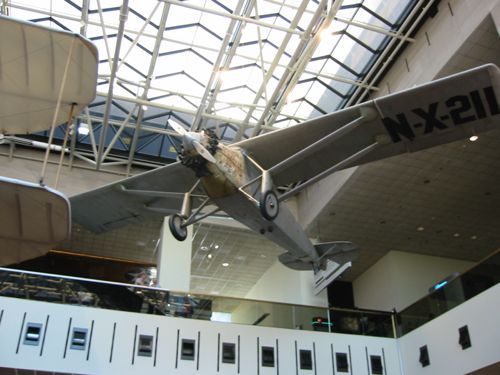
This was two decades after Charles Lindbergh completed his historic flight over the Atlantic in the Spirit of St. Louis, aircraft had changed substantially:
“The Spirit of St. Louis” was designed with one thought in mind: to get to Paris. Extra fuels tanks were added and the wing span increased to accommodate the additional weight. The plane would have a maximum range of 4,000 miles, more than enough to reach Paris. One of the more innovative design decisions involved placing the main fuel tank in front of, rather than behind, the pilot’s seat. Lindbergh didn’t want to be caught between the tank and the engine if the plane was forced to land. This configuration also meant that Lindbergh would not be able to see directly ahead as he flew. It didn’t seem to trouble him much. “There’s not much need to see ahead in normal flight,” Lindbergh told Donald Hall. “I won’t be following any airways. When I’m near a flying field, I can watch the sky ahead by making shallow banks. All I need is a window on each side to see through…” If needed, Lindbergh would use a periscope attached to the plane’s left side to see what was in front of him. In his efforts to pare down the plane’s weight, Lindbergh considered every detail. Any item considered too heavy or unnecessary was left behind. These included a radio, parachute, gas gauges, and navigation lights. Lindbergh designed for himself special lightweight boots for the flight, and went so far as to cut his maps down to include only those reference points he would need. Every ounce mattered. Instead of a heavy leather pilot’s seat, Lindbergh would be perched in a far lighter wicker chair. (CharlesLindbergh.com)
In October 1947 a plane traveled faster than the speed of sound for the very first time (source). By 1977, the Concorde could fly from New York City to Paris in just 3.5 hours (source), less than the usual 8, and much less than Lindbergh’s flight half a century earlier.
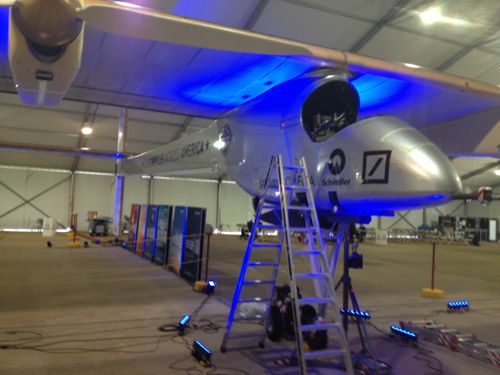
In the 21st Century the challenge is how to operate aircraft on less fuel, or even no fuel. Enter the Solar Impulse:
Solar Impulse has started to fulfill the good-citizenship role for which it was designed. The solar airplane provokes discussions amongst the highest political and economic authorities about technological solutions currently available to help them achieve the world’s agreed CO2 reduction targets. And it also allows them to tackle the problem of resistance to change, which risks locking us for too long into the dangerous and costly consequences of old habits. It is with the aim of promoting such processes of change that Europe is using Solar Impulse, to give an example of what clean technology is capable of achieving. Hence the patronage of the Presidents of the European Parliament and the Council of Europe, as well as the European Commission. (Solar Impulse)
I got to see the Solar Impulse yesterday.
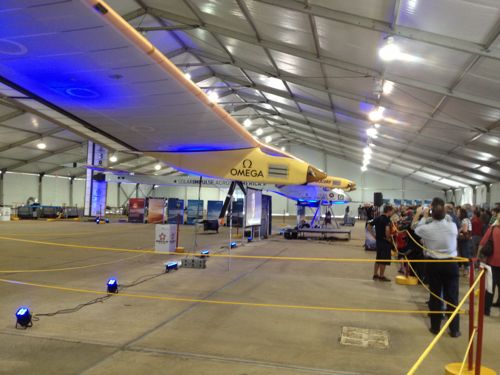
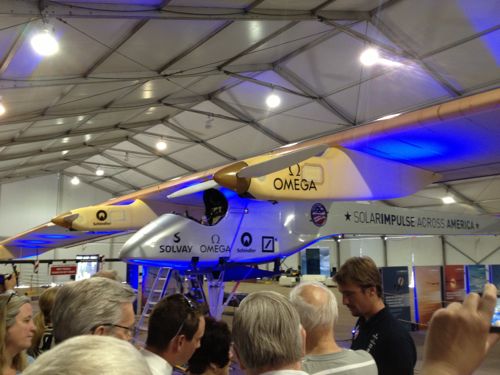
When will we be able to book a flight on a commercial solar airplane? No clue, but this effort will push development of solar technology forward. Who knows, in 20 years much more of our lives may be powered by the sun.
— Steve Patterson