Thirty Years Since the Hyatt Regency Crown Center Walkway Collapse
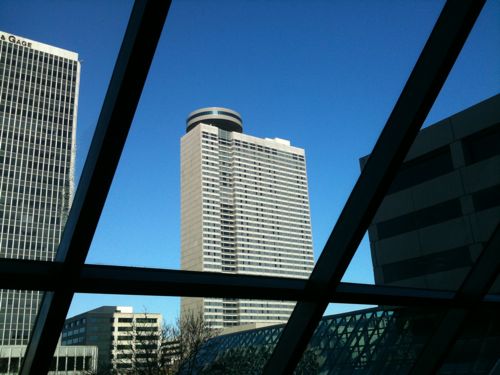
ABOVE: Hyatt Regency Kansas City as seen from the Crown Center Skywalk

Tomorrow evening marks the 30th anniversary of the walkway collapse at the Hyatt Regency Crown Ceenter in Kansas City:

The Hyatt Regency hotel walkway collapse was a collapse of a walkway that occurred on July 17, 1981, in Kansas City, Missouri, United States, killing 114 people and injuring 216 others during a tea dance. At the time, it was the deadliest structural collapse in U.S. history.

On July 17, 1981, approximately 1,600 people gathered in the atrium to participate in and watch a dance competition. Dozens stood on the walkways. At 7:05 PM, the second-level walkway held approximately 40 people with more on the third and an additional 16 to 20 on the fourth level who watched the activities of crowd in the lobby below. The fourth floor bridge was suspended directly over the second floor bridge, with the third floor walkway offset several meters from the others. Construction difficulties resulted in a subtle but flawed design change that doubled the load on the connection between the fourth floor walkway support beams and the tie rods carrying the weight of both walkways. This new design was barely adequate to support the dead load weight of the structure itself, much less the added weight of the spectators. The connection failed and the fourth floor walkway collapsed onto the second floor and both walkways then fell to the lobby floor below, resulting in 111 immediate deaths and 216 injuries. Three additional victims died after being evacuated to hospitals making the total number of deaths 114 people. (Wikipedia)

A “subtle” design change resulted in the deaths of many people.
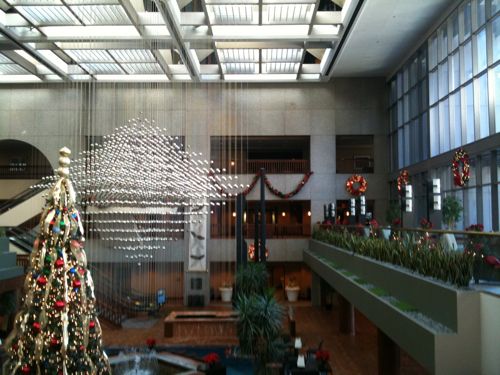
ABOVE: Hyatt Regency Crown Center Lobby, December 2010

I started architecture school just four years after this accident occurred.  This tragedy, and others, were discussed over and over, especially in structures courses. More from Wikipedia:

Investigators, including David Tonneman (a respected engineering critic), concluded that the basic problem was a lack of proper communication between Jack D. Gillum and Associates, Christopher Willoughby (a University of Michigan engineering student at the time), and Havens Steel. In particular, the drawings prepared by Jack D. Gillum and Associates were only preliminary sketches but were interpreted by Havens as finalized drawings. Jack D. Gillum and Associates failed to review the initial design thoroughly, and accepted Havens’ proposed plan without performing basic calculations that would have revealed its serious intrinsic flaws — in particular, the doubling of the load on the fourth-floor beams.

The engineers employed by Jack D. Gillum and Associates who had approved the final drawings were convicted by the Missouri Board of Architects, Professional Engineers, and Land Surveyors of gross negligence, misconduct and unprofessional conduct in the practice of engineering; they all lost their engineering licenses in the states of Missouri and Texas and their membership with ASCE. While Jack D. Gillum and Associates itself was discharged of criminal negligence, it lost its license to be an engineering firm.

This Hyatt Regency was, and is, owned by a subsidiary of Hallmark.

Hallmark was the driving force behind the Crown Center redevelopment:

Before the First World War, Downtown Kansas City was heavily populated and bustling. The area today home to Crown Center was an extension of the Union Hill historic neighborhood. Gradually, however, the center of population for the metro area moved south, and by the Second World War the area today comprising Crown Center had become dilapidated. Although Hallmark had maintained its headquarters at 26th Street and Grand Avenue since 1922, the headquarters itself and nearby Union Station comprised the only non-slum in the area. Instead, what there was were old warehouses, used car lots, and vacant buildings.

In 1966, Donald J. Hall, Sr. became President and CEO of Hallmark Cards, taking over from his father, Joyce Hall. Joyce Hall had long wished to develop the area around the corporate headquarters, and with his new leadership Donald Hall quickly made it known that he wished to renew the area entirely. Hallmark quietly began acquiring all the property surrounding its headquarters, and consulted with urban planning experts about the possibility of creating an experimental “city within a city” on the property. The City of Kansas City formally approved the plans for Crown Center (named after the Hallmark corporate symbol) by the end of 1967. (Wikipedia)

Crown Center wasn’t Urban Renewal.  Instead it was an early example of an http://en.wikipedia.org/wiki/Model_Cities_Program

To city planners, Crown Center is a mixed-use redevelopment, one of the earliest in the nation, on an 85-acre site adjacent to the international headquarters of Hallmark Cards, Inc. It has been a catalyst for change in the city’s urban core, replacing blight with quality working, living and entertainment facilities to breathe life back into the city.

Victor Gruen & Associates of Los Angeles developed the project’s original master plan, which was then modified and implemented by Edward Larrabee Barnes of New York. Crown Center was announced to the public in January 1967, and ground broke on September 16, 1968, for the first phase of the project – an underground parking facility, five-building office complex and landscaped central square. (PDF of Crown Center History)

Victor Gruen is the father of the shopping mall with the open-air Northland Center (1954), enclosed Southdale Mall (1956) and pedestrianization of a street with the Kalamazoo Mall (1959).  I’m not a fan of Gruen’s centralized designs.

I’m also not  a fan of Crown Center. I am a fan of making sure those who must be diligent to protect the safety of the public are checked and double checked.

– Steve Patterson


Brick Relief Sculpture Nearly Removed from Council Towers

ABOVE: Just one small section remains on the east face of Council Towers

A brick sculpture once covered the east facade of the 27-story Council Tower Senior building. Here is the description when the 5-building Council Plaza complex was listed on the National Register of Historic Places in 2007:

A 250 foot relief sculpture was designed and created in brick by artists Saunders Schultz and William Severson, nationally known sculptors and is visible on the St. Louis skyline on the east elevation. The bas relief carving took 15 months to complete and used about 100,000 brick. The sculpture utilizes a series of abstract arch geometric designs representing, “man’s continual striving toward God.” The artists also designed a small fountain within the complex and a sculpture within the fountain, Catfish and Crystal.

For a picture with the relief sculpture intact see this post at Saint Louis Patina or earlier discussion at NextSTL. I’m saddened by the removal of this sculpture.

– Steve Patterson


Civic Space in Rock Hill Missouri

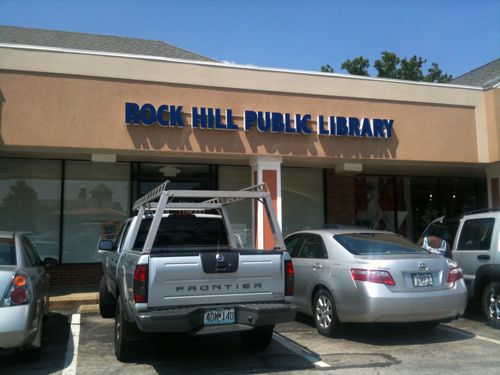
ABOVE: Rock Hill Public Library at 9741 Manchester Road

The Rock Hill Public Library is just down the street from the Rock Hill City Hall. Both are located in generic strip centers, with the library in the newer of the two.  One benefit is each is near food, the library has a pizza buffet next door while city hall is next to a chop suey place.

With the most important civic spaces in a municipality just a storefront among many it is no wonder they don’t care to save the historic 19th century church I posted about on Tuesday. How could I expect this community to value history, good design, or anything without a massive asphalt parking lot?

– Steve Patterson


Readers Want Ald Freeman Bosley Sr. Out of Office

Ald. Freeman Bosley Sr.

Many people think Ald Freeman Bosley Sr. (D-3) has been a member of the Board of Aldermen longer than any other member. However, Phyllis Young & Fred Wessels hold that honor, both were first sworn in on April 16, 1985 (26 years!). Next is Joseph Roddy, first sworn in on March 11, 1988 (23 years!). Freeman Bosley Sr., and Terry Kennedy, were first sworn in on April 18, 1989 (22 years!).

In the poll last week readers picked the father of former mayor Freeman Bosley Jr. as the alderman they’d most like out of office. Where do I begin? Bosley’s plan for his 1/28th of the city has been tear down anything vacant more than a week. If not for the persistence of the staff at the city’s Cultural Resources office, and others, the third ward would have significantly fewer buildings.

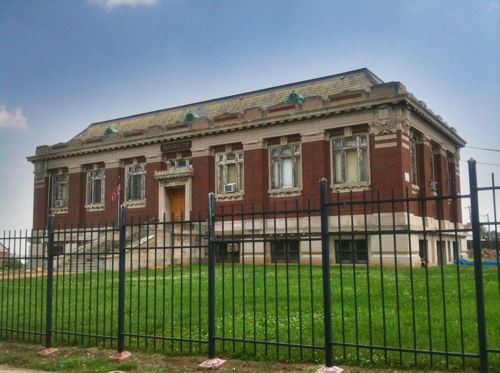
As an example, Ald Bosley has mentioned for years about razing the beautiful library in Hyde Park with an IHOP.  I like eating at IHOP but I’m a bigger fan of the historic library.

ABOVE: the historic library in Hyde Park

In my first weeks of blogging I spoke at a Preservation Board meeting against the demolition of a historic church on North Grand that Bosley supported.  Thankfully they rejected the application and the church remains.

Here are the Top 10 vote getters in the poll, readers could pick up to five (those shown in bold are the ones I voted for):

  1. 3) Freeman Bosley Sr. 75 [14.34%]
  2. 19) Marlene E. Davis 60 [11.47%]
  3. 6) Kacie Starr Triplett 40 [7.65%]
  4. 7) Phyllis Young 38 [7.27%]
  5. 5) April Ford-Griffin 34 [6.5%]
  6. 20) Craig N. Schmid 32 [6.12%]
  7. 1) Charles Troupe 28 [5.35%]
  8. 18) Terry Kennedy 24 [4.59%]
  9. 15) Jennifer Florida 22 [4.21%]
  10. 9) Kenneth Ortmann 19 [3.63%]

The following are the remaining, in order.  In the case of a tie the software placed them in numerical/alphabetical order.

  • 21) Antonio D. French 16 [3.06%]
  • President Lewis Reed 15 [2.87%]
  • All of them 14 [2.68%]
  • 13) Fred Wessels 12 [2.29%]
  • 17) Joseph D. Roddy 12 [2.29%]
  • 8) Stephen Conway 11 [2.1%]
  • 4) Samuel L. Moore 10 [1.91%]
  • 28) Lyda Krewson 10 [1.91%]
  • 11) Thomas Albert Villa 7 [1.34%]
  • 27) Gregory Carter 7 [1.34%]
  • 22) Jeffrey L. Boyd 6 [1.15%]
  • 23) Joseph Vaccaro 6 [1.15%]
  • 2) Dionne Flowers 5 [0.96%]
  • 10) Joseph Vollmer 5 [0.96%]
  • 12) Larry Arnowitz 4 [0.76%]
  • 16) Donna Baringer 4 [0.76%]
  • None of them 2 [0.38%]
  • 14) Carol Howard 2 [0.38%]
  • Unsure/no answer 1 [0.19%]
  • 24) Scott Ogilvie 1 [0.19%]
  • 25) Shane Cohn 1 [0.19%]
  • 26) Frank Williamson 0 [0%]

No votes for Williamson? Someone I know didn’t vote then.

Clearly many of them don’t know when to make an exit.  Twenty-six years?  If we want them out we’ve got to make it happen by challenging them at the next election, recall or just being so critical of everything they finally give up and step aside so younger folks can take a shot at leadership.

Odd numbered wards, seven of the top ten, are up again in 2013. Start planning your campaign today!

– Steve Patterson


Rock Hill to Trade Namesake for Gas Station & Convenience Store

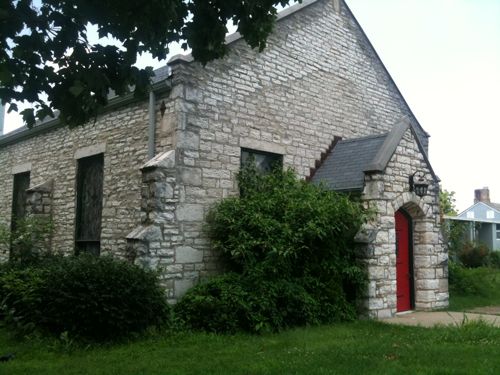
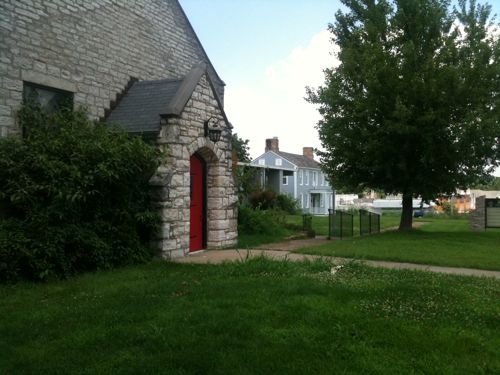
Pretend for a moment the modest stone church at the the NE corner of Manchester & McKnight was built in 1945. It would be old enough to be historic just based on age. In reality, though, the church was built by slaves in 1845. The City of Rock Hill, where the church is located, took it’s name from the church. Serious history!

Rock Hill has foolishly agreed to allow a developer to raze the recently vacated church for a gas station and convenience store. Seriously.

The 1845 limestone church, located at McKnight and Manchester roads, could very well be razed to make way for a gas station and convenience store. Rock Hill Presbyterian Church is one of the earliest churches to be established in the greater St. Louis area. Until August 2010, it was the oldest Presbyterian Church west of the Mississippi to hold worship services on a continuous basis in the same structure, according to a history from the Rock Hill Historic Preservation Commission.

U-Gas, based in Fenton, has reached a purchase agreement with the property owner, Presbytery of Giddings-Lovejoy Inc.

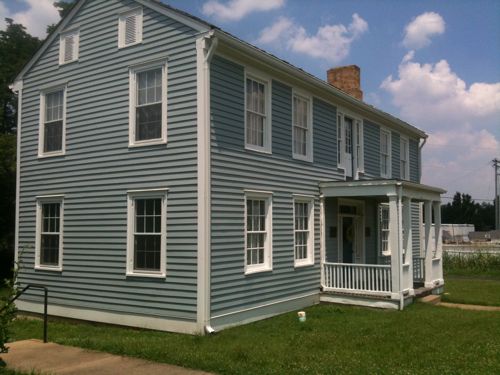
Adjoining the church on the same property is the city-owned Fairfax House. The house was built between 1839 and 1842.

Plans call for the house to be moved to the northern end of the two-acre tract, with the move paid for by U-Gas. Bill Biermann, the attorney representing U-Gas, spoke at the July 5 board of aldermen meeting. (Source)

Incredibly shortsighted! It sounds like the purchase agreement is contingent on being able to build the gas station, so it may be possible to save the last bit of history in the area.

ABOVE: The modest church was rebuilt following a fire in the early 20th century

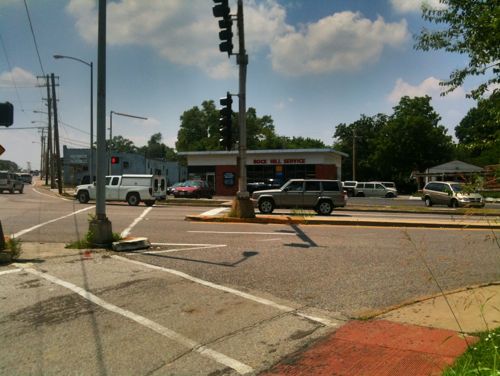
However, the developer must wait  6 months to see if someone can be found to relocated the stone structure. In the meantime, those seeking gas in the area will have to hope they have enough fuel to drive 825 feet further west, or another 1,200 feet beyond that.

ABOVE: Former gas station across McKnight to the west

The Fairfax house has been moved three times already, the most recent in 1997 from property across Manchester Rd.

The lovely timber frame home known as Fairfax is built to fit the Golden Mean in architecture. The appealing structure of four rooms joined with a central hallway is held together with tenon joinery, its frame resting upon massive oak sills hand hewn on site. Each window and door is delicately held together with a series of carefully placed hand carved wooden pegs. Delicately carved muntins lay across the panes of glass in the double hung window sashes. A brick lined food cupboard reaches floor to ceiling in the dining room and two massive Rumford Chimneys reach from cellar floor through rooftop. The hand turned newel post is still pinned underneath the first floor visible from the basement after being in constant use for some 160 years! (source)

The house would be moved a fourth time.

ABOVE: in the background is the 1950s addition designed by P. John Hoener & Associates and the Fairfax House

To see the architect’s sketch of the addition click here.

ABOVE: Fairfax House

I propose that, if the church is razed, the city change it’s name to one of the following:

  • U Gas Hill
  • Gas Hill
  • Sprawl Hill
  • Un-Rock Hill

Driving through Rock Hill is pretty depressing, these two structures are the only thing pleasant along this stretch of Manchester Rd. Take them away and there will be no relief from the sprawl.

– Steve Patterson


Advertisement


[custom-facebook-feed]

Archives

Categories

Advertisement


Subscribe