U.S. Auto Industry Caught with wrong product mix again

May 24, 2008 Downtown 15 Comments

In the 1970s The U.S. auto industry was blindsided by the 1973 Oil Embargo. Efficient imports autos like Datsun, Honda and Toyota swept in to fill consumer demand for more economical transportation. Homegrown solutions were way off the mark — Ford already had the heavy Pinto. I owned a 1974 Ford Mustang II — what a POS that was. Did they learn anything? Nope!

Today Ford, GM and Chrysler are caught with too many trucks and SUV’s in showrooms as sales of these segments decline in the double digits. Toyota has passed Ford for the #2 sales position in the U.S. Honda is set to pass Chrysler for #3.

Why does it matter? Well the auto industry is an important part of our national economy. Many thousands of workers build the cars and many others work for suppliers to the industry. Until we can shift these people to other jobs a large part of the economy depends upon all of us doing our part and buying a new vehicle. But with the new reality of $4/gallon +/- gas consumers are finally rejecting trucks and SUVs. Frankly the U.S. economy is to reliant upon sales of autos and of new mostly suburban homes.

For years the big 3 (GM, Ford, & Chrysler) have bought and rebadged efficient vehicles to meet demand. They’ve also revised their own models that were designed and sold in Europe and other countries where fuel efficiency has long been important. For much of the 1970s and 1980s Chrysler had a deal with Mitsubishi — my 1984 Dodge Colt was a rebadged Mitsubishi Mirage — it was also a great car. Ford brought us their German built Fiesta and later rebadged Kia’s. GM looked through products offered elsewhere and brought us Vauxhall Chevettes and today they sell the Aveo built by GM Daewoo in South Korea. The Pontiac Vibe is a rebadged version of the U.S.-built Toyota Matrix. Saturn’s Astra is a European Opal. For some reason these auto makers can’t manage to design and build a small & efficient car on our shores.

This year Daimler AG, maker of Mercedes vehicles, began importing the tiny French-built smart fortwo. It only holds two people while showing we don’t all need massive vehicles to get around.
According to fueleconomy.gov the Toyota Prius remains the most fuel efficient mass production car available to U.S. buyers. Meanwhile U.S. automakers were busy trying to prop up sales of trucks and SUVs with hybrid and flex fuel technology — so now thee vehicles just get poor mileage rather than abysmal.

U.S. auto buyers have fewer efficient choices than the rest of the world. We’ve been buying land yachts for so long now the auto makers don’t waste their time with more efficient and useful vehicles. Buyers in other markets, for example, can get a Honda Accord station wagon or a 4-door Civic with a hatchback Sedans we’ve got but a handy hatchback is a rare find.

For used car shoppers the prospects are even fewer. For those on limited budgets the big gas hogs often become the most affordable vehicles to purchase. Thus, those who can least afford the price of gas have the worst mileage.

Ideally we’d have such a great mass transit system we wouldn’t need private autos but the reality is our region is so spread out that we’ll never have such a system. As gas prices rise people will still have cars. I just hope our choices of cars improves.
 

Time to Think About Running for Office

In less than a year the City of St Louis will have elections for half the Board of Aldermen — the 14 odd numbered seats. If you’d like to see some change in how the city is managed now is the perfect time to begin planning your campaign. I ran for the 25th back in 2005 and it was a very rewarding experience.

At this point you must already live in the ward in which you’d run in. Not sure what ward you live in? Then you probably shouldn’t run for office.

Those seats up for grabs next year are (existing Alderman):


Alderman Wants Gasoline Allowance

Jake Wagman of the Post-Dispatch has reported on a new bill introduced at the Board of Aldermen today:

Even at City Hall, high gas prices have drivers concerned.

That’s why Alderman Charles Q. Troupe has a relief plan — for aldermen, at least.

Troupe plans on introducing a bill at tomorrow’s meeting that would give alderman an “expense account” for their fuel costs.

While “riding the ward” is a staple of aldermanic duty — right up there with returning phone calls and sending birthday wishes — it seems unlikely that Troupe’s colleagues would endorse his plan to charge taxpayers for their gas.

In looking at Board Bill 83 we see how much Troupe is seeking:

Each alderman shall receive a monthly sum equal to four hundred (400) miles multiplied by the Internal Revenue Service (IRS) standard mileage rate for business miles driven.

The 2008 IRS rate is 50.5 cents per mile. So that is an extra $202 per alderman per month. That comes to just under $68K per year at the current IRS rate.

Aldermen are not well compensated until you consider the job is part time — $32,000/year plus a $4,200 expense allowance. Many aldermen have full time jobs that give them enough freedom to make day meetings. Do we really think each of the 28 aldermen are driving 400 miles for aldermanic business each and every month? I don’t think so.

Like everyone else the aldermen will need to find more efficient ways of getting around. At least one alderman, Phyllis Young, drives a Toyota Prius Hybrid.  Should she get the same allowance as someone that drives a less efficient vehicle?  What if an alderman only drives 175 for business in a given month?  What if they just buy their own damn gas like everyone else does?  If they don’t like it they can seek out alternatives.


New Arby’s has Required ADA Access Route

For a couple of years now I’ve showed project after project lacking a federally mandated ADA-compliant access route. The biggest culprits are often fast food joints with drive-throughs taking priority over the pedestrian (see post on recent Starbuck’s locations). Shopping centers are no exception and it wasn’t until I began highlighting the flaws at Loughborough Commons did they make changes to the original access plans. To date there is still not proper access to the Lowe’s. Granted a person in a wheelchair doesn’t come off the street to take home drywall but smaller items like light bulbs are still in need when you are disable.
I think the city’s former commissioner on the disabled used to just count the number of disabled parking spaces and give projects an OK if it met the required number. But I can assure you that not everyone arrives by car which means if they are not bicycling they are walking or using a wheelchair. And the ADA access route provides equally good access for those who are able bodied and those that are not. Those who are out pushing a baby stroller will appreciate the provisions as much as the person in a wheelchair.

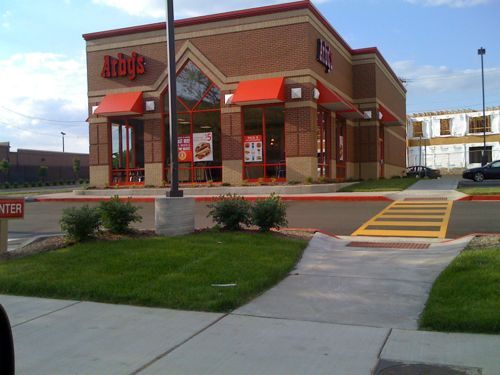
So when the Arby’s on Lindell was rebuilt following the fire at the construction project next door (see post) I was not optimistic about what sort of pedestrian access they would provide. However, I was pleasantly surprised when I saw the final outcome:


As you can see above it doesn’t take much — just a way to get from the public sidewalk to the main accessible entrance. Clearly here the pedestrian was given due consideration.

Given the urbanity of the apartment project next door it would have been nice to see the Arby’s be less suburban in nature — closer to the street, fewer auto drives, etc but at least they got the pedestrian access right. So if we are going to continue to build more suburban structures in the city, such as this Arby’s, we need to ensure they all have pedestrian access to the public sidewalk as this does.  Anything less is unacceptable.


Not all residents are happy with the King

Some owners of lofts in the King Bee building on Washington Ave have taken their complaints to court.  From a current RFT article:

In 2006 building and fire inspectors confirmed several problems: a furnace system without proper ventilation; a four-story staircase with several air conditioners stored on landings, also improperly ventilated; and untested sprinkler and alarm systems.

St. Louis’ acting building commissioner Frank Oswald calls the violations at the King Bee “major,” but says none of them are severe enough to warrant condemnation. What’s unusual to Oswald is the way they arose in the first place.

“Usually when somebody else is [violating code],” says Oswald, “they’re doing it on their property, and they haven’t sold it as a condominium.”

The fundamental issue, adds Oswald, is that the developer failed to alert the St. Louis Building Division before converting the warehouse to residences. He explains that most developers begin by filing a plan, which kicks off a series of reviews and inspections, before anyone moves in. “It clearly was not done appropriately,” Oswald says.

Deputy Fire Marshal Baron Ross agrees. “The life-safety requirements for a warehouse or factory are quite different from where people are going to be sleeping,” he explains.

Interesting.  As the article also notes, the developers asked for and received tax abatement.   So while the building division didn’t have a master plan in front of them the developers would have had to show something to St Louis Dev Corp and the Board of Aldermen.  This is probably one of the most glaring examples of a breakdown in communications between the many city departments and agencies.


Advertisement


[custom-facebook-feed]

Archives

Categories

Advertisement


Subscribe