Metro Moving Transit Forward Without Streetcars

Through its “Moving Transit Forward” initiative, Metro is holding public workshops across St. Louis City and County to get folks thinking about transit needs and system expansion.  Rather than just let attendees dream up their own rapid transit lines on maps, a breakout exercise does a good job of sharing the stark financial realities of MetroLink expansion. Participants are given just a hypothetical $700 every decade for capital projects, when the average MetroLink corridor project costs roughly $450. As a result, it becomes quickly apparent that another Prop-M only buys roughly one MetroLink corridor a decade, if that. For example, the combined Northside-Southside corridors, just within the City, cost $800. The exercise also suggests that participants consider other, cheaper alternatives, such as Bus Rapid Transit ($35) or Commuter Rail ($300).

What really concerns me with this exercise is two-fold: 1) Northside-Southside is presented as the only big idea for City system expansion, and 2) Modern Streetcars are missing from the suggested tool box of cheaper alternatives. When thinking of streetcars, I’m not talking more vintage trolleys akin to the Delmar Loop project (that’s criticism for a future post). No, I’m talking low-floor, high-capacity vehicles that travel on cheaper-to-build, embedded, street-running tracks. But back to the first point, this former planner of the Northside-Southside concept actually thinks such a “big idea” is terribly flawed, and should even be scrapped.

To understand how Northside-Southside even came to be is to tackle the very complex history of system planning and evolution of MetroLink in St. Louis. Such history would be its own series of posts. But suffice it to say, the St. Louis region is still working off a 1989 system analysis produced by East-West Gateway as the basis for all its corridors. I admire Metro using their new Moving Transit Forward initiative to scrap the prioritization of that document that hasn’t been officially updated since 1991 in a failed attempt to lure St. Charles County. But showing a map of big ideas spawned from those very corridors dreamed up now twenty years ago is perpetuating flawed thinking. I know this in part, because the Northside-Southside Study, I worked on two years ago, also perpetuated inherent flaws.

In my opinion, the key flaw of the Northside-Southside Study was the dual purpose of serving both City riders and County commuters. As a result, speed of lines to the County became essential, but of course, at an expense. Faster trains meant taking lanes and closing intersections on arterials and complex designs inside Interstate rights-of-way, all for a fast-ride to Downtown. And given such premise, modern streetcars were deemed too slow, despite their lower cost. But in the end, many County stakeholders would view the project as a lower expansion priority, especially given a roughly billion-dollar price-tag, which ironically resulted from attempts to attract their ridership.

A political reality of Metro is that the County holds the purse and the populace (albeit in voters, if not riders). One can imagine then that if you can only expand MetroLink by one corridor a decade, the City will be waiting in line for some time. Plus, as Northside-Southside showed, the City doesn’t have as attractive exclusive rights-of-way to build MetroLink-looking lines easily.

Rather than compete in a game stacked heavily against the City, I advocate changing the transit ideas discussed inside the urban core. Modern streetcar corridors, such as Grand Avenue, would offer the City projects paired well fiscally with a County MetroLink extension each decade.

And there is still time for City transit advocates to be heard. One opportunity is attending the workshop scheduled for South St. Louis City 5-7pm this Monday (10/26/09):

  • St. Louis Public Library, Carpenter Branch
    3309 South Grand Boulevard (map)
    St. Louis, MO 63118

– Brian Horton


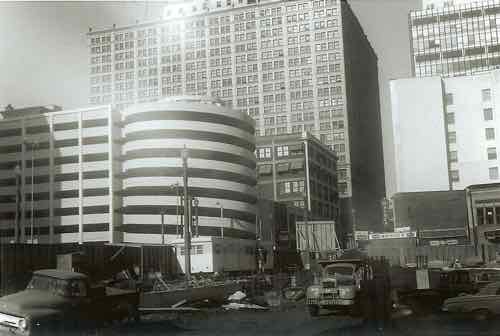
A Vintage Parking Garage

Downtown St. Louis has many parking garages, too many in fact.  Most are as bland as you’d expect a parking garage to be.

The curving exit ramp of the Macy’s garage at 6th & Pine (map link) is anything but bland.

One of the two Kiener Plaza garages are visible from the exit ramp of the Macy’s garage, above.

In this historic image, we see the Macy's garage in the background as the Kiener garages are built in the foreground.
In this historic image, we see the Macy’s garage in the background as the Kiener garages are built in the foreground.

It is hard to sustain a vibrant downtown with so much real estate used for car storage.  We built garages to accommodate everyone coming downtown but in the process created a downtown less attractive to visitors.

I just hope nobody gets the idea to list one on the National Register of Historic Places.  Wait, the city likes to raze historic buildings so perhaps we should get all of them on the register.  That may be the only way to reduce their numbers.

– Steve Patterson


Limbaugh Dropped From Rams Bid

Last week Rush Limbaugh was dropped the group seeking to take over the St. Louis Rams.  Opposition was mounting locally, nationally and even within the NFL.  Here is the poll question, answers and the final tally:

Q: Rush Limbaugh & Dave Checketts have bid on the St. Louis Rams. Reaction?

  • I don’t like Limbaugh and this would make it easier to stay away from the Rams: 77 (30%)
  • I don’t care who owns the team as long as it remains in St. Louis: 63 (24%)
  • I don’t like Limbaugh, used to support the Rams, but will stop if he becomes an owner: 39 (15%)
  • I don’t like Limbaugh but I would continue supporting the Rams: 32 (12%)
  • I like Limbaugh and the Rams, great match: 19 (7%)
  • I don’t have an opinion on Limbaugh buying the Rams: 15 (6%)
  • I like Limbaugh but not the Rams/football: 8 (3%)
  • I like Limbaugh so I might start supporting the Rams: 6 (2%)

What we can take away from these results is most of the readers here are Rams fans, or at least want them to stay in St. Louis. 134 of the 259 votes (52%) showed a positive view toward the Rams/NFL.  Conversely, nearly as many are not really interested in the Rams/NFL.  More of those voting dislike Limbaugh than those that do like him.  With Limbaugh out of the picture the focus shifts back to the region’s willingness to pay up to keep the Edwards Jones Dome among the NFL’s best:

The Rams lease agreement with the St. Louis Convention & Visitors Commission (CVC) requires the Edward Jones Dome rank among the top eight stadiums in the 32-team NFL on the Dome’s 20th birthday in 2015. If first-tier status is not met, the Rams lease would switch to year-to-year terms a decade ahead of schedule and the team would have the option to leave St. Louis.  (Source: St. Louis Business Journal, 5/16/08, Edward Jones Dome challenged to measure up)

Renovations to the dome will likely cost more in the coming years than the dome cost to build.  Estimates are in the hundreds of millions.  The hotel room tax doesn’t collect enough to fund the renovations that will be needed.  2015 will be here soon. Can we assume that if Dave Checketts and his partners are successful in buying a controlling interest in the Rams that they wouldn’t move the team out of the region?  Maybe.  Expect to hear much more about this over the next 5-6 years.

The best part is we won’t be hearing from Rush Limbaugh as a team owner.

– Steve Patterson


Site Analysis 101, Include Pedestrians/Cyclists

October 19, 2009 Planning & Design 3 Comments

Developers, architects, engineers and politicians in the St. Louis region must collectively assume that 100% of the population drives their own private vehicle on 100% of their daily trips.  They must, how else can you explain what passes for new development in the region? Only development that will remain more than a mile from the nearest structure need not worry about pedestrian access to the site. Anything closer than 1/4 mile should assume that some users will approach by a mode other private automobile.

One of my first classes in architecture school, in the mid-1980s, was site analysis.  I still have my text from that class; Site Analysis: Diagramming Information for Architectural Design by Edward T. White, 1983.  Note that the Americans with Disabilities Act did not become law until 1990.

“We should always remember that a site is never inert but is an ongoing set of very active networks that are intertwined in a complex relationship.”

White suggests a “consequence triangle” as “a convenient model for understanding the network of contextual causes and effects and how they relate to other aspects and issues of our project.”  The triangle includes the building, users and context.

The factors White listed to consider, collect data on, and to diagram, are:

  • Location
  • Neighborhood Context – 3-4 blocks adjacent to site, existing & projected uses
  • Size and Zoning – dimensional aspects of site, current and projected zoning trends
  • Legal
  • Natural Physical Features
  • Man-Made Features
  • Circulation – pedestrian & vehicular movement — quoted below.
  • Utilities
  • Sensory
  • Human and Cultural
  • Climate

Neighborhood Context:

Presents the immediate surroundings of the site for perhaps three to four blocks beyond the site boundary.  This may be extended further to an important factor or because of the scale of the project. Map may show existing and projected uses, buildings, zoning and any other conditions that may have an impact on our project.

Size and Zoning:

Documents all the dimensional aspects of the site including boundaries, location and dimensions of easements and present zoning classification with all its dimensional implications (setbacks, height restrictions, parking formulas, allowed uses, etc.) and buildable area (land available for the project after all setbacks have been subtracted).  Analysis should also document the present and projected zoning trends, plans by the city transportation department to widen roads (change rights of way) and any further trend that might affect our project in the future.

Circulation:

Presents all vehicular and pedestrian movement patterns on and around the site.  Data includes duration and peak loads for surrounding vehicular traffic and pedestrian movement, bus stops, site access edges, traffic generators, service truck access and intermittent traffic (parades, fire truck routes, concerts at nearby auditorium).  Traffic analysis should include future projections insofar as they can be made.

Clearly some of the above are dated — seldom do cities increase the width of the public right of way these days.  In places with modern zoning (not St. Louis), the urban site will have build-to lines rather than setbacks, minimum heights rather than maximums, bike parking requirements and so on.  The circulation part is still valid.  Vehicles include bicycles and motor scooters.  Pedestrians include the able-bodied as well as those with disabilities (physical, sight, hearing, etc).  The pedestrian part is what is so clearly overlooked by the professionals designing many recent projects.

They may say nobody walks in the area of their project yet a bus stop is on the edge of the site.  If you have a bus stop within a 1/4 mile you’ve got pedestrians. I’ve been so many places in our region where it seems like nobody walks at all but if you stick around long enough pedestrians begin to come from all directions.  They gather and shortly a bus appears, picking them up and dropping off others.  Those that just left the bus go in all directions.

It is not just about bus stops either.  Unless you are isolated in the middle of nowhere you have others around you.   Most will choose to drive to their destination but given the choice some will choose to walk (or bike). Designing places in such a way that a car is mandatory is just not how I was educated.  These concepts are freshman level but forgotten by many.   We need to remind them to consider all means of accessing sites.

– Steve Patterson


Father and Son

October 18, 2009 Religion, Sunday Poll 8 Comments

It is nice to see the St. Louis region make the New York Times, although of late it has done so for less than positive reasons (Limbaugh/Rams).  The latest brings up interesting issues:

O’FALLON, Mo. – With three small children and her marriage in trouble, Pat Bond attended a spirituality retreat for Roman Catholic women in Illinois 26 years ago in hopes of finding support and comfort.What Ms. Bond found was a priest – a dynamic, handsome Franciscan friar in a brown robe – who was serving as the spiritual director for the retreat and agreed to begin counseling her on her marriage. One day, she said, as she was leaving the priest’s parlor, he pulled her aside for a passionate kiss.

Ms. Bond separated from her husband, and for the next five years she and the priest, the Rev. Henry Willenborg, carried on an intimate relationship, according to interviews and court documents. In public, they were both leaders in their Catholic community in Quincy, Ill. In private they functioned like a married couple, sharing a bed, meals, movie nights and vacations with the children.

Eventually they had a son, setting off a series of legal battles as Ms. Bond repeatedly petitioned the church for child support. The Franciscans acquiesced, with the stipulation that she sign a confidentiality agreement. It is now an agreement she is willing to break as both she and her child, Nathan Halbach, 22, are battling cancer.  (full story, A Mother, a Sick Son and His Father, the Priest)

Let me state for the record that not only am I not Catholic, I don’t believe in a deity.  My thoughts here will be brief because this isn’t about my views.  I want to get your thoughts.

I believe the requirement that Catholic priests be celibate is the root of the problems they often have with women and/or children.   Male celibacy just isn’t natural. Where do I, a non-believer, get off making such a statement?

Victims of abuse have used the courts to seek resolution.  Once an issue leaves a church and enters a civil court it becomes fair game.  The Catholic Church should permit priests to marry, to have normal adult relationships.  This is the question in one of two polls this week (see right sidebar).

– Steve Patterson


Advertisement


[custom-facebook-feed]

Archives

Categories

Advertisement


Subscribe