St. Louis’ Sidewalks Will Be More Crowded with Smokers Than in NYC?

September 22, 2009 Smoke Free 42 Comments

Smokers are noisy & trashy.  So says smoking advocate Bill Hannegan in emails arguing against smoke-free public spaces.  Smokers are so bad we are best advised to keep them indoors rather than unleashing, he suggests.

Recent communication to Gary Weigert, President of the St. Louis Police Officers’ Association:

I am writing to warn you about the smoking ban proposed by Alderman Lyda Krewson and currently being considered by the St. Louis Board of Aldermen’s Health and Human Services Committee. Unlike the smoking ban proposed in St. Louis County, the St. Louis City Smoke Free Air Act of 2009 would ban smoking in all work vehicles. This ordinance would require St. Louis City police officers to park and exit their patrol cars in order to smoke. Given the dangers police officers are subject to when patrolling the streets of St. Louis City, this seems like an unreasonable and special restriction the St. Louis Police Officers Association should protest. Again, the proposed St. Louis County smoking ban contains no such restriction.

I’d say a non-smoking employee should not be forced to endure the smoke of a co-worker.  Citizens who sit in a police car while filing a complaint should also not be subjected to the smoke of an officer.  Our city vehicles should not be damaged by the smoking habit of employees. Besides police vehicles we have ambulances and service vehicles.  City inspectors, for example, use city vehicles for official business.  If these employees want to smoke in their private homes, fine.   The city has no responsibility to provide a smoking environment for employees that work outside smoke-free buildings.

Hannegan continues:

I also want to warn you that the St. Louis City Smoke Free Air Act of 2009 would continuously place bar patrons on sidewalks outside clubs, taverns and bars until 3:00 am. Since St. Louis City clubs, taverns and bars are often embedded in neighborhoods, the problems with noise complaints due to large numbers of patrons smoking outdoors will be huge.

Here is a link to a short video which documents the problems of noise and litter a smoking ban has brought to New York City. When this video was made, less than 20 percent New York City residents smoked. In contrast, 30 percent of St. Louis City residents currently smoke. The problems with smokers on the streets, especially for neighborhoods with bars embedded in them, will be far worse in St. Louis.

The  video was created by a similar group trying to prevent Chicago from going smoke-free.  So this video is a few years old since the entire state of Illinois went smoke-free on 2/1/2008.  The implication is the streets of St. Louis will dissolve into chaos of noise & litter on par with NYC if we go smoke-free.

But if we look at the numbers we see just how exaggerated the scare tactic really is:

  • New York City: 8,363,710 total population x 20%  = 1,672,742 smokers on 304.8 sq. miles of land = 5,488/smokers per square mile.
  • St. Louis: 354,361 total population x 30% = 106,308 smokers on 61.9 sq. miles of land = 1,717/smokers per square mile.

NYC has 320% more smokers per square mile than the City of St. Louis!  In no way will we have widespread problems yet the claim is it will be “far worse” in St. Louis than New York.  Only if 96% of the St. Louis population smoked would he have a fair comparison.  Pure FUD.

Besides, I thought our smokers were all going to stay home to smoke causing every restaurant to go bankrupt?  Now they are going to go out but they will clog sidewalks everywhere. Which is it?  Neither really, but that is how Fear, Uncertainty & Doubt works.

Wikipedia has some good visuals to help understand the myriad of state laws that exist.  The following is color chart used to show the variations:
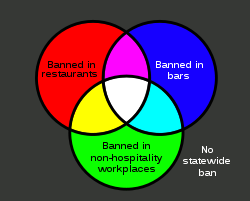
The map below shows what states have what laws using the color chart above:

Map of current and scheduled future statewide smoking bans as of June 26, 2009.

The world has not stopped spinning, the sun still rises in the East, alcohol is still consumed.  Bars, pool halls and bowling alleys still operate in states shown in white above.    Even better than Missouri clearing the air would be if the United States joined the long list of other countries with varying laws on smoke-free workplaces. Wikipedia:

The Republic of Ireland became the first country in the world to institute an outright ban on smoking in workplaces on 29 March 2004. From that date onwards, under the Public Health (Tobacco) Acts, it has been illegal to smoke in all enclosed workplaces. The ban is strictly enforced and includes bars, restaurants, clubs, offices, public buildings, company cars, trucks, taxis and vans – and within a three meter radius to the entrances of these locations.

As I understand it people still drink in Ireland.  People will still drink in St. Louis.  St. Louis’ sidewalks will not somehow become more crowded with smokers than in New York City.

– Steve Patterson


KDHX Tonight

September 21, 2009 Media Comments Off on KDHX Tonight

Tine into KDHX 88.1FM tonight at 7pm (Central) to hear me on Collateral Damage with hosts DJ Wilson & Fred Hessel.  Not in St. Louis?  No problem, you can stream the program live.

– Steve Patterson.


St. Louis’ Grand Experiment is the Norm in Chicago

September 21, 2009 South City, Transportation 12 Comments

The norm in the St. Louis region is for roads to have lots of lanes and no on-street parking.  On-street parking slows motorists and the traffic engineers will have none of that, it is all about speed for them.  But multiple lanes of speeding cars are bad for cyclists and pedestrians alike.

While the South Grand retail district (Arsenal to Utah) has always had on-street parking it has also had our lanes for through traffic.  Currently an experiment is being tested — reducing a six block section to three lanes (two plus center turn).  Have to see if these new radical ideas will work you know.

Anyone that has ever driven a car or ridden a bicycle in Chicago knows the configuration will work wonders.  Chicago has 120% more population density per square mile than St. Louis (12,649 vs 5,725).  They have lots of people, cars and bike.  Yet many of their major streets have the same basic configuration — two parking lanes, two travel lanes and a center turn lane.

Above is a view of this configuration on North Halsted.  On the right is Home Depot.  As you can see the travel lane is wide enough to accommodate motorists and cyclists.    New construction is built up to the sidewalk, in part, because streets have on-street parking.

In spaces you have a hole in the urban fabric (left above) with a parking lot here and there.  But they don’t toss out their urban principals and declare the area an auto-centric zone.

The above is a good distance from downtown Chicago.  The newish building on the right, with retail at grade and residential above, can relate to the street because it only has two lanes of traffic and because of the on-street parking.  But go out further into the inner ring suburbs and the pattern continues.

This section of Roosevelt is well outside the City of Chicago and many miles from downtown yet the street pattern is the same with only two travel lanes and on-street parking to support street oriented buildings.  Without the on-street parking you’d get standard sprawl — buildings isolated in their own parking lots.

Further out in the suburbs the two travel lanes become four but the on-street parking remains.  This ensures buildings will be built up to the street.

There is no need to test the 2 travel + turn lane configuration on South Grand.  It works and works well.

I believe if our streets were more like Chicago’s (fewer lanes, on-street parking, urban in-fill) we’d be in a position to re-urbanize & re-populate our city.  We need to extend this throughout the entire city as well as the first ring of suburbs.  Hampton, Kingshighway, Natural Bridge, Market — every street in town.  After a couple of decades we’ll see the change taking root.  If we can’t do it on six blocks of Grand I’m afraid we’ll never get to where I think we should be.

– Steve Patterson


Pro Sports Teams in St. Louis

St. Louis has a long history with professional sports teams, but, except for the Blues and the Cardinals, there’s also been a lot of changes over the years. The Browns, the Hawks and the football Cardinals have all left town. We invested heavily to get the Rams. We were once the epicenter for professional wrestling, and we currently support, among other sports, roller derby (ArchRivalRollerGirls.com).

Supporters of pro sports view them as being critical to a major city’s identity and for attracting new businesses. This is backed up with public investments like those in the Jones Dome, Busch III and Scottrade Center. But there are always groups advocating for more and different. One thing St. Louis lacks, in the traditional sense, is a pro basketball team. The Hawks were here from 1955 to 1968, but they were sold and moved to Atlanta. There are also “newer” pro sports leagues that are growing around the country, in sports that appeal more to the younger generations, sports like soccer and lacrosse.

With some regularity, we’ll see proposals, many times in Illinois, to build a new pro sports facility to support one of these new leagues. The Rams continue to make noises about the need to improve or replace the Jones Dome.  We just had a successful weekend of bike racing and the possibility of bringing the Olympics back to St. Louis is always a remote one.  There are those of us who would like to see a bigger investment in expanding our trail system, and there are others who value motorsports like NHRA and NASCAR.  Heck, there are even people willing to spend money watching monster trucks or lawnmower racing.

This all boils down to priorities.  We can’t be everything to everybody, so choices have to be made.  The Cardinals and the Blues seem to be relatively satisfied, for the time being, which leaves everyone else.  Should we focus our efforts on keeping the Rams or should we try to get an Arena Football team?  Would pro soccer be a better investment than pro lacrosse?  And should St. Louis work to keep any new facility in or near downtown, ar should we let other cities in the region share in both the glory and the headaches any pro team brings?

– Jim Zavist


Defining Urban

September 19, 2009 Planning & Design 2 Comments

The title of this blog is Urban Review St. Louis.  Its subtitle is “a look at urban planning and related politics in the St. Louis region.”  While we can all pretty much agree about what “planning” and “politics” likely encompass, there seems to be a big disparity about what “urban” actually might be.  The dictionary definition is fairly simple: “of, pertaining to, or designating a city or town.”  The reality seems to be much more complex, and likely mirrors the definition of pornography (“I’ll know it when I see it”).  Is the urban threshold crossed when population density or the number of dwelling units passes an arbitrary number per acre?  When buildings exceed a certain number of stories or when the front and/or back yards shrink or disappear completely?  When sidewalks and alleys appear and residential curb cuts disappear?  When true mixed use and viable public transit really function? When parking goes from convenient to a real pain in the a**?

New Town St. Charles and Seaside, Florida, both look a lot like parts of Soulard and San Francisco, but I doubt any of us would describe either of them as being “urban”.  Parts of our north side have fewer dwelling units or residents per acre than parts of Chesterfield.  East St. Louis is closer to our downtown than many city neighborhoods are, yet the only thing urban about the place is the wasteland part.  College dorms, state prisons and high-rise condos all have similar densities, yet have completely different interactions with the urban environment.  The core of every midwestern small town, the part laid out before 1930, is “walkable”, but few would be considered to be “urban”.

My guess is that our individual definition is a direct result of where we grew up. Like Steve, I grew up in a series of residential suburbs.  Going away to college, I experienced and learned to appreciate both higher-density urban living and the joys of owning an older home.  As an architect, I’ve worked on both urban and suburban projects, in everything from single-family residential to high-rise commerical structures.  So my view is that pretty much every part of St. Louis City is “urban”, even places like St. Louis Hills and the private streets in the CWE.  If I’d grown up on the upper east side of Manhattan in New York City, my viewpoint would most likely be much different.

The nearest common denominator for “urban” that I can identify are the old streetcar lines that were the preferred/de facto choice for transportation in many cities during the first forty years of the twentieth century.  They were the genesis for most of the commercial and mixed-use architecture that seems to define the urban ideal today.  They were also responsible for the growth of the many walkable urban neighborhoods that abut these old business districts.  Surprisingly (or not), these districts and neighborhoods were usually built with little direct government design review.  The buildings, both commercial and residential, were built simply because they were what sold, they were what the buyers of the time wanted.  The residential lots were relatively narrow because it maximized the number within walking distance of public transit.  More-expensive, higher-density, multi-family buildings could be justified if they were closer to the streetcar line.

All this changed, drastically, in the last half of the twentieth century, as the private automobile replaced public transportation as the preferred and most-prevalent form of individual transport.  Not surprisingly, architecture and what passes for urban planning evolved to reflect this changing environment.  The question then becomes what exactly is suburban and what is the new urban?  Clayton here and Tyson’s Corner in Maryland are both prime examples of the new urban – both started out as rural crossroads and both are now dense and important economic centers.  And while both are now integrating rail public transit, they remain primarily autocentric urban environments.

Every urban area has shades of grey, places/neighborhoods with very high densities and ones with lower, some even approaching suburban, densities.  Urban, to me, is both simple and complex.  Urban equals dense and diverse, in people, architecture, jobs, incomes and streetscapes.  There are no truly right or wrong answers, just an ongoing, hopefully denser, evolution.  St. Louis’ fundamental challenge is that we were once 800,000, we’re now 350,000, and many of us want to get back to 500,000 or 600,000.  We have the infrastructure.  We have the diversity.  We can focus on what was.  We can focus on a certain urban form.  We can be idealists.  But to really succeed, we need to temper our idealism with making sure we attract both new residents and new businesses AND keeping the ones that already here.

– Jim Zavist


Advertisement


[custom-facebook-feed]

Archives

Categories

Advertisement


Subscribe