Blogs are now mainstream information sources and St. Louis is fortunate to have blogs on nearly every topic imaginable. Hopefully UrbanReviewSTL.com is among your top St. Louis blogs but even if it isn’t I’m curious where you do your reading of blogs. Is it at work? Home? School? Mobile?
Vote in the weekly poll in the right sidebar, smartphone users switch to the full layout to vote. My guess is most read at work but we will see. results will be presented on Wednesday October 31st.
A beautifully illustrated book recently came across my desk, Clayton Missouri: An Urban Story by Mary Delach Leonard with Melinda Leanard:
In 1878, Ralph Clayton and his neighbors Martin Franklin and Cyrene Hanley donated 104 acres of farmland so that St. Louis County could build a courthouse and county seat. The townsfolk who pushed to incorporate Clayton, Missouri, in 1913 had little reason to suspect that their rural outpost of small frame buildings and plank sidewalks would later be recognized as a progressive metropolitan hub-one carefully buffered from quiet tree-lined neighborhoods and gorgeous parks. Clayton, Missouri: An Urban Story reveals the making of a city and the people who built it as a community. This lavishly illustrated book tells Clayton’s story through historical anecdotes and the voices of residents, timelines, and pullout sections on key facts and figures, plus stunning photographs of modern street scenes and nostalgic images of the city’s past. Also highlighted are important city leaders and residents who looked to the future at critical moments. Their efforts helped yield the Clayton of 2013, where magnificent steel and glass high-rises reach to the sky within blocks of historically splendid homes, many of them designed by noted architects of the twentieth century. (Reedy Press)
Clayton became the county seat for St. Louis County when St. Louis divorced itself from the county in 1876. I’ve only skimmed this hardback book so far but I look forward to reading more about this municipality on the west edge of St. Louis.
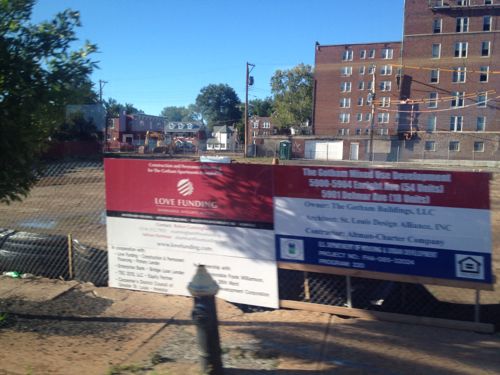
Recently, while riding the #97 MetroBus, I passed by the NW corner of Delmar Blvd & Hamilton Ave (map) just east of the Delmar MetroLink station and noticed signs on a vacant corner.
ABOVE: Pre-construction signs for new apartments on Delmar
Turns out the project will include the renovation of the historic Gotham apartment building in the background dating from 1926 as well as new construction facing Delmar:
Gotham and Delmar Apartments will consist of a substantially revitalized building recently certified by the National Park Service as a historic structure, and a newly constructed building on the same site. The transaction enables the property’s developers, Delmar Properties Management and Construction LLC, to obtain a fixed, low-rate, non-recourse loan for the period of construction and for a 40-year term once the buildings are completed. Many of the improvements being made to the existing building are designed to make the apartment units and public spaces more energy efficient and help reduce residents’ monthly expenses. (source)
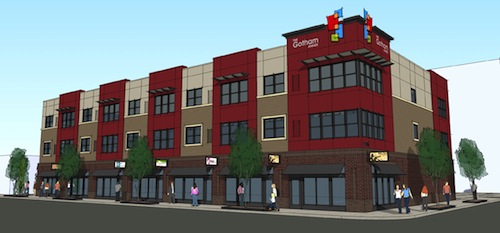
The renovation of the Gotham building will reduce its unit count to 54 apartment units from 66, while the new Delmar building will consist of 18 residential units and a number of first-floor commercial suites for office or retail use. (source)
Very good news for a part of Delmar that hasn’t seen the level of development as the other side of the MetroLink line.
ABOVE: Rendering of the new construction to face Delmar Blvd
Hopefully we will see many more new mixed-use buildings planned for Delmar as the Loop Trolley construction begins.
In addition to a new Save-a-Lot the former Foodland site, now known as Jefferson Commons, will have a Blast Fitness. Well, assuming it receives conditional use approval from the Board of Public Service today.
ABOVE: Work has started on Jefferson Commons, a public notice of a zoning hearing is postedABOVE: Hearing is this morning regarding zoning.
A hearing is required? To understand why we have to look at the absurdity known as use-based zoning, in this case our G (Local Commercial and Office) zone in Title 26 of our city ordinances:
Chapter 26.44 – G Local Commercial and Office District
Sections:
26.44.010 District regulations.
26.44.015 Purposes.
26.44.020 Use regulations.
26.44.025 Conditional uses.
26.44.030 Parking and loading regulations.
26.44.040 Specific parking and loading regulations.
26.44.050 Height regulations.
26.44.060 Area dwellings.
26.44.070 Front yard–Nondwellings.
26.44.080 Side yard–Nondwellings.
26.44.010 District regulations.
The regulations set forth in this chapter or set forth elsewhere in the zoning code and referred to in this chapter are the district regulations in the G local commercial and office district.
(Ord. 59979 § 12 (part), 1986.)
26.44.015 Purposes.
The purpose of the G local commercial and office district is to establish and preserve areas that accommodate a wide range of businesses catering to the personal and home needs of the general public and to provide for employment activity and service to the public which does not detract from nearby residential uses.
(Ord. 59979 § 12 (part), 1986.)
26.44.020 Use regulations.
A building or premises shall be used only for the following purposes:
I. Restaurants other than carry-out restaurants that operate as described in Section 26.40.026B provided that carry-out restaurants that meet the site requirements specified in Section 20.40.026B2 shall be permitted;
J. Telephone, outdoor pay, if the proposed telephone is not located on a lot that is located contiguous with or directly across a street, alley, public or private easement from a dwelling district;
K. Tinsmith or sheet metal shops;
L. Wholesale business;
M. Accessory structures and uses customarily incidental to any of the above uses;
N. Temporary buildings for use incident to construction work, which buildings shall be removed upon the completion or abandonment of the construction;
O. Any permitted use exceeding seven thousand (7,000) square feet provided it is not within a commercial structure to be erected, enlarged, structurally altered or moved.
The following conditional uses may be allowed in the G local commercial and office district, subject to the provisions of Section 26.80.010:
A. Any use eligible to be a conditional use in the F neighborhood commercial district;
B. Commercial use similar to those permitted in Section 26.44.020;
C. Any permitted use which exceeds seven thousand (7,000) square feet within a commercial structure to be erected, enlarged, structurally altered or moved;
D. Any permitted or conditional use which utilizes a sales or service window or facility for customers who are in cars except those carry-out restaurants permitted in Section 26.44.020;
E. Carry-out restaurants other than those carry-out restaurants permitted in Section 26.44.020 and that meet the applicable site requirements specified in Section 26.40.026B1;
F. Telephone, outdoor pay, if the proposed telephone is located on a lot that is located contiguous with or directly across a street, alley, public or private easement from a dwelling district.
The parking regulations for uses enumerated in Chapter 26.20 through 26.40 inclusive, except as modified by Section 26.44.040, shall apply.
(Ord. 59979 § 12 (part), 1986.)
26.44.040 Specific parking and loading regulations.
In addition, parking space shall also be provided for the following uses:
A. Wholesale, manufacturing and industrial buildings shall provide parking space within one thousand (1,000) feet of the main building sufficient to accommodate one (1) motor car for each ten (10) employees regularly employed at the site, based on the greatest number employed at any one period of the day or night.
B. All hereinafter erected or enlarged buildings having or to have more than five thousand (5,000) square feet of gross floor area and used for manufacturing, storage, warehouse, goods display, department store, wholesale store, and other uses involving the receipt or distribution by vehicles of materials or merchandise shall provide one (1) loading space, at least ten (10) feet by twenty-five (25) feet and having a fourteen (14) foot clearance, for each twenty-five thousand (25,000) square feet of gross floor area or fraction thereof in excess of five thousand (5,000) square feet.
(Ord. 59979 § 12 (part), 1986.)
26.44.050 Height regulations.
The height regulations are the same as those in the F neighborhood commercial district.
(Ord. 59979 § 12 (part), 1986.)
26.44.060 Area dwellings.
For dwellings the area regulations are the same as those in the D multiple-family dwelling district. For other buildings the following area regulations only shall be required.
(Ord. 59979 § 12 (part), 1986.)
26.44.070 Front yard–Nondwellings.
The front yard regulations are the same as those in the F neighborhood commercial district.
(Ord. 59979 § 12 (part), 1986.)
26.44.080 Side yard–Nondwellings.
A. There shall be a side yard having a width of not less than five (5) feet on that side of a lot which adjoins any dwelling district.
B. Where dwelling accommodations are hereafter created above any nondwelling use there shall be two (2) side yards each of eight (8) feet in width unless every room within that portion of the structure used for dwelling purposes shall open directly upon a front yard or a rear yard of dimensions as required in the D multiple-family dwelling district.
(Ord. 59979 § 12 (part), 1986.)
Well it is clear the type of feel desired for G zones. You don’t find it clear? Use-based zoning (Euclidean) is a maddening collection of regulations cobbled together over decades that do nothing to create desirable communities. In the early 20th century it was a way to bring some order to land development but as a tool it has outlived its usefulness.
Form-based zoning, on the other hand, is all about creating what the community determines is the appropriate feel for each part of a city. Thankfully we are seeing this new way of viewing land-use regulation in parts of St. Louis City and St. Louis County. It can’t happen fast enough.
Earlier this year Blast Fitness bought 39 clubs from Bally’s, including two in our region. (source)
It’s safe to say St. Louis voters would like to know the vision that both Francis Slay and Lewis Reed have for St. Louis, but it is not clear if we will get that before the March 2013 primary.
ABOVE: Three term Mayor Francis Slay (left) and Aldermanic President Lewis Reed (right) are the two known Democratic candidates for mayor in the March 2013 primary.
A few questions that came to mind for me:
What do each think are the challenges facing the city through Spring 2017 and beyond?
For Slay what did you wan to get done in your first three terms that hasn’t happened yet? Why not? (County reunification anyone?)
For Reed: How would city government be different if you are elected mayor?
Here are the results of the poll:
Q: Thoughts on the 2013 race for St. Louis Mayor?
Hopefully we’ll get to see their visions rather than just negative ads of the other 33 [24.44%]
Slay’s reelection war chest will ensure he wins 19 [14.07%]
It’ll be a very close race 15 [11.11%]
With a good ground game Reed can overcome Slay’s money advantage 14 [10.37%]
It won’t be a close race, a 10+ point spread 12 [8.89%]
It’s good to have two qualified candidates to pick from 12 [8.89%]
I liked it better when Slay didn’t have a serious challenger 10 [7.41%]
Other: 10 [7.41%]
Too early to think about it 4 [2.96%]
Unsure/No Opinion 3 [2.22%]
A 3rd candidate could muddy the choice for voters 3 [2.22%]
No mayor has won a 4th 4-year term 0 [0%]
The “other” answers were:
Same ol’, same ol’
Its time for Mayor Slay to step down.
Reed is nothing but a racebaiter and hopefully he will not win.
The only thing different about these two is the color of their skin.
It will become a racial race, white vs black,
slay must go!!
Paul McKee wins big if Lewis Reed unseats Slay.
poor poor stl what terrible options you have
GO SLAY!
How are they different again?
Both Slay & Reed are seasoned politicians so it will take effort from the media and public to demand substance from them.
AARP Livibility Index
The Livability Index scores neighborhoods and communities across the U.S. for the services and amenities that impact your life the most
Built St. Louis
historic architecture of St. Louis, Missouri – mourning the losses, celebrating the survivors.
Geo St. Louis
a guide to geospatial data about the City of St. Louis