Some of the comments in the recent non-scientific Sunday Poll illustrate the lack of understanding and compassion for those people with gender identity dysphoria. Just like my farther knew in the 1930s that he was left-handed, and I knew in the 1970s I was gay, those with gender identity dysphoria know from an early age their physical body doesn’t match who they are.
Zoey was born male, but she transitioned to female at a young age
Here are some excellent news stories:
Just a decade or so ago kids were told to accept the gender they were born with. Years later, as adults, they might eventually transition — if they didn’t kill themselves first. Thankfully, most parents today are helping their kids be themselves.
So-called “bathroom bills” introduced by social conservatives in states such as Arizona, Maryland, Kentucky and Florida typically mandate that people use the bathroom that matches the sex on their birth certificate. That’s a marker that is difficult for most transgender people to change, as well as one that, for them, is a bureaucratic indicator decided by someone else that should not be weighed against their innate sense of self. Just a handful of states have “modernization” processes that make it easier for transgender people to change their birth certificates. Some in the community have protested by taking selfies in the bathrooms that they would have to use under such laws, highlighting how those spaces don’t jibe with their appearance or their feelings. (Time: Everything You Need to Know About the Debate Over Transgender People and Bathrooms)
As I indicated in the post on Sunday, a century ago society was worried about men & women being in a swimming pool at the same time. Today we realize just how silly that was. It’s also silly to male these kids use the bathroom for the gender they were born with. The U.S, population is over 323 million people — less than 700k are transgender. They just want to live their lives.
The irrational fear than a transgender person is going to molest anyone in a bathroom is just ridiculous. The ones to watch are often clergy:
The poll was far more popular than usual, but the percentages stayed roughly the same throughout the 12-hour voting period.
Q: Agree or disagree: Transgender persons should be free to use the public restroom that matches their gender identity.
Strongly agree 81 [71.05%]
Agree 13 [11.4%]
Somewhat agree 2 [1.75%]
Neither agree or disagree 1 [0.88%]
Somewhat disagree 1 [0.88%]
Disagree 4 [3.51%]
Strongly disagree 10 [8.77%]
Unsure/No Answer 2 [1.75%]
Just she of 3/4 agree, while less than 15% disagreed.
In my 30+ years as an out gay man I’ve met many who are transgender. When I was younger I didn’t fully understand it. Back then they had transitioned well past puberty, not always convincing — but they were happy being themselves finally. Others, like Chaz Bono and Caitlyn Jenner, also transitioned post-puberty but medical advancements are giving them the body/appearance they’ve always wanted.
Expecting parents — just because the ultrasound tells you a gender, please consider a gender-neutral nursery. Your child will know his/her own gender.
Last month I posted about how the employee line for the main Post Office parking garage was two blocks long — costing workers time & money — and polluting. My point was to find a way to reduce/eliminate this shift-change queue. However, a few comments were classic strawman fallacy — saying I wanted this post office to close — moving the sorting & processing jobs to a suburban. Uh…no. Again, my point was to collectively find a way to get people to their jobs without having to queue up just to park. That said, the USPS might decide to move mail process out of downtown to more modern facilities. If they do — it won’t be because I don’t like the daily queue for the parking garage.
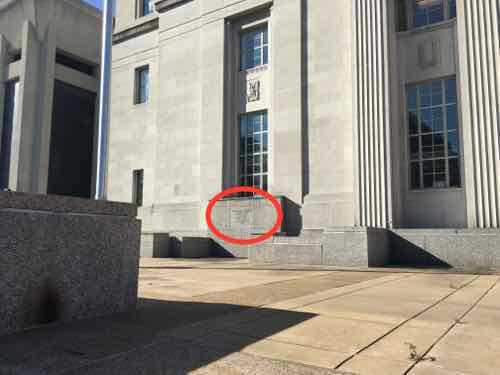
The possibility of the processing moving got me thinking about the history of the Main Post Office on this site. I knew online city records didn’t have the year built, so I’d need to investigate beyond a quick online search. Buildings from this era usually had cornerstones — people weren’t embarrassed to have their names displayed on them for eternity. Though I’d never seen a cornerstone here before, I knew one had to exist.
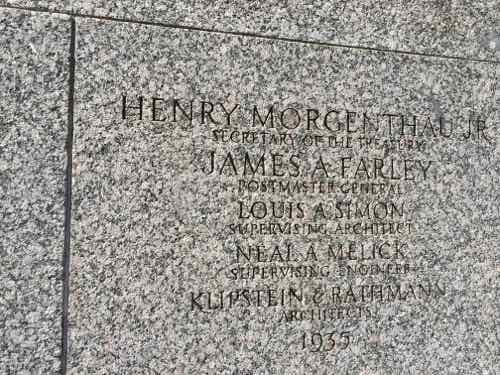
I spotted it, but couldn’t get closer in my wheelchair. I returned home to get my cane.1935 and architects of Klipstein & Rathmann should be sufficient to find out more
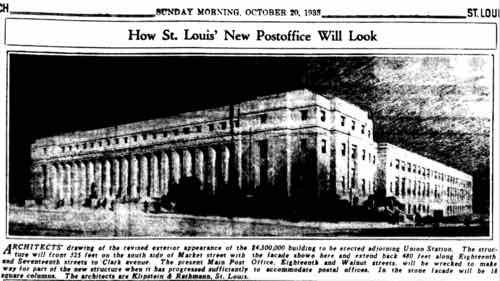
Back home I found online that an article from October 1935 talks about the design. So off to the 3rd floor genealogy department at the Central Library to find it on microfilm. Note: searching Post-Dispatch articles 1874-1922 can be done online through a free database, using your library card account for access.
On October 20, 1935 the design was shown in the Post-Dispatch. From the caption: “The present Main Post Office, Eighteenth and Walnut streets, will be wrecked to make way for part of the new structure when it has progressed sufficiently to accommodate postal offices.”
So we know the Main Post Office in October 1935 was at 18th & Walnut, from the article:
The excavation and foundation work have been completed for some time. It is estimated that it will take 900 calendar days, approximately two and a half years, to complete the superstructure. The architects are Klipstein & Rathmann of St. Louis, Engineers are W. J. Knight & Co, on structure. John D. Falvey on mechanical work and Joseph A. Osborn on electrical work.
An earlier post office, at 18th & Walnut, was razed to build the present one between 17th-18th. An older post office annex building still exists between the Union Station train shred and 18th Street.
Foundations done for some time? An earlier paragraph explains the delay:
Construction of the superstructure was delayed by the Supreme Court decision on the NRA which necessitated asking for new bids. Representative John J. Cochran of St. Louis has been in constant communication with the procurement division of the Treasury and with the Post Office Department in an effort to speed up the project.
NRA? A different one.
National Recovery Administration (NRA), U.S. government agency established by President Franklin D. Roosevelt to stimulate business recovery through fair-practice codes during the Great Depression. The NRA was an essential element in the National Industrial Recovery Act (June 1933), which authorized the president to institute industry-wide codes intended to eliminate unfair trade practices, reduce unemployment, establish minimum wages and maximum hours, and guarantee the right of labour to bargain collectively.
The agency ultimately established 557 basic codes and 208 supplementary codes that affected about 22 million workers. Companies that subscribed to the NRA codes were allowed to display a Blue Eagle emblem, symbolic of cooperation with the NRA. Although the codes were hastily drawn and overly complicated and reflected the interests of big business at the expense of the consumer and small businessman, they nevertheless did improve labour conditions in some industries and also aided the unionization movement. The NRA ended when it was invalidated by the Supreme Court in 1935, but many of its provisions were included in subsequent legislation. (Encyclopedia Britannica)
Besides serving the postal needs of St. Louis, the new building will be a distributing center for all postal supplies, machinery ns equipment for post offices throughout the Southwest.
The new post office opened in 1937. so that takes care of the history, right? Not quite. From the 1935 photo caption we know the previous Main Post Office was at 18th & Walnut, but because the current post office Walnut Street doesn’t exist between 16th-18th. So I turned to Sanborn Fire Insurance maps:
The Sanborn Fire Insurance Map Company, established in 1867, compiled and published maps of U.S. cities and towns for the fire insurance industry to assess the risk of insuring a particular property. The maps are large scale plans of a city or town drawn at a scale of 50 feet to an inch, offering detailed information on the use made of commercial and industrial buildings, their size, shape and construction material. Some residential areas are also mapped. The maps show location of water mains, fire alarms and fire hydrants. They are color-coded to identify the structure (adobe, frame, brick, stone, iron) of each building. Between 1955 and 1978, the Library of Congress withdrew duplicate sheets and atlases from their collection and offered them to selected libraries. Maps for Missouri towns and cities were given to the MU Libraries. Documenting the layout of 390 Missouri cities from 1883 to 1951, the University of Missouri-Columbia Ellis Library Special Collections Department has digitized 6,798 of the maps for Missouri cities from 1880 to 1922.
This Project is supported by the Institute of Museum and Library Services under the provisions of the Library Services and Technology Act as Administered by the Missouri State Library, a division of the Office of the Secretary of State.
Most of the ones for St. Louis are from 1907-1911.
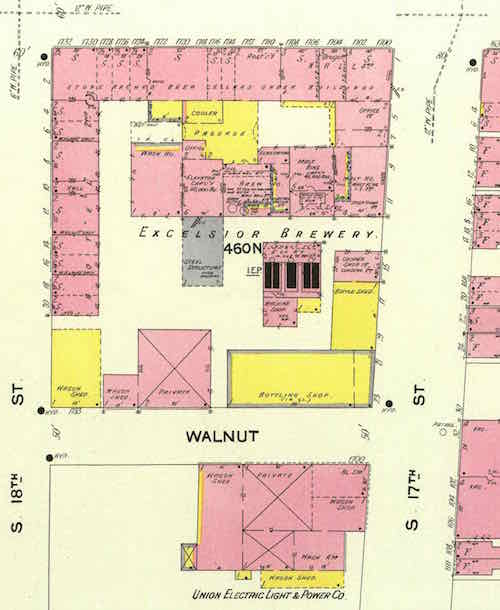
This December 1908 view has Market on the North (top), 16th on the East (right), Clark on the South (bottom), and 18th on the West (left). I’d long assumed that Walnut existed between 16th-18th, but in 1909 it didn’t exist between 16th-17th. A street called Moore runs parallel to 17th. Click image to view larger version.Trying to find the previous post office I zoomed in on 18th & Walnut
In the block bounded by Market, 17th, Walnut, and 18th is Excelsior Brewery. The only thing South of Walnut is a Union Electric building with vacant land. My unconfirmed assumption was a post office was built after December 1908 o the block South of Walnut. So the new post office replaced the brewery? That was my initial hunch, but it’s far more complicated.
An article from October 21, 1917 has the headline: “$1,000,000 HOTEL PLANNED TO FACE UNION STATION”. The “skyscraper type” hotel would have 450-500 rooms, to be built by someone from Oklahoma. From that article:
The site, which is owned by the St, Louis Brewing Association, will be acquired either under a 99-year lease or by purchase outright. Norman Jones, secretary and treasurer of the brewing association, stated the owners are not interested in the project, but are desirous of leasing the site for improvement with a building of the nature stated. He said the association would either lease or sell the plot, and for that reason it had declined to tie it up with short-term leases. He stated that the association had plans, several years ago, for a large hotel for this plot, but that they had been lost.
The Market street frontage is filled with a conglomeration of small stores, picture theaters and saloons. The rear, or Walnut street side of the block, was occupied by the Excelsior Brewery, the building of which was recently razed.
Several years ago a group of Chicago capitalists head this block under consideration for improvement with a large hotel structure, but the project collapsed when Europe was plunged into war.
This 1917 article says this hotel would be compatible with the St. Louis Real Estate Exchange’s plans for a plaza in the catty-corner block bounded by 18th, Market, 19th, and Chestnut. Side note: that plan eventually doubled in size to 20th, it was fined by a 1923 bond issue. The centerpiece Meeting of the Waters fountain & sculpture were completed in 1939 — two years after the new Post Office opened.
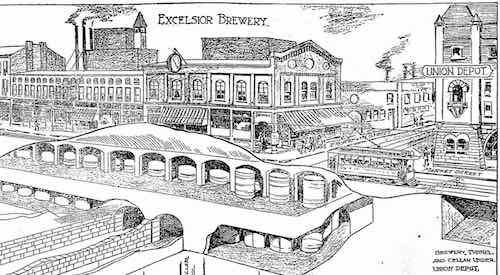
This July 6, 1902 drawing on caves in the area shows the storefronts on the left and Union Station on the right
An article from November 11. 1917 says an $800,000 13-story hotel with 700 rooms was to be built on the Northeast corner of 18th & Market.
A brewery previously existed where Union Station was built, this was operated by the Uhrigs — who earlier had opened a beer garden at Jefferson & Washington.
A Julius Winkelmeyer and Frederich Stifel moved there small operations to 18th & Market in 1846, it was started the year before at Convent & 2nd.
Ok, so both 1917 hotel plans failed, the brewing association sold the Southeast corner years later for the post office? Yes and no, respectively.
Ever since the Terminal Railroad Association of St. Louis opened Union Station on September 1, 1894, there was an effort to “improve” the appearance of the blocks facing it. Prohibition lasted from 1920-1933. A week ago I found an article suggesting they had bought the Excelsior Brewery property, my assumption is they sold or donated it for the new post office.
At some point I may return to dig more into the history of this intersection, but I’ll stop for now.
A little local history about gender-related issues before I get into today’s poll:
July 6, 1916
The commissioner of parks and recreation proclaimed that the new plan for the city’s swimming pools was a success: ladies were to swim in the morning hours and men in the afternoon and evenings. Homeowners in the neighborhood of Fairground Park had complained that the mixing of the sexes in an informal atmosphere at the swimming pool might attract undesirables. The disapproving residents were joined by members of the Catholic and Protestant clergy.
In spite of official and clerical sanction, the city’s director of public welfare called the plan a failure. Attendance, especially of women, had fallen off considerably. Newspapers made light of the situation, suggesting that if a gentleman wanted ri take HER swimming, he’d better try the Meramec. Common sense and the emergence of women as full citizens resulted in the later opening of municipal pools to men and women, boys and girls, together, with no disastrous consequences. (Source: St. Louis Day by Day by Frances Hurd Stadler, pp: 127-128)
A century later the issue is about those who are transgender — physically born as one gender, but identifying as the other. So we have the transgender bathroom debate, the subject of today’s poll:
AARP Livibility Index
The Livability Index scores neighborhoods and communities across the U.S. for the services and amenities that impact your life the most
Built St. Louis
historic architecture of St. Louis, Missouri – mourning the losses, celebrating the survivors.
Geo St. Louis
a guide to geospatial data about the City of St. Louis