St. Louis City & County Voters Rejected Same Four Amendments, Two Approved Statewide

A decade ago Missouri voters amended our state constitution to ban same-sex marriage, but the majority of voters in the City of St. Louis voted no. As is often the case, city voters differed from state voters. I’ve not looked at previous elections, but this year voters in St. Louis County voted against the same four amendments.  Two amendments city & county voters rejected, Amendments 1 & 5, were approved by statewide voters.
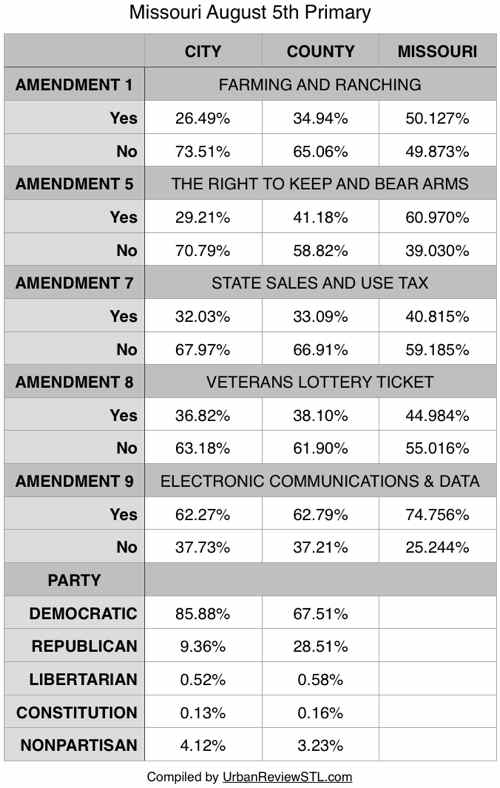
caption
caption

I couldn’t locate statewide information on the number of ballots cast from each party, most likely greater than half were Republican.

The amendment that received the most votes was #7, a 3/4-cent sales tax for roads.

Transportation officials have been working for more than a decade to find more money. In 2002, voters defeated a proposed $483 million sales and fuel tax increase.

“There is no perfect solution,” said Kehoe, the sponsor. He said Amendment 7 was crafted around polling that showed a sales tax was most likely to pass at the polls. He said the fuel tax would have to be raised 20 to 25 cents per gallon to generate the money needed. (stltoday)

As you’ll see, Missouri has long resisted increases in the fuel tax. Here is the text from MoDOT’s funding history page:

Funding History

 2008

In July, the start of fiscal year 2009, Amendment 3 is fully phased-in, providing MoDOT with all of the motor vehicle sales tax revenues previously going to General Revenue.

MoDOT sold bonds for a portion of the new Interstate 64, a design-build project in the St. Louis region. For the first time, MoDOT secured bonds primarily with federal funds, rather than state funds. These bonds are called Grant Anticipation Revenue Vehicle (GARVEE) bonds.

2004
In November, Missouri voters approved Constitutional Amendment 3, which requires all revenues collected from the sale of motor vehicles come to MoDOT. Previously, half of the sales tax went to MoDOT and half to the state’s general revenue fund. It requires the Missouri Highways and Transportation Commission to issue bonds for building highway and bridge projects and uses these additional revenues to pay back the bonds over a period of time. The additional Amendment 3 revenues are to be phased-in over a 4 year period in 25 percent increments.

2002
Legislation is passed extending the 6-cents-per-gallon motor-fuel tax, which was due to expire in 2008. Proposition B, an omnibus transportation bill that would have increased the motor-fuel tax by 4 cents per gallon and the general sales tax by 1/2 percent, is defeated by voters by a 3-to-1 margin.

2000
Legislation was passed, effective May 30, 2000, allowing MoDOT to issue $2.25 billion in bond financing to accelerate highway improvements. Up to $250 million in bonds can be issued in 2000 and up to $2 billion from 2001 through 2006. Projects funded by the first $250 million were required to come from MoDOT’s 5-Year Statewide Transportation Improvement Program. MoDOT can issue up to $500 million per year in bond financing through the year 2006. MoDOT submits a bond financing project list to the Legislature each January for approval.

1992
A 6-cent per gallon increase in the motor fuel tax is passed by the Legislature. The 6 cents is to be phased in over a 5-year period; 2 cents in 1992, 2 cents in 1994 and 2 cents in 1996.

1987
Proposition A, a constitutional amendment to increase the motor fuel tax by 4 cents per gallon, is approved by the people. It becomes effective June 1.

1984
Fees for motor vehicles and truck classes not raised in 1983 are increased.

1983
Fees for some classes of trucks are increased.

1982
Proposition B, a constitutional amendment to raise the motor fuel tax by 4 cents per gallon, is defeated by the people.

1979
Voters approve a constitutional amendment changing the CART distribution formula. Counties receive 10 instead of 5 percent, cities receive the same 15 percent and the state receives 75 instead of 80 percent. The law is effective Jan. 1, 1980. The amendment also merges the Highway Department with the Transportation Department. Also included in this legislation is a provision that one-half of the motor vehicle sales tax go to finance road and bridge construction. Of this half, 74 percent would go to the state, 15 percent to the cities and 10 percent to the counties. The remaining 1 percent goes for planning of other transportation modes.

1978
An initiative petition to increase the fuel tax 3 cents per gallon is defeated.

1972
The Legislature passes a bill increasing the gas tax from 5 cents to 7 cents per gallon.

1961
The Legislature passes a bill temporarily raising the fuel tax from 3 cents to 5 cents per gallon. The bill provides that a constitutional amendment be put before the people which would allow cities and counties to share in state motor fuel tax revenues. If the amendment is not submitted within six months, or if it is rejected, the tax would revert to 3 cents. Voters approve the amendment on March 6, 1962, and the 5-cent per gallon tax becomes permanent. This act establishes the County Aid Road Trust program.

1952
On March 24, an act is approved increasing the motor vehicle tax from 2 cents to 3 cents per gallon. The law becomes effective July 29.

1950
On April 4, Missourians again reject a referendum proposal to increase the motor vehicle tax. The proposal would have increased the tax from 2 cents to 4 cents per gallon.

1938
On Nov. 8, the people defeat by referendum election an attempt of the Legislature to raise the fuel tax from 2 cents to 3 cents per gallon. At the same time, an initiative petition proposal to amend the Constitution to fix the fuel tax at 3 cents for 10 years is also defeated.

1924
A 2-cent tax rate for motor vehicle fuel is adopted by a vote of the people under initiative petition. It is the state’s first motor fuel tax.

From the above I made this list of the fuel tax rate since 1924:

  • 1924 2-cents
  • 1952 3-cents (28 years, 100% increase)
  • 1961: 5-cents (9 years, 66% increase)
  • 1972: 7-cents (11 years, 40% increase)
  • 1987: 11-cents (15 years, 57% increase)
  • 1992: 13-cents (5 years, 18.18% increase)
  • 1994: 15-cents (2 years, 15.38% increase)
  • 1996: 17-cents (2 years, 13.33% increase)

It has now been 18+ years since the fuel tax was increased, the only period longer was the first increase after the initial tax! Had the 1990s 2-cent increase every two years continued we’d be at 34-cents — double the current rate. We’d still be lower than Illinois and many other states. Amendment 7 proponents say voters rejected a 2002 attempt to raise the fuel tax rate. From above: “Proposition B, an omnibus transportation bill that would have increased the motor-fuel tax by 4 cents per gallon and the general sales tax by 1/2 percent, is defeated by voters by a 3-to-1 margin.” They’d proposed a measly 4-cent fuel tax increase combined with a 1/2-cent general sales tax. I don’t recall how I voted a dozen years ago, but I likely voted no based on the general sales tax increase.

Here’s what should happen:

  • The Missouri legislature should pass legislation to double the fuel tax from 17-cents to 34-cents over the next 5-10 years.
  • The Missouri legislature should pass legislation make I-70 a toll road between Kanas City and St. Louis. This revenue, not the fuel tax, would be used to widen I-70.

We do need to maintain our infrastructure, we should be cautious about adding to the system if we aren’t willing to raise the fuel tax. Why build more miles of highway if we can’t maintain what we have now?

— Steve Patterson
 

Readers: Horses Pulling Carriages Downtown Are Fine; City Vet Makes Recommendations

August 6, 2014 Downtown, Featured 2 Comments

More than half the readers last week indicated the horses pulling carriages downtown are fine, here are the results:

Q: St. Louis’ Director of Health wants to ban horse carriages, we should:

  1. ignore her, the horses are fine 96 [51.61%]
  2. Increase fees on operators to fund inspection & enforcement to protect the horses 50 [26.88%]
  3. ban them, it’s cruel to the horses 27 [14.52%]
  4. Unsure/No Opinion 12 [6.45%]
  5. Other: 1 [0.54%] “Streets of DT smell like pee, they should be banned or clean up after themselves”

While I don’t think they should be banned, I do see room for improvement.

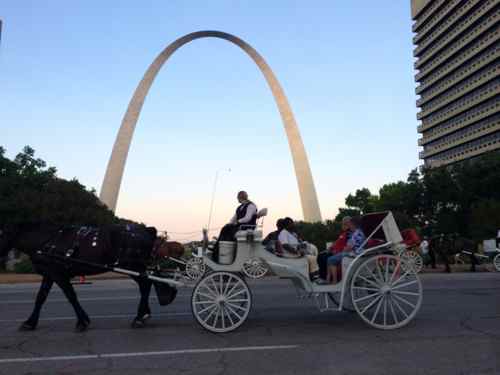
A horse-drawn carriage on 4th Street

The city’s veterinarian also sees room to improve, here’s her recommendations:

Based upon my assessment, investigation, and professional judgement, I recommend the following actions be taken at a minimum:

  • Ensure that carriage horse stables operating within the city are held to the current standards and best practices of equine husbandry including but not limited to:Work with carriage horse stables to improve record keeping and access to records such as: medical records (including most recent Coggins test); farrier records; work schedules; and number of weeks on/off duty.
    • Adequate fresh air and ventilation (i.e. individual and industrial fans in good repair combined with windows, doors, grates, vents and eaves).
    • Fastidious cleaning practices to minimize horse exposure to dust, debris and odor.
    • Ideally, storage of food and bedding materials in an area separate from the horse barn.
  • Develop a system of welfare checks enacted by Health Department Animal Control Officers and City Veterinarian. This would include inspection of stables as well as horses working in the field at various times of day/night.
  • Develop a consistent hot weather policy for working carriage horses and ensure that it is adhered to.
  • Requiring that the individual horse, Moose, undergo a complete respiratory diagnostic work­up and is found to be healthy and unremarkable prior to his return to the city for use as a carriage horse. Primarily, he should have Bronchoalveolar Lavage performed to rule­in or rule­out Inflammatory Airway Disease (IAD) and quantify the severity of the condition if present, as a variety of management techniques and therapies may be indicated at that time. This work­up should be performed in collaboration with the City Veterinarian.

Included in this document find only the earnest observations, opinions, and recommendations of the veterinarian serving the City of St. Louis.

Dr. Sarah Frei Veterinarian,

City of St Louis 2801 Clark Ave St. Louis, MO 63103

You can read her full assessment here. Additional information is available on the Department of Health’s Carriage Horse page. The press release indicates:  “The Department is also requiring that, effective immediately, all horses not be worked when the maximum heat index reaches 100 degrees on any single day.”

— Steve Patterson


Missouri Primary Today

The St. Louis Board of Election Commissioners is on the first floor at 300 N. Tucker (@ Olive)

Today is Missouri’s primary election, please be sure to go vote if you’re registered.

Here’s a couple of related posts from last week:

The polls are open 6am-7pm. It took me a while to find the hours, it wasn’t on the postcard or website from STLElections.com.  I finally found it on Ballotpedia.

— Steve Patterson


Parking Battle Close To Home

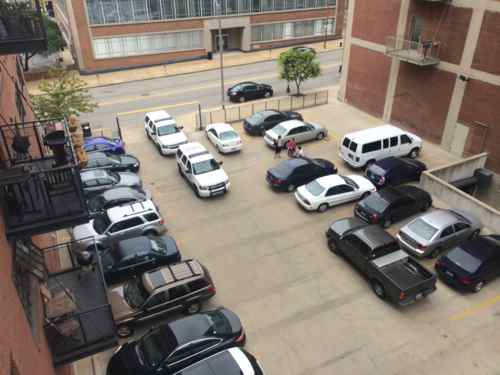
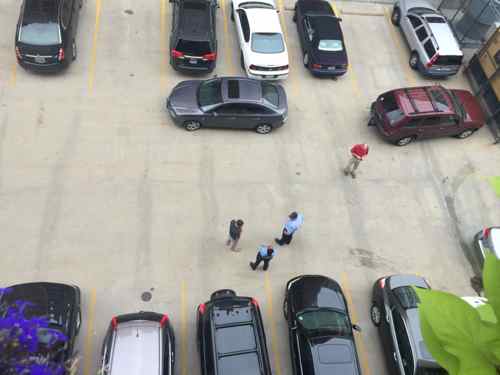
I often write about parking issues, like the Arcade building needing additional parking to get renovated. Closer to my loft I’ve written this year about the former CPI parking lot to the north of my building. Today’s post is even closer — the small private lot that’s park of my condo association. On Friday July 25th I noticed some commotion outside, out on the balcony I see more cars than usual and two police vehicles.

View from ,my balcony on Friday July 25th.
Police officers talking to a person whose car is blocked and a person who blocked.

The tenant in the commercial space of my building, upset that residents of our two buildings sometimes park in “their” lot, parked in a way that blocks resident’s vehicles. Some condo owners, myself included, have read the condo docs over and over concluding the spaces in this parking lot are a common use area, not deeded to the owner of the commercial spaces. The parking below is common use but our spaces are legally deeded to us. The original developer, who retains ownership of both commercial spaces, insists the parking lot is for use by commercial tenants only. The other commercial space is vacant.

Here’s what I see going on:

  • A lot of my neighbors, single & couples, have just one car which they park in their garage space. Lots of other couples have two cars, with some having spaces for both.  Still, we have many 2-car couples where one vehicle must be parked outside.
  • The tenant used to share the parking lot when the other commercial space was occupied, but since it closed a couple of years ago they’ve decided all spaces are theirs.
  • When the developer gets a new tenant for the vacant space this tenant will need a strategy for reducing the number of employee vehicles.

Personally I think my neighbors (residents & tenant) need to take a serious look at bicycling and/or public transit. When you live/work in suburbia abundant free parking is a given, but when you decide to live or locate your firm downtown you can’t continue to have the same expectation. My husband and I have one car between the two of us. We’re hoping Enterprise CarShare will add some vehicles west of Tucker for those rare times we both need a vehicle.

On Washington Ave, a block north, we have the #94 & #97 MetroBus lines, with #10 on Olive, a block south. Two blocks east on 14th we have the #32, #31, & #74, the #99 downtown trolley stops a couple of blocks away. Within a 1/4 mile are more bus lines. Sure, there are couples that work far away in opposite directions, but I bet among residents and the tenant’s staff are people that could fairly easily use public transit.

— Steve Patterson


Poll: Is Allowing A 7-9 year Old Child To Play At A Local Park ‘Child Neglect’?

August 3, 2014 Featured, Parks 9 Comments
Please vote in the poll, located in the right sidebar

The St. Louis region has many beautiful parks, many within walking distance of resident’s homes.  But last week events in South Carolina and Florida might give parents pause before allowing their kids to go play in the nearby park.

In South Carolina a mom was arrested after allowing her 9-year old daughter to play in the park unsupervised:

She spent 17 days in jail, temporarily lost custody of her girl, thought she lost her job, and still faces 10 years in prison if convicted of felony child neglect. (CBS News

A very similar case reported in Florida the next day when a mom allowed her 7-year old to play in a park:

Dominic was playing when Port St. Lucie Police pulled up. Police took him home and arrested his mom charging her with child neglect. (source)

Judging by the online discussion of these two arrests I thought this would make a great poll question for this week. Here’s the question: Is allowing a 7-9 year old child to play at a local park ‘child neglect’? The poll is in the right sidebar, you can share your thoughts in the comments below.

— Steve Patterson


Advertisement


[custom-facebook-feed]

Archives

Categories

Advertisement


Subscribe