My Vision Is Better Than It Was On Sunday!

August 22, 2018 Featured, Steve Patterson Comments Off on My Vision Is Better Than It Was On Sunday!

Sunday’s non-scientific poll was about vision. My poll answers are still the same, but my vision is better today than it was on Sunday. Monday morning I had outpatient surgery on my left eye to remove the cataract.

A cataract is a clouding of the lens in the eye which leads to a decrease in vision. Cataracts often develop slowly and can affect one or both eyes. Symptoms may include faded colors, blurry vision, halos around light, trouble with bright lights, and trouble seeing at night. This may result in trouble driving, reading, or recognizing faces. Poor vision caused by cataracts may also result in an increased risk of falling and depression. Cataracts cause half of all cases of blindness and 33% of visual impairment worldwide. (Wikipedia)

Over a decade ago, not long after my stroke, I was diagnosed with early cataracts — my lenses were just beginning to cloud over.

Like the myth about the frog in boiling water, the change is gradual.  Myth because the frog would notice and would jump out. Over the years I’d learned how to compensate — going into a building because I couldn’t see my phone’s screen outside, having apps set on the largest text option, not driving when glare would be an issue. This year I jumped out of the pot and asked my physician to refer me to a specialist. The first ophthalmologist that examined me agreed both lenses should be replaced, I just needed to come back to make sure the surgeon concurred.
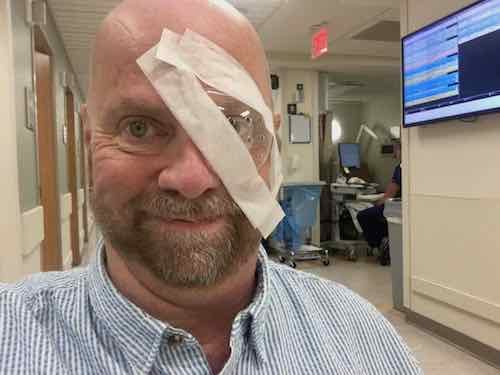
Monday as I was about to be wheeled out of the Center for Advanced Medicine

She did, no prescription would help me see as well as I should. On Monday I got a new lens in my left eye — it also corrected my near vision. Colors are more vivid, everything is sharp now.

The right eye will hopefully happen soon. I’ll still wear glasses for distance. Cataracts runs in my family — my mom had it, as did her mom. My dad had it. My two older bothers both have it, though the oldest has had one lens replaced. For some, like me, it starts earlier and progresses faster. Lucky me…

Through all this I thought about a 60 Minutes story from April 2017 — two US doctors who travel to other countries to perform the surgery I just had:

U Myint Oo hadn’t seen for two years, until this moment. Others here had been blind for decades. They all had cataracts – a milky, white build-up of protein that clouds the lens of the eye.  In the U.S. they mainly afflict the elderly; removing them – a routine operation. But here in Burma, also known as Myanmar, cataracts go untreated and blindness is a way of life. (CBS News/60 Minutes)

Yes, left untreated cataracts gradually leads to blindness. This is why my maternal grandmother had her cataracts surgeries in the early 1960s — back then it was a major operation that required hospitalization — and it didn’t correct vision — just removed the clouded lens. She wore thick glasses, but wasn’t blind. A few years later Dr. Charles D. Kelman’s research changed the process:

In 1967, the phacoemulsification procedure was introduced. Instead of making a large incision in the eye and removing the lens, doctors could make a tiny one. Then they inserted an ultrasonic tip which, vibrating thousands of times a second, broke up the cataracts without damaging the surrounding tissue. The remains of the cataract were suctioned out.

The procedure, which Dr. Kelman taught to thousands of doctors around the world, is now performed more than a million times a year in the United States alone. Artificial lenses that he developed in the 1970’s are now routinely implanted in patients’ eyes, making unnecessary the ultrathick glasses that once were common after surgery. And his ultrasonic approach has been adopted in other fields of medicine, including neurosurgery. (New York Times)

Both of my parents, already in their 70s, had both eyes done in the 2000s. I recall my mom being so thrilled — something I can finally understand. Sadly, she died just a few years later. After my mom died my dad had both of his cataracts removed, but was hospitalized & died just after the 2nd — completely unrelated to the cataract surgery. Getting mine done at 51, I hope to have many more years of enjoying good vision again.
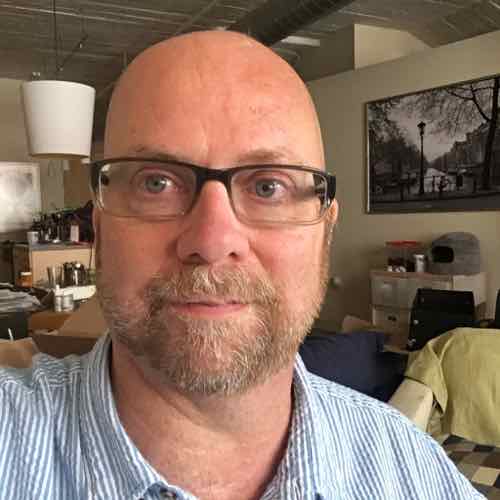
Yesterday after returning home from my followup with the surgeon

Cataracts is one of the big four causes of adult blindness/low vision:

Four eye diseases — age-related macular degeneration, diabetic retinopathy, glaucoma and cataracts — account for most cases of adult blindness and low vision among people in developed countries. Unlike many other ailments associated with aging, they cause no pain and often no early symptoms and thus do not automatically prompt a person to seek medical care. But a thorough checkup by an ophthalmologist can detect them in their earliest stages, followed by treatment that can slow or halt their progression or, in the case of cataracts, restore normal vision.

Macular degeneration, a leading cause of vision loss in Americans 60 and older, involves an irreversible loss of retinal cells that robs people of the central vision needed to read, watch a TV program or identify a face or object in front of them. There are two types, dry and wet. In the dry type, the light-sensitive cells in the macula, a structure near the center of the retina, gradually break down. In the wet type, abnormal blood vessels grow under the macula.

Steps you can take to lower your risk of macular degeneration or slow its progression include not smoking, eating lots of dark leafy green vegetables, wearing sunglasses to block ultraviolet light, and taking one or more supplements formulated to support macular health. There are also treatments specific for wet A.M.D., including laser surgery, photodynamic therapy and drugs that are injected into the eye to slow the growth of abnormal blood vessels.

Diabetic retinopathy, the cause of most blindness in American adults, also affects the light-sensitive retina, damaging the vision of more than half of people with diabetes age 18 or older. The most effective preventive is maintaining a normal level of glucose in the blood through medication and a proper balance of diet and exercise. Blood glucose should be routinely monitored, high blood pressure effectively treated and smoking avoided entirely.

Glaucoma, another leading cause of blindness, involves a rise in fluid pressure inside the eye that damages the optic nerve. It affects more than four million Americans, about half of whom don’t know they have it, and is especially common among African-Americans and Hispanics. It can be detected with a comprehensive eye exam, which should be done annually for African-Americans and those with a family history of the condition.

Although glaucoma is not curable, treatment to lower pressure in the eye with prescription eye drops and, in some cases, pills or surgery can control the condition.

Cataracts are the most common cause of vision loss among people over 40. They involve a gradual clouding of the lens, a normally transparent tissue directly behind the iris and pupil that helps to focus images on the retina. As cataracts progress, it becomes increasingly difficult to see clearly, impairing the ability to read, drive or recognize faces.

Preventing or slowing the development of cataracts involves protecting the eyes from sun damage, not smoking, consuming a diet rich in vegetables and fruits and, if you have diabetes, keeping blood sugar under control.

In years past, doctors often advised patients with cataracts to wait until they were far advanced before removing them surgically. This is no longer the case. Cataract surgery is now done when the condition begins to affect a person’s quality of life or interferes with the ability to perform normal activities.

The surgery is nearly always done under local anesthesia on an outpatient basis. If both eyes have cataracts, as is usually the case, the second eye is typically treated some weeks after the first to avoid the rare risk of a postoperative infection in both eyes. The operation involves removing the clouded lens and, in most cases, replacing it with a clear artificial lens that often gives patients better vision than they had even before developing cataracts. (New York Times)

Here are the results from the recent non-scientific Sunday Poll:

Q: How is your vision? Check all that apply.

  • I wear prescription glasses: 14 [38.89%]
  • I often wear sunglasses: 7 [19.44%]
  • I don’t need glasses/contacts: 6 [16.67%]
  • I wear prescription contacts: 4 [11.11%]
  • I have reduced vision: 3 [8.33%]
  • TIE: 1 [2.78%]
    • I have cataracts
    • I have glaucoma
  • TIE: 0 [0%]
    • I’ve had laser or other surgery to correct my vision
    • I have no vision (blind)
    • I have age-related macular degeneration
    • I have diabetic retinopathy

If you haven’t had an eye exam in the last couple of years, please do so soon.

— Steve Patterson
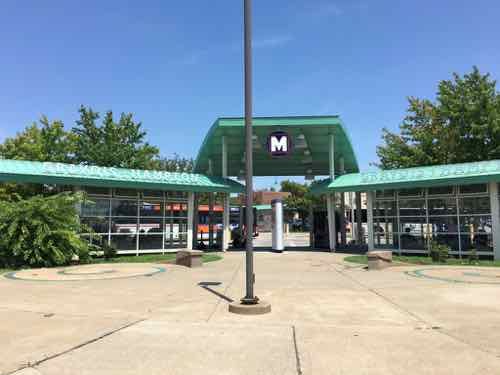
 

Well-Used Bus Stop Is A Muddy Hole After It Rains

August 20, 2018 Accessibility, Featured, Public Transit, Transportation, Walkability Comments Off on Well-Used Bus Stop Is A Muddy Hole After It Rains

Usually when I go to my regular doctor I take either the #97 (Delmar) MetroBus or MetroLink to connect with the southbound #90 MetroBus at Goodfellow or Forest Park station, respectively. However, depending on the bus schedule and my appointment time I’ll take the #10 MetroBus from Olive @ 16th to the Gravois-Hampton MetroBus Transit Center, and then catch the #90 MetroBus heading northbound. The alternative takes about 15 minutes longer, but often will get me to my destination closer to my appointment time.

The #10 (Lindell-Gravois) MetroBus ends at the transfer center on the NE corner of Hampton & Gravois

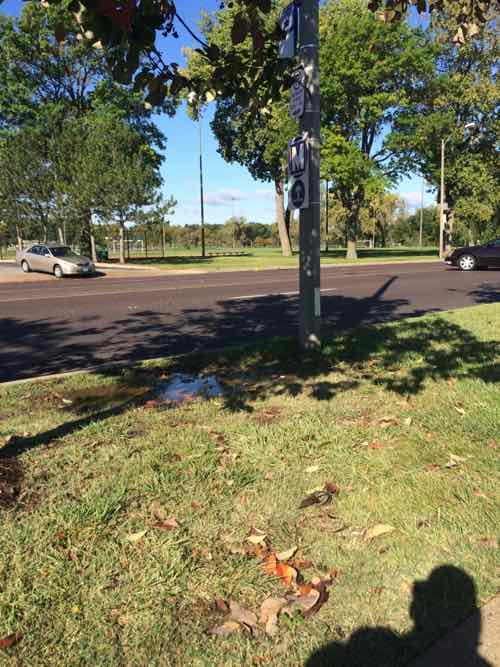
But I only take the Gravois-Hampton alternate if it hasn’t rained recently. You see, the bus stop I use to catch the Northbound #90 is a muddy hole if it has rained recently.

The bus stop is where thw standing water is on this October 2014 photo.

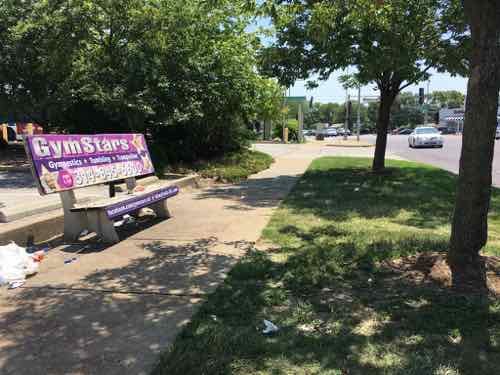
‘The Northbound #90 bus stays on Hampton rather than pulling into the transit center. Riders getting off/on must use the grassy tree lawn.

At the bus stop looking South toward the MetroBus transit center
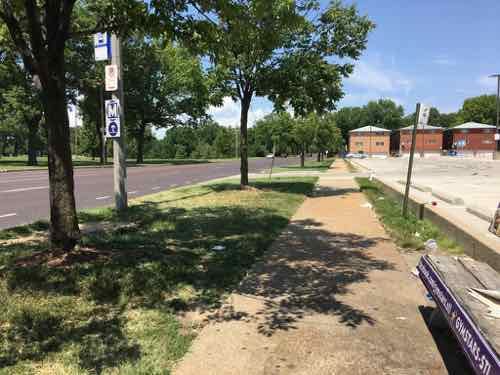
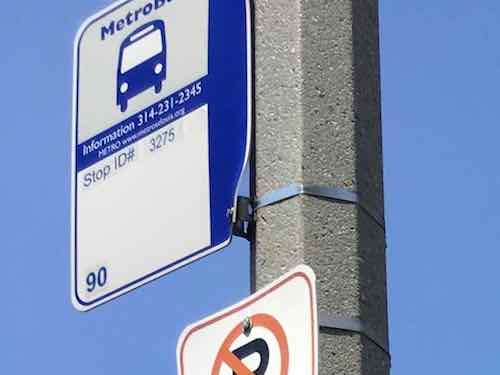
Looking North, note the bus stop sign is mounted very high on the poll — and facing the street. I couldn’t read the stop ID from my wheelchair.
Cropping later I could see it’s stop #3275
The tree lawn is quite wide here, you can see how the grass is well-worn.
Up close I could see a tire track likely made when it was muddy

Even dry this stop is a problem when boarding. When the bus driver puts out the ramp/lift it leaves a huge gap my chair must get up — this is because all the use has worn this spot down so it’s lower than the curb and surrounding grass. Recently I was waiting in the grass just before the stop to avoid this problem. It’s adenegrated  experience for everyone dry or wet, impossible for us wheelchair users when wet.

Metro occasionally gets grants to improve accessibility of MetroBus stops — #3275 needs to be toward the top of the list for improvement.

— Steve Patterson


Sunday Poll: How Is Your Vision?

August 19, 2018 Featured, Sunday Poll Comments Off on Sunday Poll: How Is Your Vision?
Please vote below

Most of us experience cities through all our senses, primarily visually. For those with reduced visibility/blindness the city experience is different.

Navigating a mega-city like London on foot can be a fraught experience no matter who you are. But as a sighted person living in a sighted world, it’s nearly impossible to imagine what that experience can be like with a visual impairment.

Take, for example, the ubiquitous pedestrian crossing. While many in London are outfitted with tactile pavements to indicate where to cross and a protruding “cone” device at the bottom of the control box, it can easily take a blind person 10 seconds to orient themselves enough to safely enter the street. In that time, dozens of sighted Londoners may have already crossed the street without giving it much thought. (The Guardian)

It’s no surprise the public fears vision loss:

A recent study from researchers at the Wilmer Eye Institute at Johns Hopkins University School of Medicine found that most Americans regard loss of eyesight as the worst ailment that could happen to them, surpassing such conditions as loss of limb, memory, hearing or speech, or having H.I.V./AIDS. Indeed, low vision ranks behind arthritis and heart disease as the third most common chronic cause of impaired functioning in people over 70, Dr. Eric A. Rosenberg of Weill Cornell Medical College and Laura C. Sperazza, a New York optometrist, wrote in American Family Physician. (NY Times)

Today’s poll relates to vision.

This poll closes at 8pm tonight. Wednesday I’ll share the non-scientific results and some personal news on the subject.

— Steve Patterson


Where Am I? Facebook Page Cover Image Contest

August 17, 2018 Featured, Site Info Comments Off on Where Am I? Facebook Page Cover Image Contest

I’ve often changed the cover image of the UrbanReviewSTL Facebook page, but now I’m asking “Where Am I?” for most images.

Click image to go to Facebook page to comment on cover photos.

In the above example, which will ne uploaded this morning, three buildings are visible. The best answer will identify all three.

The reward for getting the first correct answer? Zip, nothing, etc. If this interests you like the page and look for notifications of new cover photos.

Have a great weekend!

— Steve Patterson

b

b


Economic Impact of PGA Championship Won’t Be Felt Where Needed Most; St. Louis Looked Favorable To A Wide Audience

August 15, 2018 Economy, Featured, St. Louis County Comments Off on Economic Impact of PGA Championship Won’t Be Felt Where Needed Most; St. Louis Looked Favorable To A Wide Audience

When it comes to economic impact estimates I’m largely a skeptic. Such was the case with last week’s PGA Championship:

The 100th PGA Championship Aug. 9-12 is expected to have an economic impact felt well beyond Bellerive Country Club’s picturesque course, up to $100 million, according to some estimates. Hotels are filling up downtown, nearly 20 miles from the course that’s situated in a mostly residential area with few hotels nearby. (Post-Dispatch)

Two key words: “Up to…” OK, so $100 million is the estimated maximum impact. What’s the very minimum? $10 million? $25 million? $50 million?   And “bel beyond?” I seriously doubt it’ll be felt in the region’s poorest zip codes.

I took a photo of my TV on Sunday

I’m not the only one questioning these estimates.

This month’s PGA Championship in St. Louis will generate $102 million in economic benefits for the state of Missouri.

Actually, it won’t. But inevitably, many fans watching or reading about the PGA Championship will hear or see that figure thrown about.

As in every sport these days, big events bring big claims of economic windfalls for the host cities. Tourism officials on Long Island projected the U.S. Open at Shinnecock Hills would generate $120 million in economic benefit. (Or maybe it was $130 million. Who’s counting?) A similar number was floated by the Angus (Scotland) Council this year with regard to the British Open at Carnoustie. Over the years, the Masters has been said to bring in a comparable nine-figure haul to Augusta, Ga. (GolfWeek)

The reasons are numerous. A lot of the fans that crowded into Bellerive Country Club were local. The money they spent on tickets, merchandise, food, etc would’ve likely been spent within the region anyway. Much of what they spent will leave the region, Visitors to St. Louis did spend money, hotels corporations will enjoy the profits. Some local businesses, such as those near parking venues, saw an uptick in business.

The 47,000 square-foot Championship Shops merchandise venue is located at the Main Entrance along the spectator walkway. This merchandise shopping experience offers men’s, women’s, and children’s apparel and headwear from major brands including Ralph Lauren, Nike, Adidas, Cutter and Buck, Under Armour, FootJoy, Travis Mathew, Forty Seven Brand, New Era, and many more! The Championship Shops also offers a major selection of exclusive accessories, gifts, and memorabilia. (PGA)

Hopefully the new money added to our economy meets or exceeds the money leaving our economy. Though I view televised golf as an event that too often delayed the news or 60 Minutes, I know championship events likely never benefit low income areas. How would they?  Golf and say North St. Louis have no connection. Oh wait…

Bellerive Country Club began in 1897 in north St. Louis as a nine-hole course with 166 members. In 1910, the membership incorporated as Bellerive Country Club, naming the club after Louis St. Ange De Bellerive, the last French commander in North America.

That same year, Scotsman Robert Foulis designed the “new Bellerive” in Normandy where the club remained for 50 years.

Led by Hord Hardin and Clark Gamble, the membership decided to move west in 1955, and allowed renowned architect Robert Trent Jones, Sr. to pick a prime farm location for the new site.

The “Green Monster of Ladue” opened on Memorial Day, 1960. (Bellerive Country Club)

I wanted to know more, so I dug deeper:

The club opened 121 years ago in 1897 as The Field Club, founded by several St. Louis sportsmen who wanted a place for golf and other leisure activities. Northwest of St. Louis, the course featured nine holes until another nine were added some years later. It was built on land leased from the estate of War of 1812 war hero Daniel Bissell.

In 1910, the club moved to nearby Normandy and renamed the Bellerive Country Club after Louis Groston de Saint-Ange de Bellerive, the last French governor of Illinois Country in 1765. With a Georgian-style clubhouse, Bellerive’s first notable event was the 1949 Western Amateur Championship. Four years later, it hosted the PGA Tour’s Western Open, won by E.J. “Dutch” Harrison.

In 1957, Bellerive put its 125-acre (0.5 km2) Normandy site on the market for $1.3 million. At the same time, the Normandy School District began discussing the need for establishing a junior college as an affordable alternative to the privately-owned Washington University and Saint Louis University. The club lowered the price to $600,000 and the Normandy Residence Center opened in a renovated clubhouse in 1960 with classes taught by the University of Missouri; the campus became the University of Missouri–St. Louisin 1963 and the nearby village is Bellerive. (Wikipedia)

A local site offers a little more specifics:

1897 St. Louis Field Club builds a 9 hole course near the Bissell Mansion. Triple A Club is organized. The First City Championship is held and E.E. Steedman of The Country Club is the winner. (STLGolfHistory)

I did find one more document with some great info:

ST. LOUIS FIELD CLUB.—On the Burlington Railroad, near St. Louis; a Field Club station is on the links. Organized and incorporated, 1897. Entrance fee, $25. Annual dues, $25. Membership, 127. The course consists of nine holes, which were laid out in October, 1897, by D. O. Ives and A. L. Kenneth.

President, D. O. Ives; vice-president, Harry S. Cullin; secretary, F. R. Bissell, 306 Wainwright Building, St. Louis; treasurer, Jno. S. Carter; governing committee, above officers and A. T. Perkins; greenkeeper, Ed. McNamara. (Official Golf Guide 1899)

At first I thought perhaps it became O’Fallon Park, but it opened in 1908.  I’d love to know a specific location for the course and train station. If anyone knows please comment oj this post on Twitter or Facebook.

Back to the recent PGA Championship — the television ratings, thanks to Tiger Woods, were impressive:

PGA Championship TV ratings are in and you won’t be surprised to learn that CBS is extremely happy with how they turned out. The network is the latest to reap the benefit of Tiger Woods’ latest comeback, announcing a 6.1 rating for Sunday’s final round, up 69 percent from 2017. Woods finished runner-up, but stole the show with a 64 that included a dizzying three-under par front nine in which he failed to hit a single fairway.

The final round peaked between 7:00-7:15 p.m. ET with an 8.3 rating. And St. Louis, where Bellerive Country Club is located, was the No. 1 market during the broadcast with an 11.5. The 6.1 also tied for the highest non-Masters TV rating since the final round of the 2012 U.S. Open. (GolfDigest)

I was one of those who tuned in (briefly) on Sunday.

While I’ll like to see more realistic numbers and an attempt to share the wealth through the region, I cannot stress enough how valuable it was for golf fans worldwide to see St. Louis in a positive context. Not sure if that’ll lead to anything, but can’t hurt how we’re perceived by those outside the region.

— Steve Patterson


Advertisement


[custom-facebook-feed]

Archives

Categories

Advertisement


Subscribe