St. Louis Board of Aldermen Week 19 of 2017-2018 Session
October 13, 2017 Board of Aldermen, Featured Comments Off on St. Louis Board of Aldermen Week 19 of 2017-2018 Session
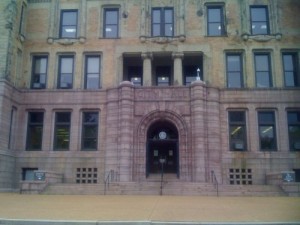
St. Louis City Hall

The St. Louis Board of Aldermen will meet at 10am today, their 19th week of the 2017-2018 session.

ON THE AGENDA* FOR INTRODUCTION TODAY 10//13/17:

*Note that just because a bill is on the agenda doesn’t mean it’ll be introduced, similarly, bills not on the agenda might be introduced if they suspend the rules to do so. This information is based on the published agenda as of yesterday @ 8am:

  • B.B.#141 – Roddy –An Ordinance recommended by the Planning Commission, to change the zoning of property, from “J” Industrial District & “G” Local Commercial and Office District to “G” Local Commercial and Office District only in City Block 3957 (4001-99 Chouteau) and from “B” Two?Family Dwelling District to “G” Local Commercial and Office District in City Block 3965 (4113?15, 4117?19 & 4121?23 Chouteau; and containing an emergency clause.B.B.#142 – Muhammad ? An ordinance approving a Redevelopment Plan for the 4400?44 & 4401?43 Red Bud.
  • B.B.#143 – Vollmer –An ordinance approving a Redevelopment Plan for 5345 Daggett.
  • B.B.#144 – Spencer –An ordinance approving a Redevelopment Plan for 3442?44 California.
  • B.B.#145 – Moore –An ordinance approving a blighting study and redevelopment plan for St. Ferdinand Phase II Redevelopment Area; and containing a severability clause.
  • B.B.#146 – Muhammad –An ordinance approving a blighting study and redevelopment plan for 4100?4798 and 4101?4799 W. Natural Bridge Ave. Redevelopment Area; and containing a severability clause.
  • B.B.#147 – Conway –An ordinance approving a Redevelopment Plan for the 4131 Flora Place.
  • B.B.#148 – Conway –An ordinance approving a Redevelopment Plan for 4212 Botanical.
  • B.B.#149 – Conway –An ordinance approving a Redevelopment Plan for 3931 Russell.
  • B.B.#150 – Ingrassia –An ordinance approving a Redevelopment Plan for 2806?12 Locust.
  • B.B.#151 – Ogilvie –An ordinance approving a Redevelopment Plan for 6755, 6767, & 6769 Nashville.
  • B.B.#152 – Williamson –An ordinance approving a Redevelopment Plan for 1416?18 Union.
  • B.B.#153 – Coatar –An ordinance approving a Redevelopment Plan for 2330?32 S. 12th Street.
  • B.B.#154 – Coatar – An ordinance approving a Redevelopment Plan for 2263?65 Indiana.
  • B.B.#155 – Spencer –An ordinance approving a Redevelopment Plan for the 3422 Oregon.
  • B.B.#156 – Moore –An ordinance amending Ordinance #65955 by expanding the boundary of the 3922?68, 3919?29 & 3939?67 Lincoln Ave. Redevelopment Area to include 3937 Lincoln Ave. and renaming the area the 3922?68, 3919?29 & 3937?67 Lincoln Ave. Redevelopment Area (“Amended Area”).
  • B.B.#157 – Guenther –An ordinance approving a Redevelopment Plan for 3325 Wisconsin.
  • B.B.#158 – Roddy –An ordinance approving a Redevelopment Plan for the 1302 Boyle.
  • B.B.#159 – Coatar –An ordinance approving a Redevelopment Plan for the 1001?03 Russell.
  • B.B.#160 – Coatar –An ordinance approving a Redevelopment Plan for the 2222 Mernard.
  • B.B.#161 – Roddy –An ordinance approving a Redevelopment Plan for the 4170?4174 Manchester.
  • B.B.#162 – Roddy –An ordinance approving a Redevelopment Plan for the 4211, 4219, & 4235?39 Chouteau.
  • B.B.#163 – Roddy –An ordinance approving a Redevelopment Plan for the 4330 & 4337 Gibson Ave. and 4210 Chouteau.
  • B.B.#164 – Roddy –An ordinance approving a Redevelopment Plan for the 4310?20 Vista.
  • B.B.#165 – Roddy –An ordinance approving a Redevelopment Plan for the 1115?23 N. Newstead Ave.
  • B.B.#166 – Conway –An ordinance approving a Redevelopment Plan for the 3441?51 Juniata.
  • B.B.#167 – Ogilvie –An Ordinance establishing a four?way stop site at the intersection of Piccadilly and Commonwealth regulating all traffic traveling on Piccadilly at Commonwealth and regulating all traffic traveling on Commonwealth at Piccadilly, and containing an emergency clause.
  • B.B.#168 – Howard –An ordinance repealing Ordinance 70475 and in lieu thereof enacting a new Ordinance to be known as the City of St. Louis Whistleblower Law, pertaining to reporting improper governmental action and providing protection from retaliatory action for reporting and cooperating in the investigation and/or prosecution of improper governmental action; containing definitions, procedures for reporting improper governmental action and retaliation, and penalties; and containing severability and emergency clauses.
  • B.B.#169 – Muhammad –An Ordinance in relation to developing a comprehensive Urban Agriculture Plan.
  • B.B.#170 – Muhammad –An Ordinance authorizing and directing the Director of Streets to temporarily close, barricade, or otherwise impede the flow of traffic on the 4400 block of Red Bud by blocking said flow of traffic at the north curb line of Carter.
  • B.B.#171 – Spencer –An ordinance to revise Ordinance 68610, pertaining to a semiannual registration fee of two hundred dollars for certain buildings and structures, by removing the fee exemption for properties subject to a specific redevelopment agreement with the City and its development agencies.
  • B.B.#172 – Roddy –An ordinance authorizing and directing the Mayor and Comptroller to execute, upon receipt of and in consideration of the sum of Three Thousand Five Hundred Dollars ($3500.00) and other good and valuable consideration, a Quit Claim Deed to remise, release and forever quit?claim unto Botanical Heights Homes, LLC certain City?owned property located in City Block 5114, which property is known by address of 4223 Gibson Avenue.
  • B.B.#173 – Boyd –An ordinance approving a Redevelopment Plan for 2809 Belt.

The meeting begins at 10am, past meetings and a live broadcast can be watched online here. See list of all board bills for the 2017-2018 session.

— Steve Patterson
 

Opinion: St. Louis Expects Lots of Lanes Because of Harland Bartholomew

October 11, 2017 Featured, Planning & Design, Transportation Comments Off on Opinion: St. Louis Expects Lots of Lanes Because of Harland Bartholomew

Before the automobile public right-of-ways (PROW), public-owned land that connects private property, was shared by pedestrians, people on horseback, horse-drawn carriages, trollies pulled by horses, etc.  PROW in cities were becoming increasingly crowded. Many roads were unpaved, those that were in cobblestones. Waste from horses & mules made the PROW filthy.

The new automobile made the PROW even more crowded. More than a century ago, a civil engineer in his late 20s arrived in St. Louis.

Harland Bartholomew (September 14, 1889 – December 2, 1989) was an American urban planner. Although a civil engineer by training and disposition, Harland’s career started just as the automobile production was about to take off, industrial development was booming and urban populations grew. The novel challenges and opportunities brought about by this new form of transport inspired the invention of new community concepts and required the development of new approaches to planning transportation in cities. These challenges called for the skills of an engineer to analyze transportation needs quantitiatively as well as those of a person passionate about urban design and social conditions. Harland was able to deliver these qualities. Starting in 1911 and continuing until 1930 Harland Bartholomew created new methodologies and new designs and concepts which made contributions that remain relevant to urban planning in North America today. This novel approach became known as comprehensive planning. His skills and experience were sought by many city planning commissions. Ultimately cities would develop their own in house technical staff to carry on with planning issues. Harland himself was the first full-time planner employed by an American city, and he remained a planner with St. Louis, Missouri for 37 years. During this period both the city of St. Louis and its surrounding areas were thriving and growing. Due to his groundbreaking work he can be described as the father of American and Canadian city planning in the age of the automobile. (Wikipedia)

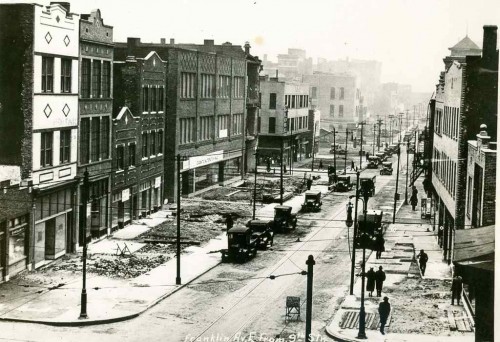
Bartholomew, like his better-known contemporary, NYC’s Robert Moses, believed it was necessary to destroy the city to save it from itself. Everything prior to the 20th century was wrong for the modern world of the automobile.

Franklin Ave looking East from 9th, 1928. Nothing in this image remains. Collection of the Landmarks Association of St Louis

This make room for the automobile view is clear in Bartholomew’s 1947 plan, from the streets & trafficways section:

Since 1916 St. Louis has expended over $40,000,000 in opening, widening, connecting, and extending the system of major streets. Much has been accomplished in converting a horse and buggy street system to automobile needs. As the total volume of traffic increases, however, certain new needs arise. An example is the desirability of grade separations at extremely heavy intersections, such as at Grand and Market and at Kingshighway and Lindell. Likewise there is a need for complete separation of grade where traffic volume is sufficiently heavy to justify the cost involved. The Federal Government, which has helped finance our splendid system of national highways, has recently revised its policies and Congress has appropriated substantial funds to aid the cities in the construction of express highways and for facilitation of traffic flows from certain selected state highways through metropolitan areas to the central business districts of large cities. Past and present experience reveals the need for four types of major streets and trafficways as follows:

  1. Secondary Streets (4 Lanes)
    Most St. Louis streets were laid out with a width of 60 feet. A considerable volume of traffic can be accommodated in a 60-foot street with a 40-foot roadway, especially if curb parking is restricted at times of heavy traffic flow. Such streets as Nebraska, Compton, and Goodfellow can pr6bably continue for many years to accommodate a considerable volume of traffic flow without widening. All local residential areas require access and must be served either by wide major streets or by these secondary streets which thereby become important integral parts of the major street plan.
  2. Major Streets (6 Lanes)
    Grand Avenue, Chippewa Street, and Easton Avenue are examples of important cross-town routes which accommo date a considerable volume of traffic including mass trans portation facilities (i.e., streetcars or buses). Their general width of 80 feet permits a 54 or 56 foot roadway to accom modate six lanes of traffic. There is need for quite a number of such routes where traffic volume is insufficient to warrantgreater width of the street except by expensive widening of the street.
  3. Major Streets (8 Lanes)
    These are the main traffic ways, as for example Gravois Avenue, Market Street, Natural Bridge Road, Lindell Boulevard and Kingshighway. They are the dominant structural elements of the street plan. Their traffic capacity is unusually high since they permit three or four lanes of moving traffic in each direction. It is impractical to provide for streets with wider roadways because of weaving and complications encountered in traffic control.
  4. Express Highways
    When traffic volume becomes so great that it cannot be accommodated even on eight lane surface highways it becomes necessary to provide for uninterrupted traffic flows through grade separations in the form of depressed roadways in wide right-of-ways or by roadway elevation. An overall right-of-way width of 200 feet is generally considered a minimum standard. This is far more costly than street widening but a limited mileage can be justified where there is sufficient traffic volume.

In today’s money that’s nearby a billion dollars! I’m uncertain if any city carried out the costly widening of the PROW the way St. Louis did. Based solely on my personal observations in other cities, I’d say St. Louis was the most aggressive. It’s no wonder that more than a quarter of those of voted in the recent non-scientific Sunday Poll have a problem with road diets.

Q: Agree or disagree: ‘Road Diet’ projects slow traffic too much, cause congestion; should be reversed.

  • Strongly agree 7 [18.42%]
  • Agree 0 [0%]
  • Somewhat agree 3 [7.89%]
  • Neither agree or disagree 3 [7.89%]
  • Somewhat disagree 1 [2.63%]
  • Disagree 8 [21.05%]
  • Strongly disagree 14 [36.84%]
  • Unsure/No Answer 2 [5.26%]

Sadly, our road diets have been designed to appease critics, so sidewalks new still too narrow — barely wide enough for existing for traffic.  Motorists usually drive on typically wide Set. Louis area streets then encounter the “Great Streets” section for a brief period before returning to the more common Awful Streets of our region. We’re too timid to do more, so it can have a ater impact on population density, pedestrian/transit rates, etc.

Bartholomew also thought St. Louis’ population in 1970 would increase to 900,000 — it had dropped to 622k. Fingers are crossed we don’t drop below 300k in 2020. If St. Louis wants to grow again the entire region needs to reject the many ways Bartholomew screwed up our region.

— Steve Patterson


St. Louis Should Celebrate Indigenous People, Not Columbus

October 9, 2017 Featured Comments Off on St. Louis Should Celebrate Indigenous People, Not Columbus
Bocce is one of many long-standing traditions on The Hill. January 2011 photo

One hundred fifty years ago the the fist Columbus Day parade was held in St.Louis — 70 years before becoming a federal holiday.

The Italian American Heritage Corporation is one of the oldest Italian American organization in the United States. It was organized on November 11, 1866 and was incorporated on December 6, 1866 it is composed of many St. Louis Italian-American Organizations, who joined together a number of years ago to ensure that there will always be a Columbus Day Parade.

The first parade was organized by the Fratellanza Society in 1867 through the effort of an Italian settlement in downtown St Louis. The parade route started downtown and terminated at the statue of Chistopher Columbus ( donated by Henry Shaw ) in Tower Park. For many years it has been held on ” The Hill” .

The parade is always the highlight of the Columbus Day celebration by many Italian Organizations to promote the philosophy and culture of their heritage by participating in a Festa after the parade. The Festa is traditionally held in Berra Park. (Facebook page

The Civil War ended two years prior to this first parade. It was now illegal to own other humans as slaves, so why not celebrate another dark path of our history?

Columbus Day has been criticized for celebrating the discovery of a place that was already inhabited and because Columbus himself is considered responsible for the rape and murder of those indigenous people.

“One of the biggest misconceptions about Columbus is that he was righteous,” Leo Killsback, a citizen of the Northern Cheyenne Nation and assistant professor of American Indian Studies at Arizona State University, told CNN. Killsback also noted that Columbus never actually landed in what in the now the United States.

Berkeley Loni Hancock, who was the Mayor of Berkeley in 1992, told TIME Magazine in 2014 that they opted for the alternative to Columbus Day because the existing celebrations were “Eurocentric and [have] ignored the brutal realities of the colonization of indigenous peoples.” (Time) 

I love the Italian neighborhood known as The Hill, but celebrating Columbus needs to stop. Have a festival with lots of food to celebrate Italian-American history in St. Louis.Even keep a parade. Just change the name.

Local governments, however, need to pass legislation to change the name of the holiday. This is important since we ran off Native-Americans and leveled their mounds.

— Steve Patterson


Sunday Poll: Should Vehicle Lanes Lost During Road Diet Projects Be Put Back?

October 8, 2017 Featured, Sunday Poll Comments Off on Sunday Poll: Should Vehicle Lanes Lost During Road Diet Projects Be Put Back?
Please vote below

For more than a decade the East-West Gateway Council of Governments, our Metropolitan Planning Organization (MPO), has been working on a road diet project it calls  The Great Streets Initiative:

East-West Gateway launched the St. Louis Great Streets Initiative in early 2006 to expand the way communities think of their streets. Rather than viewing a roadway project as solely a way to move more cars and trucks faster, the goal of the St. Louis Great Streets Initiative is to trigger economic and social benefits by centering communities around interesting, lively and attractive streets that serve all modes of transportation. (Great Streets)

Communities all over the country have been doing the same thing for the same reasons, but in the Los Angeles area one community is putting lanes back:

The move eliminated traffic lanes and added a bike lane, reducing parts of Venice Boulevard, Pershing Drive, Jefferson Boulevard, Vista del Mar and Culver Street to one lane in each direction in order to slow cars and make streets safer for bike riders.

The plan, however, left area residents in an uproar.

An online petition calling for an end to the project gathered thousands of signatures and an online campaign has raised tens of thousands of dollars for its supporters to take legal action against the city and organize opposition.

The anger over the elimination of lanes prompted an effort to recall Bonin.

The changes announced Wednesday include the restoration of lanes to Vista del Mar while still allowing transportation officials to continue to address the city’s liability issues while maintaining coastal access, Bonin said. (CBS LA)

Today’s poll is about road diet projects like South Grand and Natural Bridge here in St. Louis.

This non-scientific poll will close at 8pm.

— Steve Patterson


St. Louis Board of Aldermen: Board Bills #133-140

October 6, 2017 Board of Aldermen, Featured Comments Off on St. Louis Board of Aldermen: Board Bills #133-140
St. Louis City Hall

The St. Louis Board of Aldermen will meet at 10am today, their 18h week of the 2017-2018 session. One bill was introduced last week that wasn’t on the published agenda:

Board Bill No. 133 | Vacation of Primm St. from Reilly westwardly

BOARD BILL # 133 INTRODUCED BY: ALDERWOMAN SARAH MARTIN An ordinance recommended by the Board of Public Service to conditionally vacate above surface, surface and sub-surface rights for vehicle, equestrian and pedestrian travel in Primm Street from Reilly Avenue westwardly 96.45′ to a point in City Blocks 3126 and 3150 in the City of St. Louis, Missouri, as hereinafter described, in accordance with Charter authority, and in conformity with Section l4 of Article XXI of the Charter and imposing certain conditions on such vacation.

Maybe if we give away all the public right-of-way our city will be great again…

ON THE AGENDA* FOR INTRODUCTION TODAY 10/6/17:

*Note that just because a bill is on the agenda doesn’t mean it’ll be introduced, similarly, bills not on the agenda might be introduced if they suspend the rules to do so. This information is based on the published agenda as of yesterday @ 8am:

  • B.B.#134 – Green –An ordinance concerning the protection of First Amendment rights of protesters, repealing ordinance 15.52.010, and enacting in lieu of it clarifying policies relating to improving police community relations with the St. Louis Metropolitan Police Department and limiting the use of chemical agents.
  • B.B.#135 – Davis –An Ordinance recommended and approved by the Board of Estimate and Apportionment authorizing and directing the Director of Airports and the Comptroller, owner and operator of St. Louis Lambert International Airport to enter into and execute, the First Amendment to Professional Service Agreement for Fleet Vehicles and Special Equipment Maintenance /Repairs Services to the Professional Service Agreement for Fleet Vehicles & Special Equipment Maintenance/Repair Services, between the City and Complete Auto Body & Repair; containing a severability clause; and containing an emergency clause.
  • B.B.#136 – Davis –An ordinance pertaining to leases on the unimproved wharf repealing Ordinance 66275 and enacting a new ordinance authorizing the Port Authority Commission, within six months prior to the expiration, extension, execution, or renewal of any lease on the unimproved wharf, to negotiate the rates and other terms of conditions of a lease; and if such fails, to advertise for proposals in newspapers of general circulation, the city journal and trade journals of national publications, and containing a severability clause.
  • B.B.#137 – Green –An ordinance to revise Section 17.76.020 of the Revised Code of the City, Ordinance 67757 Section One approved November 5, 2007, pertaining to Residential Disabled Parking, to allow an eligible person whose vehicle is owned by another to apply for a residential disabled parking space permit.
  • B.B.#138 – Roddy –An ordinance authorizing and directing the Mayor and the Comptroller to execute and deliver the Fifth Supplemental Trust Indenture; authorizing and directing the taking of other actions and approval and execution of other documents as necessary or desirable to carry out and comply with the intent hereof; superseding provisions of prior ordinances of the City to the extent inconsistent with the terms hereof; and containing a severability clause.
  • B.B.#139 – Moore –Pursuant to Ordinance 68937, an ordinance authorizing the honorary street name, Norma Leggette Lane, will begin at the intersection of Bishop P.L. Scott and Garfield and run southeast on Garfield to North Vandeventer.
  • B.B.#140 – Howard –An ordinance approving a Redevelopment Plan for the 5335 Gilson Ave.

The meeting begins at 10am, past meetings and a live broadcast can be watched online here. See list of all board bills for the 2017-2018 session.

— Steve Patterson
 

Advertisement


[custom-facebook-feed]

Archives

Categories

Advertisement


Subscribe