A Decade Since Steve Patterson Filed To Run For The St. Louis Board Of Alderman

A decade ago today I decided I wasn’t going to let an incumbent win four years in office because of a lack of a challenger.  If she, Dorothy Kirner, wanted a four-year term she was going to have to work for it. Two months later I lost the primary, receiving 44.1% of the vote.  Not bad considering I started putting together my campaign after filing on the very last day, instead of months earlier.

Here I was a candidate but I had no team, no money, no plan.   My check for the filing fee didn’t even clear, thankfully then-Democratric party chair Brian Wahby allowed me to replace it rather than disqualify me from the race. At this point I was an unknown, this blog had only been around a little over two months.

I had been paying attention though, the day before filing I posted:

Carl Coats, a former city building inspector, had filed to challenge Dorothy Kirner for the 25th Ward aldermanic seat. On 1/4/05 he withdrew himself as a candidate. Unless someone files tomorrow Dorothy Kirner will win by default. This is my ward – I was hoping someone would mount a good challenge to Kirner. (See 25th Ward Challenger Carl Coats Has Withdrawn from Race).

That night I realized nobody else was going to run, but why not me? I was 37 and self-employed, so I had the time. I owned three properties in the ward, one co-owned with a friend, so I was invested. I had ideas I wanted to become part of the conversation during the election. I called a few people that night and the next day I went down to the Board of Election Commissioners to file.

People I know & people I just met stepped up to offer help, money, advice, etc. — too many to thank them all individually.
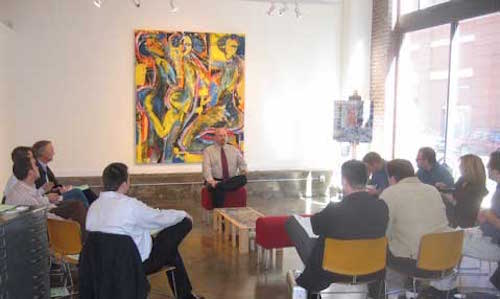
Steve Patterson speaking at a gathering at Gallery Urbis Orbis downtown, February 2005
Candidate Steve Patterson speaking at a gathering at Gallery Urbis Orbis downtown, February 2005
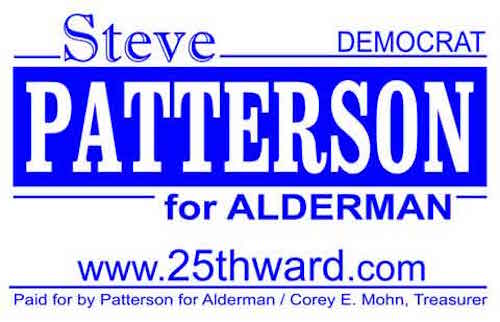
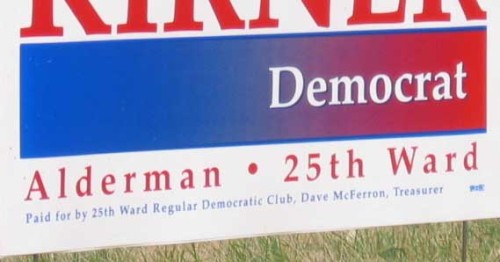
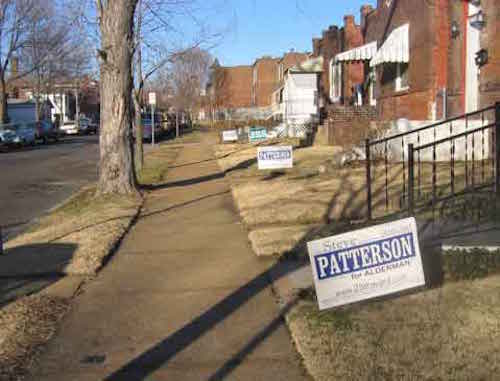
Patterson yard signs in the 25th Ward
The yard sign graphic
The yard sign graphic with my campaign website prominently displayed
Kirner reused signs from the prior year, before the 25th Ward Regular Democratic Club had endorsed her in the current race
This rink in Mt. Pleasant Park was one issue during the campaign, none of us in the immediate area asked for this in the park -- it just appeared,
This rink in Mt. Pleasant Park was one issue during the campaign, none of us in the immediate area asked for this in the park — it just appeared

Early press was discouraging, such as the story ‘Incumbent aldermen assured of re-election’  in the South Suburban Journal five days after filling closed:

Incumbent Alderman Dorothy Kirner, 70, of the 3700 block of Taft Avenue, faces challenger Steven L. Patterson, 37, a real estate agent living in the 3100
block of Mount Pleasant Street. The primary is March 8.

“I have lived in the neighborhood for 48 years,” said Kirner, who was elected June 15, 2004 to succeed her husband, Alderman Dan Kirner, who died in office. Stressing her experience, she said, “I have been around longer than my husband was in the political field.”

But Patterson, who has lived in the neighborhood for 10 years, said he had a lot of experience in getting things done, in looking at development and managing people and projects.

“I think the fact that I haven’t spent many years in politics is actually a benefit to me. It’s time for a fresh approach to the ward,” he said.

As the campaign progressed the coverage did improve, from the Vital Voice, an LGBT publication, just days before the primary:

Steve Patterson is busy knocking on doors and talking to residents throughout the 25th Ward in hopes of becoming the first openly gay individual to serve in the 28-member St. Louis Board of Alderman.

Patterson, who turns 38 on Feb. 28, is mounting a serious challenge to unseat incumbent Alderwoman Dorothy Kirner in the March 8 primary. Kirner, 69, was elected last June to serve the remaining ten months of her late husband, Dan Kirner’s term.

“What brought me into politics is the desire to see change and realizing that I couldn’t sit here and complain that no one was taking charge without realizing that maybe that should be me,” said Patterson of his insurgent campaign. “The campaign experience is awesome. I’m really enjoying getting involved and being involved. It actually feels really good to be this civic minded.”

The 25th Ward, which includes neighborhoods around far South Grand is ethnically diverse with large Caucasian, African American, Bosnian and Vietnamese communities. The ward also has a representative gay, lesbian, bisexual and transgender (GLBT) community. Nevertheless, the heavily Democratic 25th is socially conservative and accordingly voted to approve Amendment 2 last August witch banned gay marriage in the Missouri Constitution.

Yes, only one of the city’s 28 wards voted in favor of Amendment 2 and I, an openly gay man, was running for alderman in that ward just 4 months later.  What was I thinking? I do remember knocking on one door, the woman who answered asked me if I supported gay rights or same-sex marriage. When I told her I was gay I turned a sceptic stranger into a voter, we remain friends today.

Although Kirner won a full 4-year term I have no regrets about running, one of the best decisions I ever made.  I do have some hindsight from my one and only political campaign:

  • Plan well ahead, don’t wait until the last day to file to start putting the campaign together.
  • Run to win, but know that becoming serious candidate makes you a winner even if you don’t win the election.
  • Video record your debate, I wish I’d done so!

This election was prior to social media — no Facebook or Twitter! Like I indicated in the photos above, I had a blog/website, one of the earliest aldermanic campaigns to have one. I raised & spent about $1,200m Kirner raised & spend about $12,000 — she  had to hire consultants to build a website.   She showed up for a debate on the issues, something she wouldn’t have had to do otherwise.

One issue raised during our campaign was a Citizen Review Board, I favored it while Kirner, whose late husband had been a police officer, opposed external review of the police. The Board of Aldermen passed a Civilian Review Board bill a year later — vetoed by Mayor Slay.
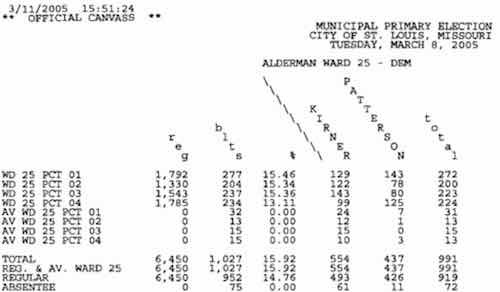
I received
I received 278 votes (51.5%) in the two precincts East of Grand, while Kirner received 292 votes (64.7%) from the two precincts West of Grand.  I lived East of Grand, Kirner West of Grand, her support was stronger than mine. Total votes was 437 vs 554.

After serving her one term, Dorothy Kirner didn’t seek a 2nd in 2009, setting up a 4-way race for the open seat. Openly gay Shane Cohn won the democratic primary with 487 votes (46.25%), this 4-way race had 1,053 votes vs 991 votes in my 2005 race.

Filing for the March 2015 primary has closed, though independent candidates can still get on the ballot in the April general by collecting signatures. Those of you in odd numbered wards who are considering running in 2017 should begin planning now.

Tomorrow I’ll look at the 2015 spring municipal races.

— Steve Patterson
 

Some Seek To Lower Missouri’s Voting Age

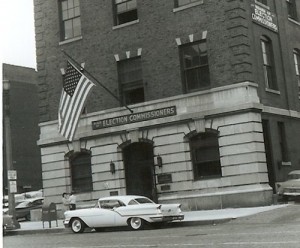
Former offices of the St. Louis Board of Election Commissioners

In early December news came out about a proposed change to Missouri’s voting age:

Democratic Rep. Karla May of St. Louis this week filed a joint resolution to amend the state constitution to reduce the legal age to vote from 18 years old.

If passed by both the state House and Senate, the measure would go to a public vote. (Missouri lawmaker wants to lower voting age to 16)

Currently you need to be 17-1/2 to register, 18 to vote. Decades ago the minimum voting age

The long debate over lowering the voting age in America from 21 to 18 began during World War II and intensified during the Vietnam War, when young men denied the right to vote were being conscripted to fight for their country. In the 1970 case Oregon v. Mitchell, a divided U.S. Supreme Court ruled that Congress had the right to regulate the minimum age in federal elections, but not at the state and local level. Amid increasing support for a Constitutional amendment, Congress passed the 26th Amendment in March 1971; the states promptly ratified it, and President Richard M. Nixon signed it into law that July. (History.com)

The following is an argument in favor of lowering the voting age:

FairVote supports expanding suffrage to 16 and 17-year-olds in municipal elections. The proposal to extend voting rights to people after they turn 16 may surprise some, but the latest research is a revelation. All evidence suggests that cities will increase turnout by allowing citizens to cast their first vote after turning 16. The reason is simple. Many people at 16 and 17 have lived in their communities for years and are taking government classes in high school. That combination results in more people exercising their first chance to vote if they are 16 or 17 than if they are unable to vote until they have left home and school.

A voting age of 18 means that many people won’t get a chance to vote in city elections until they are nearly 20. A detailed study of voting age and voters in Denmark found that 18-year-olds were far more likely to cast their “first vote” than 19-year-olds, and that every month of extra age in those years resulted in a decline in “first vote” turnout. Allowing 16- and 17-year-olds to vote in local elections will enable them to vote before leaving home and high school, and establish a life-long habit of voting.

Lowering the voting age to 16 is becoming an international movement. A growing number of nations like Austria, Argentina, Germany and the United Kingdom that have extended voting rights to people at 16 for national, regional or local elections. Evidence from Austria confirms that extending voting rights to people after they turn 16 promotes higher turnout for first-time voters and over time. Austria’s experience also shows that 16- and 17-year-olds are ready for voting as far as making choices that accurately reflect their views.

Long-time backers of a lower voting age, like the National Youth Rights Association, make a fairness argument as well. Turning 16 has special significance in our culture. At age 16, we can drive, pay taxes and for the first time work without any restriction on hours. Many states already allow citizens under 18 to vote in Democratic and Republican primaries for president, Congress and governor. (FairVote)

I hadn’t read the above before the poll, I’m liking the idea of 16 for local elections, 18 for state & national, just not sure if that would be an administrative nightmare or not.

When I checked the Sunday Poll results about 3-4 hours before it closed the number of votes was low and keeping the age at 18 had a majority of votes, but by bedtime it was clear a group decided to push the “15 or lower” answer.

Q: What should the voting age be in Missouri?

  1. 15 or lower: 50 [65.79%]
  2. 18: 18 [23.68%]
  3. 16: 5 [6.58]
  4. 21: 1 [1.32%]
  5. 22 or higher: 1 [1.32%]
  6. Unsure/No Opinion: 1 [1.32%]

I would’ve been pleased if the total of all votes was 50, but that’s how many voted for 15 or lower late in the day, it had maybe 1 vote earlier. To my knowledge no state vote to lower the voting age below 18 has been successful.

— Steve Patterson


Broken Zipper: Washington Ave Street Tree Wells

The Washington Avenue streetscape, completed about 15 years ago, was designed to visually play tribute to the area’s history as a garment district:

Through the ’30s and ’40s, St. Louis had one of the largest needle-trade centers in the country—second, many said, only to New York—and was the center of manufacture for junior-size dresses. (St. Louis Magazine)

So Washonhgton Ave was given a zipper motif. But in the last 15 years the very expensive streetscape’s design elements haven’t always been respected. Most recently the street trees.

caption
The picture on the left shows how the metal tree grate aligns with stones in the street, the pic on the right was take just to the West. The same visual has been totally obliterated because the pavers were opened up to uncover more of the tree well.

The street trees never did well because the costly streetscape was designed with style over function — too small of a surface area to collect rainwater. After removing the dead/dying trees extra grates were used to cover the holes where the original trees were planted, which kept the design motif intact.

If the the new trees survive perhaps it’s worth sacrificing the design, still visually jarring after all these years.

— Steve Patterson


Sunday Poll: What should the voting age be in Missouri?

January 4, 2015 Featured, Missouri, Politics/Policy, Sunday Poll Comments Off on Sunday Poll: What should the voting age be in Missouri?
Please vote in the poll, located in the right sidebar

In the news last month was a report that a Missouri legislator wants to change the voting age. I’m being vague on purpose, so as not to influence today’s poll: What should the voting age be in Missouri?

The poll is in the right sidebar, mobile users can switch to the desktop view at the bottom of the mobile layout (not visible within apps like Facebook). Check back on Wednesday Tuesday for the results, specifics on the current & proposed voting age, and a bit of local political history.

— Steve Patterson


4th Anniversary of Local Smoking Bans

I can understand that the ‘Good News Friday’ topic for today might be a matter of viewpoint, but it’s my blog and I think it is good news. Four years ago clean air/smoking bans in St. Louis City & County became effective. This has allowed me to visit places that I’d previously considered off-limits, such as:

Smoke-free interior of O'Connell's Pub in July 2013
Smoke-free interior of O’Connell’s Pub in July 2013
Hodak's, May 2014
Smoke-free interior of Hodak’s, May 2014
Milo's on The Hill claimed an exemption for ja little over a month, but went smoke-free on February 7, 2011.
Milo’s Bocce Garden on The Hill initially claimed exemption, but went smoke-free just over a month later. Milo’s is owned by 10th Ward Alderman Joe Vollmer

The St. Louis exemption for small bars will expire in just one year, on Saturday January 2, 2016 establishments that had been granted exemptions to continue allowing smoking will no longer be exempt. Will they be ready or will they be surprised at how quickly five years has passed by? No doubt some will squander the next 12 months but hopefully others are completing patios and such.

Casinos in the city & county, unfortunately, remain exempt. Other Missouri counties in the region aren’t yet smoke-free. The entire state of Illinois is smoke-free, including casinos.

— Steve Patterson


Advertisement


[custom-facebook-feed]

Archives

Categories

Advertisement


Subscribe