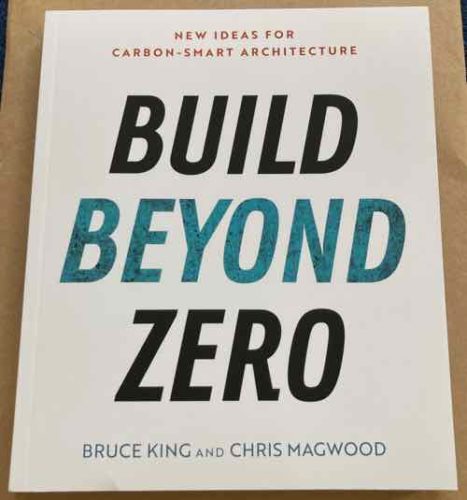
New Book — “Build Beyond Zero: New Ideas for Carbon-Smart Architecture” by Bruce King and Chris Magwood
September 23, 2022 Books, Environment, Featured, Planning & Design Comments Off on New Book — “Build Beyond Zero: New Ideas for Carbon-Smart Architecture” by Bruce King and Chris Magwood

With all the talk of electric vehicles it’s easy to forget that buildings are a major contributor toward climate change. Building low or neutral carbon buildings has been the goal for a long time, now a new book is proposing going even further:

“Net Zero” has been an effective rallying cry for the green building movement, signaling a goal of having every building generate at least as much energy as it uses. Enormous strides have been made in improving the performance of every type of new building, and even more importantly, renovating the vast and energy-inefficient collection of existing buildings in every country. If we can get every building to net-zero energy use in the next few decades, it will be a huge success, but it will not be enough.  
 
In Build Beyond Zero, carbon pioneers Bruce King and Chris Magwood re-envision buildings as one of our most practical and affordable climate solutions instead of leading drivers of climate change. They provide a snapshot of a beginning and map towards a carbon-smart built environment that acts as a CO2 filter. Professional engineers, designers, and developers are invited to imagine the very real potential for our built environment to be a site of net carbon storage, a massive drawdown pool that could help to heal our climate.
 
The authors, with the help of other industry experts, show the importance of examining what components of an efficient building (from windows to solar photovoltaics) are made with, and how the supply chains deliver all those products and materials to a jobsite. Build Beyond Zero looks at the good and the bad of how we track carbon (Life Cycle Assessment), then takes a deep dive into materials (with a focus on steel and concrete) and biological architecture, and wraps up with education, policy and governance, circular economy, and where we go in the next three decades. 
 
In Build Beyond Zero, King and Magwood show how buildings are culprits but stand poised to act as climate healers. They offer an exciting vision of climate-friendly architecture, along with practical advice for professionals working to address the carbon footprint of our built environment. (Island Press)

We need as many “climate healers” as we can get! Like so many books this is highly detailed and technical. So here’s the chapters so you can see how they present their arguments:

  • Chapter 1: The Story of Carbon: The Birth of the Universe, of Carbon, and of Life
  • Chapter 2: A Brief History of Green Building: Waking Up to Climate Emergency
    Box 2.1: The Existing Building Solution by Larry Strain
  • Chapter 3: Life Cycle Analysis: Tracking Carbon’s Stocks and Flows
  • Chapter 4: Metals and Minerals: Steeling Ourselves
  • Chapter 5: Concrete: Many Ways to Make a Rock
    Box 5.1: Asphalt: the Other Concrete
    Box 5.2: The Case for Modern Earthen Building by Lola Ben Alon
    Box 5.3: Human Health is Climate Health by Gayatri Datar
    Box 5.4: Entering the Market as an Earth Block Producer by Lisa Morey
    Box 5.5: Can We Grow Carbon-Storing Buildings? by Wil Srubar
  • Chapter 6: Biological Architecture: Wood and Mass Timber, Agricultural By-Products, Purpose- Grown Crops, Waste Stream Fibers, and Lab-Grown Materials
    Box 6.1: Landscape: Connecting the Carbon Conversation by Pamela Conrad
  • Chapter 7: Witches’ Brew: Plastics, Chemistry, and Carbon
  • Chapter 8: Construction: On Site and Under Zero
  • Chapter 9: Education: We All Need Schooling to Make This Possible
  • Chapter 10: Circular Economy: Extending the Lifespan of Captured Carbon
  • Chapter 11: Policy and Governance: Twenty-first Century Cat Herding
  • Chapter 12: A Just Transition: Building a Better Society Means More than Capturing Carbon
    Box 12.1: A Manifesto for the Pivotal Decade by Ann Edminster
  • Chapter 13: The Next Three Decades: Where Do We Go from Here?  15 by 50
    Box 13.1 Case study, Trent University’s Forensic Science Building
  • Chapter 14: What’s Next? Wow. Just, wow.

I can’t say they’ve hit on the right solution, but those making building decisions (architects, developers, code officials, etc) should give this a serious review. If you’re planning new construction or a major renovation project these ideas might also be good food for thought.

— Steve Patterson
 

What Will California’s 2035 Ban of Internal Combustion Engine Cars Mean to the St. Louis Region, If Anything?

September 8, 2022 Electric Vehicles (EVs/BEVs), Featured, Politics/Policy, Transportation Comments Off on What Will California’s 2035 Ban of Internal Combustion Engine Cars Mean to the St. Louis Region, If Anything?
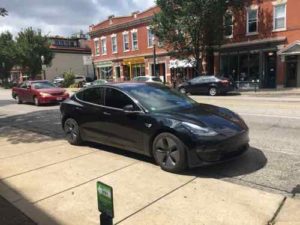
A friend’s Tesla Model 3 on South Grand, October 2019

Last month the California Air Resourses Board (CARB) voted to approve new statewide regulations that will gradually reduce the number of passenger vehicles powered solely by gasoline or diesel in their state. They drafted these regulations after California Gov. Gavin Newsome issued an executive order a year ago to make this happen.

”California regulators voted Thursday to ban the sale of all new gasoline-powered vehicles by 2035 as the state looks to aggressively tackle the climate crisis.” (NBC News)

So what will this mean for the St. Louis region? In the short term, very little. In the long term, however, it will greatly impact St. Louis and the rest of North America. Possibly the world. 

First we must understand it’s the federal government, through the Environmental Protection Agency (EPA) that sets nationwide standards for emissions and such. However, unlike the other 49 states and the District of Columbia, our most populous state is allowed to set standards that are stricter than federal policy. The EPA must first issue a waiver for California’s new regulation. It’s highly unlikely the Biden administration will attempt to block it. Still, a GOP lawsuit is challenging California’s right to set a stricter emissions standard. 

As the most populous state California is also the biggest car market in the nation, its population is more than double Missouri & Illinois combined!  In the past the following states have opted to follow California’s stricter standards: Connecticut, Delaware, Maine, Maryland, Massachusetts, New Jersey, New Mexico, New York, Oregon, Pennsylvania, Rhode Island, Vermont, Washington state and Washington D.C. So far two stated, Massachusetts and Washington, have already indicated they will follow California’s lead. The combined vehicle sales in this states is huge! Combined with future ICE vehicle bans in Europe and the world’s largest car market (China) that is pushing EVs it’s clear new internal combustion engines will be rare before 2035 arrives.

It will be very challenging, but auto manufacturer’s line ups will meet these higher standards…for everyone, essentially becoming a national standard. Some have suggested by 2035 there will be nearly zero consumer demand for ICE vehicles. This new rule will rapidly accelerate the transition to electric vehicles.

Let’s look closer at California’s 2035 ban on fossil fuel vehicles. First, it doesn’t mean they’re banning existing gas powered vehicles — they can be driven, and used models can be bought & sold.

“Starting with 2026 models, 35% of new cars, SUVs and small pickups sold in California would be required to be zero-emission vehicles. That quota would increase each year and is expected to reach 51% of all new car sales in 2028, 68% in 2030 and 100% in 2035. The quotas also would allow 20% of zero-emission cars sold to be plug-in hybrids.” (CNN)

While 2035 model year vehicles are still a dozen years away,  2026 models are will be here in just 3 years! To scale up production manufacturers will need to sell EVs beyond states with an EV mandate, though if supplies are limited the inventory will go to those states so they meet the requirements.

 By 2025 plug-in hybrids (PHEVs) must achieve 50 miles in pure electric mode — a substantial increase from the 18-25 miles seen in current PHEVs. In the last decade a lot of PHEVs were only available in California, going forward expect more to be nationwide. Motorcycles and large trucks will be regulated separately, with a longer time frame.

Dealerships in the St. Louis region will offer more EVs, and fewer fuel burning vehicles. They’ll also need to renovate their facilities to be able to charge & service the electric cars they’ll be selling. The selection of EVs will rapidly increase, just as the selection of new gas vehicles will decline. Municipalities like St. Louis with many residents parking on city streets will need a way to charge their vehicles. 

Businesses that depend on gas vehicles will need to reinvent themselves. For example, places that do oil changes, radiator flushes, and transmission work will consolidate — fewer will be necessary. Something else will occupy that real estate in the future.

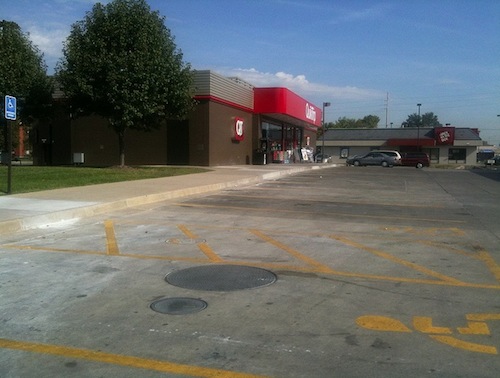
QuikTrip in Granite City, IL. February 2011.

Gas stations make very little money from fuel, their profit comes from the convenience store portion of the business model.  Many are owned by individuals living in our region, not corporations in other states.  Those located near interstates can add high speed charging points to lure travelers to stop and spend money while replenishing their batteries.

Some gas stations will close. Eventually we’ll see gas deserts with few options for filing up that classic 2020 Toyota Corolla you’re driving until it dies. Auto parts stores will still be around for a long time, but they can’t survive on selling wiper blades.

At the start of the 20th century a major restructuring happened as the change from horse & buggy to cars took place. Jobs building carriages, caring for horses, etc went away. Such a restructuring is beginning now, with this mandate.

Those of you alive in 2040, 2050 will be part of a different St. Louis. It’s impossible to predict how it will all play out, but rest assured things won’t be static. The combination of vehicles going electric and the temperatures getting hotter will necessitate physical changes.

I hope the region will occupy less total land in the future, with considerably less impervious surfaces per capita. Hopefully the entire region will see a much higher use of public transit.  And yes, our electrical grid will need to improve.  Users will also need to learn to minimize using electricity during periods of peak demand.

Exciting times.

– Steve Patterson


Advertisement


[custom-facebook-feed]

Archives

Categories

Advertisement


Subscribe