Sunday Poll: Should The Feds Allow Illinois & Other States Opt Out Of Changing Clocks Twice Per Year?

January 5, 2020 Featured, Politics/Policy, Sunday Poll Comments Off on Sunday Poll: Should The Feds Allow Illinois & Other States Opt Out Of Changing Clocks Twice Per Year?
Please vote below

Daylight Saving Time will start again on Sunday March 8, 2020 — giving us an extra hour of daylight in the evenings. It’ll end on Sunday November 1, 2020. Nearly 8 months of the year, with the rest being standard time. Now Illinois is considering a major change from neighboring states like Missouri.

The idea of having Missouri and Illinois in different time zones is circulating after the Illinois Senate approved legislation earlier this year that would make daylight saving time the standard in Illinois.

Although the proposal still needs approval in the Illinois House, as well as the signature of the governor and an OK from the federal government, it has residents and business owners on both sides of the Mississippi River thinking how it might affect their lives. (Post-Dispatch)

The Illinois Senate passed bill 533 last month, it was introduced by state Sen. Andy Manar, D-Bunker Hill.

Originally enacted as an energy-saving measure during World War I, daylight saving time reached its 100-year anniversary in 2018. While initially reserved as a local decision, the practice became law nationwide when U.S. Congress passed the Uniform Time Act in 1966.

As such, states that approve proposals to end the clock change must first get approval from the federal government before they take effect, according to Manar. “The only two ways that it can change in Illinois, ultimately, even with this bill becoming law, is either Congress gives us an exemption as a state or Congress implements a uniform standard presumably different than what we have nationwide,” Manar said, according to the Illinois Radio Network. (Illinois Policy)

Today’s poll is about the federal government and states wishing to make changes to DST in their states.

This poll will close at 8pm tonight.
— Steve Patterson


High Marijuana Taxes Means Black Market Will Continue

January 3, 2020 Crime, Featured, Metro East, Recreational Marijuana Comments Off on High Marijuana Taxes Means Black Market Will Continue

I’ve long supported the legalization of marijuana. No, I’m not a regular user — my last time was in the Fall of 2017 to deal with severe pain after breaking my wrist.

I just think legalization is good public policy. Criminalization was horrible public policy.

In the 1930s, Prohibition was repealed in the middle of the Great Depression. Straight-laced bureaucrats looking for another target turned their attention to marijuana, which, at the time, was mostly being used in the Mexican and black communities. They painted the drug—and the communities using it—as a threat to the already crippled country and began the process of banning it. Twenty-nine states had outlawed marijuana by 1931, and in 1937, the Marijuana Tax Act was passed, essentially making the plant illegal in the United States. (History.com)

So some bureaucrats wouldn’t be out of work during the Great Depression they used race to get marijuana criminalized! Eight plus decades later 11 states have legalized recreational use. It was 6 years ago that Colorado became the first, Illinois became the 11th on January 1, 2020.

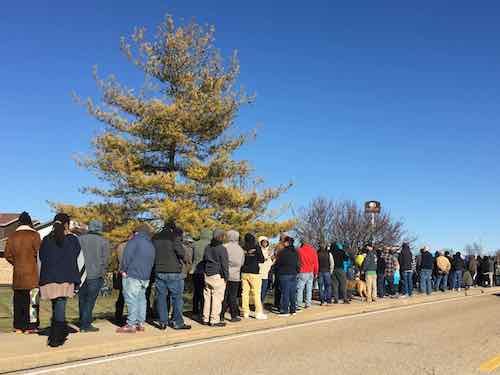
On the first day of legal sales in Illinois the line at HCI Alternatives in Collinsville stretched hundreds of feet around the corner.

Illinois needed to legalize, for the tax revenue.

It depends on the amount of THC, the chemical responsible for most of marijuana’s psychological effects. In flower form, there will be a 10% tax. Edibles are taxed 20% but jumps to 25% if the THC levels are above 35%.

In most states that have legalized recreational weed, it’s typically 30-50% more expensive than illegal weed. (CBS Chicago)

That’s the part I’m struggling to get past: 30%-50% more expensive than illegal weed. The cash cow to help state budgets is keeping the black market alive.

In the United States, high tax rates have been effectively driving consumers to purchase black market marijuana.

California, for example, is taxing the daylights out of its pot buyers. In addition to passing along a state tax and local tax, buyers are paying a 15% excise tax, as well as a wholesale tax of $9.25 per ounce of dried cannabis flower, or $2.75 per ounce of cannabis leaves. Add this up, and it could work out to an aggregate tax rate of 45% on legal pot. And, mind you, this doesn’t include additional costs such as the laboratory testing on weed grown in the Golden State, which is also being factored into the price that consumers pay. (Motley Fool)

Taxes on alcohol & tobacco are higher than things like, say, toilet paper. That’s fair, I suppose. Yet there’s no black market for those, at least not that I’m aware of.

Food trucks filled the parking lot to sell food & beverage to those who waited in line for hours to buy legal cannabis.

Will the legal and illegal markets continue side by side? Maybe that’s a good balance? I need to let go of my expectation that legalization will lead to the end of the black market.

On the other hand, the black market does a poor job supplying quality concentrates & edibles.

— Steve Patterson


2020 Census Prediction: St. Louis City & County Will Each Lose Population

January 1, 2020 Featured, Politics/Policy, St. Louis County, STL Region Comments Off on 2020 Census Prediction: St. Louis City & County Will Each Lose Population

The decennial census is ramping up for an important task three months away:

The U.S. census counts each resident of the country, where they live on April 1, every ten years ending in zero. The Constitution mandates the enumeration to determine how to apportion the House of Representatives among the states. (U.S. Census)

The 2010 census officially showed population losses for St. Louis City (a smaller percent than prior decades), St. Louis County (first time losing population), and a small gain for Missouri (resulting in the loss of a seat in the U.S. House of Representatives).

I haven’t seen anything happen during the last ten years to convince me we won’t see a repeat for 2020. Yes, St. Louis’ central corridor will again see gains, but the net for the city will be a loss. The percentage of loss may drop again, but that’s small consolation.

I have no doubt St. Louis County will see another net loss, as the exodus from North County continues. Hopefully I’ll be proven wrong about the city & county, but I don’t think I’ll have to eat my words.

Here are the results of the recent non-scientific Sunday Poll:

Q: Will the City & County population change with the 2020 census?

  1. St. Louis City & County will both have population losses: 16 [64%]
  2. St. Louis County will have a population increase, St. Louis City a loss: 4 [16%]
  3. St. Louis City & County will both have population increases: 3 [12%]
  4. St. Louis City will have a population increase, St. Louis County a loss: 2 [8%]
  5. Unsure/no answer: 0 [0%]

Obviously the majority agree with me.

Missouri is expected to hold onto its congressional seats, but Illinois won’t be so fortunate. Illinois is one of ten states expected to lose a seat(s).

New census figures will be used to redraw everything from the city’s wards (dropping from 28 to 14) to House & Senate districts. New wards/districts will be in place for 2022 elections.

— Steve Patterson


Advertisement


[custom-facebook-feed]

Archives

Categories

Advertisement


Subscribe