Going Postal, 23rd Anniversary of Edmond OK Postal Shooting

August 20, 2009 Crime 2 Comments

It happened as I was preparing to start my sophomore year at the University of Oklahoma in the Oklahoma City suburb of Norman.  On the other side of the region, in Edmond, postal employee Patrick Sherrill killed 14 & wounding others before killing himself:

He was a relief carrier. He would carry different routes on different days, and was making delivery errors. He also delivered mail later than the customers were used to getting it. When people called to complain, they spoke to supervisors. On the afternoon of Aug. 19, 1986, Patrick was reprimanded by two supervisors in a glassed-in office.

On the afternoon before the killings, he approached a female clerk who had been kind to him (while most people ignored him or hassled him) and asked her if she was coming to work the next day. She replied, “Of course.” He told her she should stay home.  (Source: Wikipedia)

Locally and nationally, everyone was in shock.  Such shootings have become too commonplace over the last 23 years.  Security measures have increased.

A few months shy of nine years later was the bombing of the Murrah Federal Building in Oklahoma City (Wikipedia). By that point I had been living in St. Louis for nearly four years.

Every region has tragedy.  I think we tend to forget about older tragedies as new ones happen.  So today I remember those who died in Edmond Oklahoma 23 years ago today.

– Steve Patterson


The Worst Main Street Revitalization Ideas

Main streets across this country, from big cities to suburbs to small towns, have been abused by urban planners over the second half of the 20th Century trying to find the right formula to reverse the exit to the edge.

In big cities you had white flight and schools as explanations for flight but in many small towns these reasons didn’t exist.  They didn’t have the mall on the edge of town drawing customers away from main street.  They had only the single school district.  However, many had Wal-Mart pulling customers out of the existing downtown’s.

The “solutions” were almost universal from big city CBD‘s to suburban areas to small towns.  With some exceptions these all failed:

  • One-way traffic – charming main streets were turned into high speed roads to get through town.  See Collinsville IL and many others.
  • Elimination of on-street parking – Saw this in Springfield MO.  A street where you could drive through but you couldn’t stop and shop.
  • Pedestrian mall – a few have done well but most separated remaining customers from remaining stores.
  • Indoor mall – an alternative to the open-air pedestrian mall is the enclosed indoor mall.
  • Removal of projecting signs – main streets were cleansed of unique signs.  Projections were viewed as a bad thing.
  • Uniform signage – uniformity was considered an asset. All businesses were encouraged to have the same font & size.
  • Concrete canopies – numerous towns were sold the idea of uniform concrete canopies over the sidewalks.  Beautiful facades were bisected.
  • Modernize facades – cheap modern materials covered detailed old storefronts.  Sometimes the original facade can be restored but often they are damaged beyond repair.
  • Structures over roadway – Salina KS has 4-5 open grid structures over their main street.  Adds nothing but a dated look.
  • Parking in rear – Many towns built excessive parking behind main street buildings.  With new rear entrances the street out front became useless.

Visuals of some of the above, all coincidentally from Kansas towns:

Atchison KS
Atchison KS
Parsons KS
Coffeyville KS
Salina KS
Salina KS

Agree?  Disagree?  Have additional “solutions” to add to the list?  If so, use the comments below.

– Steve Patterson


Welcome to Houston

August 18, 2009 Guest 7 Comments

Hello from Texas!

A little over a year into property ownership in this town in which I have been resident for two years has been an education in “development without borders.”  As many are no doubt aware, Houston, the fourth largest city in the country (a title once held by St. Louis), has no zoning laws.  In addition, the building requirements are also quite minimal.  Oh and historic preservation laws?  Hardly.  It makes for largely unregulated market-based development, and it’s interesting to see the results.

My current home is “Inside the Loop,” as we say here, which means it is inside the innermost highway ring of the city in which downtown is at the center.  As urban as the location may be, it is a far cry from the layout I grew up with in Dogtown.  My neighborhood is a redeveloped community that started turning over in the late 90’s, after Houston removed its minimum lot size restriction that had resulted in the building of tiny bungalows on huge lots for decades prior.  It was a great plan for creating the urban density the city lacks, but it left the planning of that re-creation largely up to the developers who now buy the properties, tear them down, and squeeze massive townhouses into the space like mini cul-de-sacs.

Now that my neighborhood has almost completely turned over, it is easy to see where a little guidance from the local planning commission might have prevented a few of the annoyances we currently face over things like parking, sidewalks, and utilities.  Alas, the “damage” has been done, and the residents are left to make it work somehow.  This is good, in a way.  It promotes community activism and participation in what your neighborhood becomes.  When people decide they no longer can tolerate this style of community, they will move to an area that more closely fulfills their needs.  If enough people turn away from this area, developers can tear down the current stuff and start all over with a new “product.”  Market-based planning at its finest.  It’s not very “green” but there are no rules against it, so it will happen.

It’s too early to predict how all of this will play out, so for now, I give you my neighborhood – and a couple of others later on – as they currently stand, along with the issues that come with them.

A well-kept version of the bungalows that used to dominate this neighborhood:
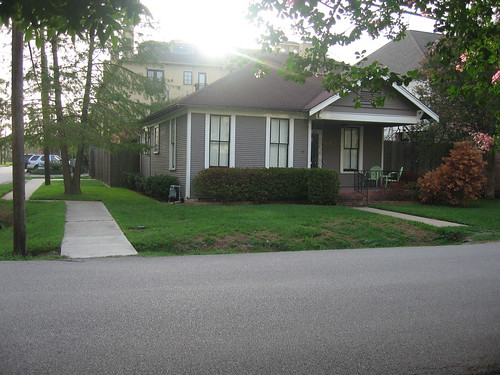
Well kept bungalow

This is what is left of two nearby bungalows by 4 in the afternoon, after receiving demo permits that morning:
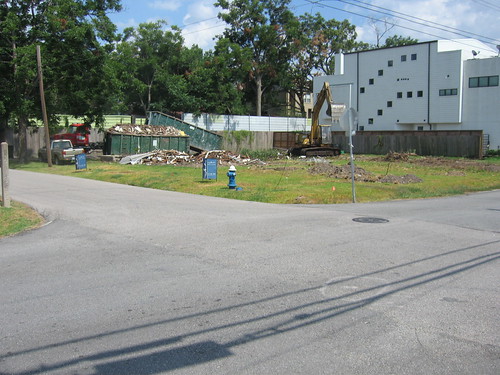
Demo Down the Block

A typical townhouse cul de sac development. The prevailing design of the three story townhouse consists of two front entrances: one for the household cars and a much smaller one for the people. In some designs, the “front entrance” is on the side of the house. It is not very inviting for guests. Street parking is awkward as well, as can be seen in the following picture.
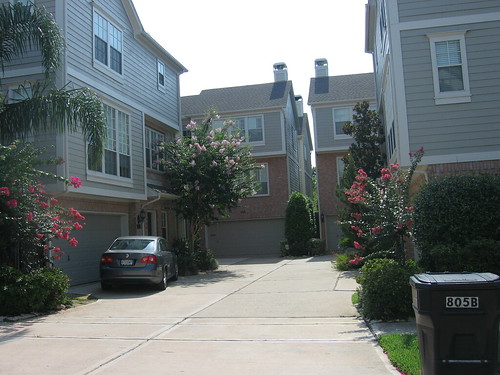
Inner Loop Cul de Sac

Another typical set up across from the cul de sacs – driveways on one side, narrow parking on the other. When this area started to redevelop, the city did not seem to pay any attention to the narrow streets, the awkward utilities, or the drainage options. As a result, the developers are able to build all the way up to the narrow right of way, and the residents play chicken with each other down the streets. The loser ends up in the drainage ditch or backing into the closest available driveway. There is talk of making the neighborhood streets one way and moving to permit parking. This will be an interesting issue to watch.
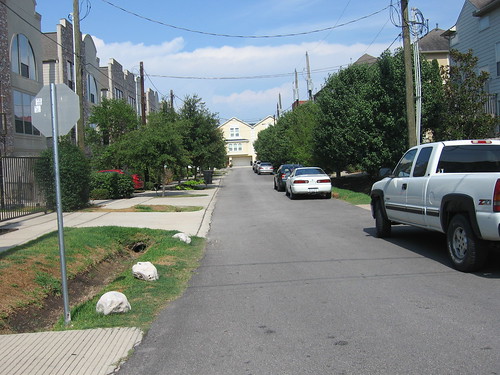
Driveways one side

It’s been an interesting adjustment to change my expectations of what I think neighborhoods should have and what is provided. I’ll try to tackle a few of the areas of my neighborhood I would have liked to see done differently, plus show off a few of the other trends in other neighborhoods and a little bit of real estate politics down here as I go along. Be patient though! I also have to get your natural gas delivered safely to keep my own lights on!

– Liz Rutherford


The Widening of Delor Street

Delor Street winds through South St. Louis, from East of Grand to the River Des Peres.   The block of Delor Street West of the Bevo Mill area (map) is know for cute but modest houses and for a very narrow roadway:

(image source: Google Street View)

Delor Street, above, has been so narrow that cars had to go very slow.  Now the city is in the process of widening the curb to curb width.  The South curb line (right, above) is being moved a few feet over.  I have mixed feelings about this work.  The narrow width helped slow traffic.  But I would not want to try to get in/out of my car on the narrow street.

When I drove down Delor Street recently I saw the construction in progress.  One thing is clear is the narrow tree lawn was being eliminated in order to move the curb line. Mark Groth has observations and a couple of construction pics on his blog, St. Louis City Talk (link to post).  From his pics I can see curb bulbs and islands.  Once construction is complete I’ll return, walk this block as part of my therapy and get photos.

– Steve Patterson


I’m Not Lost. I’m Free

August 14, 2009 Downtown 13 Comments

Spotted earlier today at Citygarden:

A book sitting on a bench, proclaiming to be free.  Nothing inside with credit for the good deed. I like little things like this — better than any splashy development.  We need more unexpected pleasantries such as this.

If you have not yet visited Citygarden I suggest you check it out this weekend.  Take MetroLink to the 8th & Pine stop and walk 2 blocks South.  Live out of town?  When you fly in you can take the light rail from the airport to a downtown hotel. Don’t delay, book you flight, train or bus pass now.

The Terrace View Cafe at Citygarden opens Monday August 17, 2009.  The menu includes many locally grown & raised items. I’m rolling my pennies now so I can afford to go.

– Steve Patterson


Advertisement


[custom-facebook-feed]

Archives

Categories

Advertisement


Subscribe