Abandoned Construction Elevator Platform Blocks Midtown Sidewalk

February 11, 2009 Accessibility, Midtown 12 Comments

In November of 2004 the ball started rolling to renovate the  Metropolitan building located at Grand & Olive in Midtown St. Louis:

At least six developers are interested in two Grand Center sites up for redevelopment.

A joint pre-bid conference on the properties, which include a vacant site owned by Saint Louis University on the northeast corner of Grand and Lindell and the Metropolitan Building on the northeast corner of Grand and Olive owned by Grand Center Inc., drew several developers or teams of developers. (source)

Pyramid Construction was one of those developers and they succeeded in getting the Metropolitan building by 2006.  Today, however, the building remains vacant and the wooden base from the long-removed construction elevator blocks the sidewalk.

Based from removed construction elevator blocks sidewalk.

Last April I broke the story that Pyramid had collapsed and was in the process of shutting down.  By June of 2008 most of their vast real estate holdings were either sold to others or taken back by creditors.  Such was the case with the Metropolitan:

Centrue Bank, the first mortgage holder on a loan to Pyramid Cos. for a planned redevelopment of the building, has assumed ownership of the building at 500 N. Grand. Pyramid bought the vacant, seven-story building for $2 million in 2006. The company planned to open a Hyatt Place hotel on the upper floors with retail on the ground floor. The total development cost was estimated at $30 million.  (source)

The owner of the construction elevator at the site removed the elevator following Pyramid’s collapse in April.  Since then the platform has continued to block the sidewalk and several on-street parking spaces.  The city is losing revenue by not having these spaces open for vehicles.  Pedestrians walking back and forth from various businesses & restaurants in the area must go into the street or walk over the platform.

The renovated Woolworth Building is in the background.

Centrue unfortunately got stuck having to foreclose on the property.  Based on tax records, they remain the owner. I’m sure all they want is to be the former owner.

I will be sending the bank, 19th Ward Alderwoman Marlene Davis, and the City’s Director of Streets  an email asking for this to be removed so the sidewalk is once again open for use.

Hopefully we will once again see construction activity at this location but in the meantime the sidewalk needs to remain free of obstructions.  With newly renovated buildings and several new restaurants in the immediate area the last thing we need is an abandoned platform reminding us of Pyramid’s failure.


New $13 Million Villa Lighting HQ Lacks ADA Access Route

February 10, 2009 Accessibility 19 Comments

Walkability and accessibility do not happen overnight.  With strong leadership and a commitment to these goals, as new buildings are built we can incrementally improve both.  However, without the right leadership and tools in place to ensure improvements in walkability and accessibility, we will continue to invest in projects geared toward a single mode — the private auto.

I thought I had hammered this message home to Ald. Matt Villa over the poor accessibility of Loughborough Commons, a suburban style highway-centric big box/strip center in his ward (11th).  While that project has improved greatly in the last few years it is clear that was as a reaction to pressure from me.  To date, the Burger King & Lowes still lack an ADA access route.

I’ve had numerous conversations with Matt Vila over accessibility and walkability.  You’d think he would have learned something and ensured the new $13 million headquarters of his family business would have been accessible. With a reported 80 employees it would be reasonable to assume that some might arrive to work on foot — either walking directly from home or taking public transit.

This project is located in my ward, the 6th, where  Ald. Kacie Triplett has been on the job for just shy of two years.  Of course I don’t think walkability or accessibility should be left up to each of the 28 Aldermen. They clearly don’t know about these things.  We are a small city — only 61.9 square miles of land area.  This is less than two square miles larger than Columbia MO (60.1 sq. miles of land) and smaller than Springfield Missouri (73.2).  My hometown of Oklahoma City is a whopping 607.0 square miles of land area.  So we are small in terms of land area but we are fairly dense despite having lost a half million in population since our 1950 peak of 856,000.

But while Springfield Missouri only has 2,000 persons per square mile we have over 5,700.  San Francisco has over 17,000 persons in each of its  46.7 square miles of land area.  Manhattan, the prominent NYC Borough, has over 70,000 residents per square mile (22.96 square miles of land area).  At our 1950 peak, our density was slightly higher than Chicago’s density in 2000.

The point is the greater the density the greater the likelihood of having a population that walks and uses transit.  Regions such as NYC and San Francisco have dense walkable centers with less dense, less walkable fringes.  Here we continue to weaken our core.  Lowering the standard down to that might be acceptable 20 miles outside of the core.  I know of no growing region where the core being reduced to suburban fringe levels of density and non-walkability.

Which brings us back to Villa Lighting’s new facility.  It is great they stayed in the city.  It is unfortunate the building was made to be arrived at by private car only — not by foot or bicycle (no bike rack out front).  On the edge of the region it is more reasonable to do single mode development but not in the core.  This facility is a short walk from the #70 Grand bus route and the Grand Metrolink light rail station.

Villa Lighting HQ as seen from the corner of Chouteau & Ewing.

For those who physically can, climbing the hill is the most direct route to the front door.  Remember this is all new construction so they created the grades.

View looking West along Chouteau.  Note the new public sidewalk, too bad it isnt connected to the entrance
View looking West along Chouteau. Note the new public sidewalk, too bad it isn't connected to the entrance

There is sufficient room for a stair & ramp to the entrance so the new building can be brought into compliance.

View looking North along Ewing.  Note the lack of sidewalk on this side of Ewing.
View looking North along Ewing. Note the lack of sidewalk on this side of Ewing.

For anyone in a wheelchair this is a fortress.

The auto entrance is the only option for pedestrians.

So once again the pedestrian is relegated to the drive designed for autos.  So I’m thinking the architect, Clayco’s Forum Studio, must be out of touch on the ADA.  But then I switched from the East to West side of the building.

View of SW corner of building with leasable space.
View of SW corner of building with tenant space.

Here the new sidewalk continues on the side street.  They even included a street tree.  No curb though.

Accessible route from public sidewalk to entrance.

Hallelujah, an accessible route for tenant spaces on the West side of the building.  So this has me even more confused.  They are obviously aware of the requirement as they complied here.  My only guess is they didn’t do it on the East side claiming it wasn’t feasible due to the grades —- grades they created.  We should do better.


Green? Yes. Accessible? No.

Green building is all the rage these days.  That is a good thing, but I wished walkability was given the same importance.  Walking, after all, is one of the most green & healthy things we can do.

So last year when the old Sym’s clothing store in the St. Louis suburb of Brentwood was converted into an Office Depot & Westlake Ace Hardware I was hopeful that pedestrian access would make it into the renovation plans.  I periodically scooted by and saw the nifty bioswales being carved out of the existing parking lot but no accessible route connecting the public sidewalk to the accessible entrance of the two stores..

Office Depot & Ace Hardware on Manchester Rd.

The parking lot was completely redone so there was plenty of opportunity to do the greenest thing of all — welcome pedestrians.

Detail of bio-swale
Detail view of "bioswale"

I love the green bioswales which catch and use water runoff.

Public sidewalk along Manchester Rd. at entry to Office Depot/Ace Hardware.

But when we’ve got major reconstruction of both building and site and no priority is given to connect to the existing public sidewalk we have a problem.  When “green” ignores pedestrians, we have a problem.  When developers and large retailers are able to ignore the basic right of accessibility we have a problem.

You might be saying to yourself, “npobody walks that stretch of Manchester Rd.”  First, not true.  Some do walk here.  But given the lack of consideration for the pedestrian it is no wonder too few walk.  This property is surrounded by residential properties and is only a mile from the Maplewood MetroLink light rail station to the East.

Which comes first the pedestrian or the sidewalk?


I’m on Google Streetview

February 6, 2009 Midtown, Scooters 8 Comments
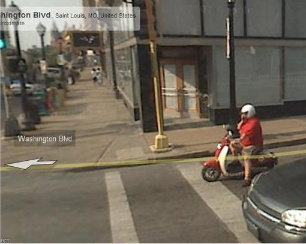
Steve Patterson on Google’s Streetview taken before 2/1/08.

If you love Google maps then you probably love streetview — the ability to see what an actual street looks like.

Friends of mine, planning students from St. Louis living in New Orleans, recently blogged about spotting me on my former Honda Metropolitan scooter in a streetview at Washington & Grand (link).

Thankfully I wasn’t over the stop line!  Thank you to Matt Mourning and Michael Powers!  I’ll be back on a scooter by Spring 2010.


Sales Tax Rates Will Vary

February 6, 2009 Taxes 11 Comments

The rate of 7.25% seems stuck in my head as reasonable.  But recent receipts in the city show a rate of 8.241% on non-food purchases.  Yikes!  Last month I brought stuff at the Ikea store in the Chicago suburb of Bolingbrook which had a rate of 8.5%.  Food purchases have a rate of 5.1409%.  I forget how that came to be — I think it was the elimination (or reduction) of the state portion?  Most of my purchases during the last year have been food and books for school.  But boy those 1/8th of a cent tax increases add up.

We tax ourselves in order to provide services.  These can be everything from public schools to police/fire/ems to public libraries, transit, street lighting, parks and on and on.  Taxes come in many forms depending upon the jurisdiction where you live.

A decade ago I had my luggage stolen from my car the day I was traveling to Seattle.  I arrived in Seattle with the clothes on my back and a magazine purchased in the Minneapolis airport.  The next morning we were driving from Seattle to visit Portland, OR.  Oregon has no sales tax so as I bought clothes (& luggage) to replace those that were stolen the savings added up.  That $24.99 shirt was just $24.99.  That same shirt bought today in St. Louis would cost another $2.50.

As a tourist enjoying tax-free purchases I likely paid more for some items because other taxes, such as property taxes, are often reflected in the final price of the goods & services.The renter doesn’t escape property taxes — part of the rental rate is there to cover those taxes.  The issue of evaluating tax levels from city to city within the same region and state is complicated enough but comparing region to region gets even more complex.  I’m sure somewhere out there I could find a study to show what a family might pay in various taxes in the St. Louis region vs. Dallas vs. San Diego and so on.

Sales taxes just happen to be one we see regularly.  We have the option to order online and potentially avoid paying sales taxes (although not necessarily).  If our online purchases exceed I believe $2,000 annually in Missouri we are supposed to pay use tax on those purchases.  My online purchases never come close to approaching that amount.

But then we go back to figuring in services relative to taxes paid.  Some places have lower tax rates but they also have a reduced level of services.  Thus it comes back to the question if you are pleased with the level of services provided by your government based on your total annual tax bill?  As consumers cut back on spending and shift more purchases away from retailers in their communities to online stores local & state government budgets are going to feel the pinch.  With less money that means less services.

Share your views below on taxes.


Advertisement


[custom-facebook-feed]

Archives

Categories

Advertisement


Subscribe