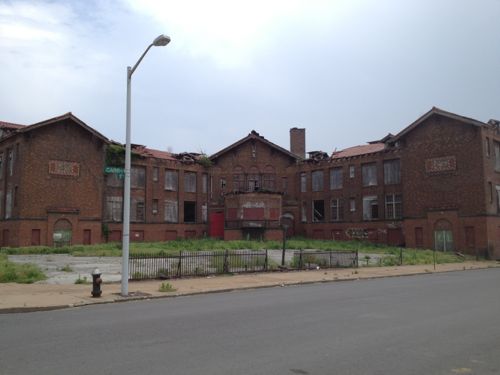
Carr Square Tenant Management head Rodney Hubbard Sr. will announce later today that the nonprofit will finally renovate the crumbling Carr School.
Carr School, built in 1908, has been vacant for decades. 2013 photo
After collecting fees from & suing actual developers, the Hubbard family is going to put on the developer hat. Securing permits won’t be a problem because Rodney’s daughter Tammika Hubbard is the alderman. Unless James Page defeats her at the polls on Tuesday.
Carr School is owned by Carr Square. The ground surrounding it is owned by NorthSide Regeneration, the Paul McKee-led effort to compile property in north St. Louis, in which Carr Square is partner. (Post-Dispatch)
Yes, the Hubbards will likely turn to their buddy Paul McKee for help. Their nonprofit helped McKee get his tax credits. Expect the project to proceed at the pace of other McKee’s NorthSide projects.
[Spoken Intro: LaWanda Page and RuPaul]
Once upon a time, there was a little black girl, in the Brewster Projects of Detroit, Michigan. At fifteen, she was spotted by an Ebony Fashion Fair talent scout and her modeling career took off You better work.
These initial lines weren’t sung by RuPaul, they were spoken by the very recognizable voice of Lawanda Page (1920-2002). Though Page was born in Cleveland, Ohio she was raised in St. Louis. According to Wikipedia she attended Banneker Elementary School at 2840 Samuel Shepard Dr. This school closed in 2005. This is just north of what was the Mill Creek Valley neighborhood, where she likely lived.
LaWanda Page, born Alberta Peal, is best known for her roll as Aunt Esther on the sitcom Sanford and Son, starring her friend St. Louis-born Redd Foxx (1922-1991). Born John Elroy Sanford, his father was indeed named Fred Sanford. While Foxx was born in St. Louis he was actually raised in Chicago.
Back to the song lyrics and that little black girl. None of the three male songwriters were from Detroit, much less the Brewster projects. However, three little black girls from the Brewster projects in Detroit Michigan founded the group that became Motown’s The Supremes. Supreme Mary Wilson (1944-2021) recently died.
Like so many housing projects, Brewster began as low rise buildings but later buildings were high rises.
The Brewster Project and Frederick Douglass Apartments were built between 1935 and 1955, and were designed by Harley, Ellington & Day of Detroit. The Brewster Project began construction in 1935, when First LadyEleanor Roosevelt broke ground for the 701-unit development; the first phase, consisting of low-rise apartment blocks, was completed in 1938. An expansion of the project completed in 1941 brought the total number of housing units to 941. The Frederick Douglass Apartments, built immediately to the south of the Brewster Project, began construction in 1942 with the completion of apartment rows, two 6-story low-rises, and finally six 14-story high rises completed between 1952 and 1955. The combined Brewster-Douglass Project was five city blocks long, and three city blocks wide, and housed anywhere between 8,000 and 10,000 residents, at its peak capacity.
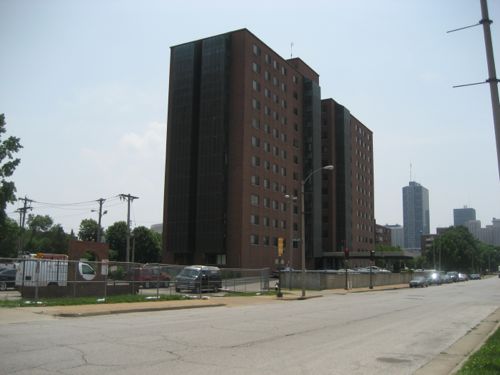
St. Louis followed the same pattern of low rise initially, followed later by massive high rise projects. Today’s Carr Square neighborhood included numerous public housing projects, both low & high rise: Carr Square Village is low rise, followed by high rise Vaughn Housing & Pruitt-Igoe.
Donny Hathaway (1945-1979) was born in Chicago but raised in the Carr Square neighborhood. My favorite Donny Hathaway song is his 1972 duet with Roberta Flack, Where Is The Love? He lived with his grandmother and attended Franklin Elementary & Vashon high school. I wasn’t able to find a specific address so I’m not sure where they lived. I do know another song he’s known for is The Ghetto.
Franklin school is now senior housing, October 2007
The Spinks family, including boxer Leon Spinks Jr. (1953-2021), also lived in the Carr Square neighborhood. Early on it would’ve been called Kerry Patch, and later DeSoto-Carr. Unlike Donny Hathaway, I do know exactly where the Spinks family lived.
Leon Spinks Sr was born in 1937. In the 1940 census he was the youngest of 8 kids living with Lewis & Ava Spinks at 1409 N 14th Street. The house they lived in was on the 1909 Sanborn map, but was torn down prior to the 1980s construction of the existing apartments at that addresses. The 53 year old Lewis Spinks Sr. listed the 14th Street address on a war registration card but marked it out, writing in 1024 N 21st. As a reference he listed Lewis Spinks Jr, now living separately at 1423 Biddle.
Leon Spinks Jr was born in 1953. In 1965 his father was living in the 2800 block of Biddle, in or near Pruitt-Igoe. By 1969 the senior Leon Spinks was living at 2210 Cass — definitely Pruitt-Igoe.
Not sure why I enjoy looking up where people lived, but I do.
Tenant management of public housing projects was a new thing forty years ago:
In 1971, brought together by frustration with poor management and maintenance, the residents of the Bromley-Heath public housing development In Boston formally Incorporated the nation’s first resident management corporation That same year, St. Louis’ public housing residents waged a rent strike against their housing authority to protest poor maintenance and rising rents In the wake of the strike settlement, the authority eventually delegated control over a number of management functions to newly-formed resident organizations at several Sites, Including Carr Square and Cochran Gardens. These events marked the beginning of the resident management movement, which today is viewed by resident advocates and policy makers as a potential solution to many of the problems facing America’s public housing stock and the people who live In it. (HUD – Evaluation of Resident Management in Public Housing – 1992)
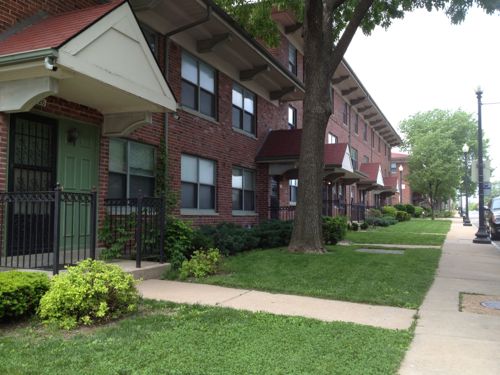
Carr Square, built by the St. Louis Housing Authority in the 1950s, has been updated over the years
The St. Louis Rent Strike actually took place in 1969, it took a few years to get to tenant management. The Carr Square Tenant Corporation was incorporated as a non-profit on September 27, 1972, before Cochran Gardens. Initially tenant management corporations had limited roles but over the years this has expanded greatly, especially at Carr Square. Rodney Hubbard Sr. is the Executive Director of the Carr Square Tenant Corporation.
Cochran Gardens leader Bertha Gilkey became a high-profile face of tenant management with a May 3 1991 visit by President George H.W. Bush to Cochran Gardens (read speech) and was honored by Oprah Winfrey in 1992. In 1998 the Post-Dispatch discovered Gilkey had charged thousands of dollars on Cochran credit cards for personal use. The Housing Authority demanded the return of the credit cards and questioned expenses at Carr Square:
The new leaders of the St. Louis Housing Authority are questioning hundreds of thousands of dollars of expenditures at the Carr Square housing complex.
The biggest expense in question: a contract for at least $ 616,000 for telephone work at the development.
Meanwhile, Thomas P. Costello, interim executive director of the Housing Authority, said he also wants top officials of another public-housing development, Cochran Gardens, to return their credit cards. That demand followed publication Sunday of a Post-Dispatch investigation that showed that Cochran board chairwoman Bertha Gilkey made thousands of dollars of purchases for herself and her consulting firm on her Cochran- issued credit card. (St. Louis Post-Disptach 1/14/1998)
The Last high-rise tower at Cochran Gardens was razed in 2011
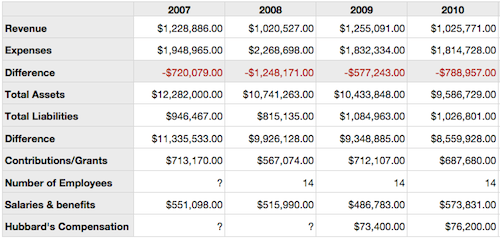
What’s this about deficit spending? Take a look:
Summary of selected figures from 990s.
I obtained the 990s (non-profit tax return) for 2008-2010, the 2008 return also includes figures for the prior year, 2007. I’ve uploaded these to Scribd for review:
In the four years covered above they had revenue of $4,530,275 and expenses of $7,864,725, for a cumulative deficit of -$3,334,450. I’m not an accountant, but I know you want revenue to be higher than expenses. Much of their revenue is from HUD and other government agencies. I don’t understand how this continues.
The St. Louis Comptroller’s Office has reviewed compliance for an annual daycare contract of less than $40,000. In December 2001, May 2009, and November 201o the results were the same: “Conclusion: The Agency did not fully comply with federal, state, and local CDA requirements.”
Perhaps a public square or park as a neighborhood center? Or a commercial district? Not if you live in Carr Square urban renewal area:
All the natural neighborhood centers were razed along with the rest of the neighborhood during the dreadful years of Urban “Renewal.” With community centers that evolved over time the planners & architects created faux versions. View the above on a Google Map.
The basketball and tennis courts, adjacent to the center, are quite sad.
Carr Square Village was one of the earliest clearance projects in the city. It was completed in August 1942. The 24.3 acre development consisted of 53 2 & 3 story buildings with a total of 658 units.
The above center was not in place as of a 1971 aerial photo of the city. The building appears to be from the 1970s or perhaps as late as the mid 1980s. By then the renewal area would be been 30-40 years old. The “neighborhood center” was likely another attempt to renew the area.
At some point after 1971 much of the housing was razed from the two green sections in the bottom left corner. The remaining buildings have also changed considerably since 1942. With enough time and money we will eventually reverse all the mistakes of the past. But will this neighborhood ever have a real center again? Doubtful.
AARP Livibility Index
The Livability Index scores neighborhoods and communities across the U.S. for the services and amenities that impact your life the most
Built St. Louis
historic architecture of St. Louis, Missouri – mourning the losses, celebrating the survivors.
Geo St. Louis
a guide to geospatial data about the City of St. Louis