Opinion: Our Gas Prices Are Way Too Low
Gasoline here in the U.S.is cheap compared to much of the world.
The average price of gasoline around the world is 4.09 U.S. Dollar per us gallon. However, there is substantial difference in these prices among countries. As a general rule, richer countries have higher prices while poorer countries and the countries that produce and export oil have significantly lower prices. One notable exception is the U.S. which is an economically advanced country but has low gas prices. The differences in prices across countries are due to the various taxes and subsidies for gasoline. All countries have access to the same petroleum prices of international markets but then decide to impose different taxes. As a result, the retail price of gasoline is different. (GlobalPetrolPrices)
Comparing gas prices alone doesn’t tell the full picture. For that I turned to a handy Bloomberg site,
Global gas prices are on the decline—about 2.3 percent, on average, in the past three months. Behind that modest decrease is a wide range of price swings felt differently around the world. We ranked 61 countries by three economic measures to see which has the most affordable gas and which feels the most pain at the pump.
It listed the US is the third most affordable — behind Venezuela and Saudi Arabia. Initially I decided to limit myself to the G7 countries:
Canada
Canada is seeking to restore its image as a leader on global warming with a nationwide tax on carbon pollution. The country has a lot to lose: Vast reserves of difficult-to-extract oil will mean either an environmental toll to produce it or an economic toll to keep in the ground. Cheap gasoline in Canada goes hand in hand with high consumption—only Americans use more per person.
France
The French can afford to pay for their expensive gasoline, but they’re increasingly turning to electric cars instead. French automakers Peugeot and Renault are both competing in the expanding market for EVs. France has one of the world’s highest EV sales rates and one of the densest charging networks.
Germany
German gas isn’t exactly cheap, but it’s little bother for the average driver in Europe’s largest economy. Gas consumption is average and is likely to decrease as the country commits to battery-powered cars. Incentives were introduced for car buyers in 2016, and BMW and Volkswagen are now working to electrify their fleets.
Italy
Car ownership in the home country of Ferrari and Maserati is among the highest in the world. However, the prolonged slump in global oil prices offered less relief to Italian drivers than in most countries, largely because of the country’s high taxes on fuel.
Japan
Japan’s long-standing national gasoline tax helped its carmakers take an early lead in developing fuel-efficient vehicles. Toyota and Honda invested big in fuel-cell technology, while the Nissan Leaf became the world’s best-selling electric vehicle. Japan now has more public battery chargers than gas stations.
United Kingdom
Sales of electric vehicles are accelerating in the U.K.—one of the biggest markets for battery-powered transportation. EVs make a lot of sense in a region defined by short driving distances and one of the highest gasoline prices in the world.
United States
President Donald Trump has scrapped environmental regulations and supported fossil-fuel production in the first months of his presidency. But if success is judged by the price of gasoline, there isn’t much room left for improvement. U.S. gasoline prices tumbled under his predecessor, Barack Obama, while oil production soared and cars became more efficient. Americans still guzzle more gas than any other country, so even with low prices, a thirst for the open road takes a bite out of the average paycheck.
I then decided I needed to also look at the country with the most expensive gas and the two where gasoline is more affordable than here:
Norway
Norway’s high gas prices and high incomes are an electric car maker’s dream. The country has the biggest share of electric vehicles in the world. That may seem strange for an economy built on oil, but Norway is one producer that doesn’t subsidize gasoline at the pump. Instead, the country uses its oil riches to fund national services, such as free college education and savings for infrastructure improvements.
Saudia Arabia
The Saudis sit atop two enormously valuable bodies of liquid: oil and water. Both are being pumped to the surface at unsustainable rates. Saudis rank among the greatest gas guzzlers in the world, but they devote a below-average share of their incomes to buying it. That’s because the government heavily subsidizes the price at the pump.
Venezuela
Life, liberty and the pursuit of happiness. Countries have different ideas as to which rights are inalienable, and Venezuela stands alone in considering nearly free gasoline a birthright. In 2016, President Nicolas Maduro raised pump prices 6,000 percent, but filling up a tank of gas still costs less than a cup of coffee. Venezuela isn’t a rich country but consumes gas like one.
I complied some of the information into a chart — looking at price per gallon, affordability relative to wages, gallons used per driver, and how each compares to the highest user of gasoline.
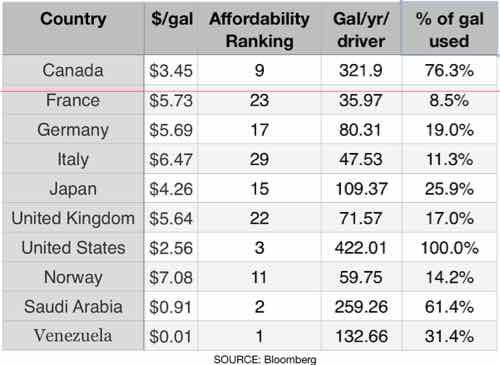
As you can see four other G7 countries (France, Germany, Italy, UK) have gas prices that are at least twice ours. Twice. We use far more gasoline than everyone else — even the two countries with more affordable gasoline.
The recent non-scientific Sunday Poll had fewer responses than usual:
Q: Current gas prices in St. Louis, at around $2.27/gal, are…
- Extremely high 0 [0%]
- High 1 [5%]
- Somewhat high 1 [5%]
- Neither low or high 7 [35%]
- Somewhat low 4 [20%]
- Low 3 [15%]
- Extremely low 4 [20%]
- Unsure/no opinion 0 [0%]
Still, more than half said our gas prices are on the low side of the scale. Decades of low taxes enabled us to build a non-sustainable auto-centric built environment. We can’t just raise taxes to where they should be, at least not too quickly. But we can’t continue to neglect our massive amount of crumbling infrastructure.
— Steve Patterson