Harland Bartholomew negatively impacted many cities

Twenty Ten years ago today famed urban planner Harland Bartholomew died.  From his NY Times Obituary, Harland Bartholomew, 100, Dean of City Planners:

Harland Bartholomew, the dean of comprehensive city planning in the United States, died Saturday at his home in Clayton, Mo., a suburb of St. Louis. He was 100 years old.

Mr. Bartholomew, a consulting engineer, was appointed to Federal planning committees by three Presidents, Herbert Hoover, Franklin D. Roosevelt and Dwight D. Eisenhower.

In 1941 President Roosevelt appointed Mr. Bartholomew to a committee to recommend a limited system of national highways. He also helped plan the Metro subway system in Washington, and he represented the Rockefeller interests in the restoration of historic Williamsburg, Va.

President Eisenhower appointed Mr. Bartholomew chairman of the National Capital Planning Commission a position he held for seven years, A City Planner in Newark Mr. Bartholomew became the nation’s first full-time city planner in 1914, when he went to work for the city of Newark. Two years later he went to St. Louis as a city engineer, and he later opened a consulting firm, Harland Bartholomew & Associates, which now has its headquarters in Memphis. He retired in 1965. His firm prepared comprehensive plans for more than 500 cities and counties, including Bal Horbour, Fla., St. Croix, V.I., and Grand Bahama Island in the Bahamas. Mr. Bartholomew also prepared plans for the reconstruction of the resort community of Bar Harbor, Me., after two-thirds of it was destroyed by a forest fire in 1947.

His firm also assisted in the preparation of many zoning ordinances. including a statewide ordinance for Hawaii.

He was an early advocate of slum clearance and city planning, and served on the national Slum Clearance Advisory Committee. His ideas helped shape the Housing Act of 1937 and the Housing Act of 1949.

There is no doubting Bartholomew’s influence on both cities and the profession of urban planning. His considerable influence is why he had such a negative impact on cities. We are still dealing with problems created by his solutions to early 20th century problems.

In 1919 he founded Harland Bartholomew & Associates here in St. Louis. For decades the firm operated from offices in the Louderman Building at 11th & Locust (map). From 1916-1950 he was St. Louis’ planner.
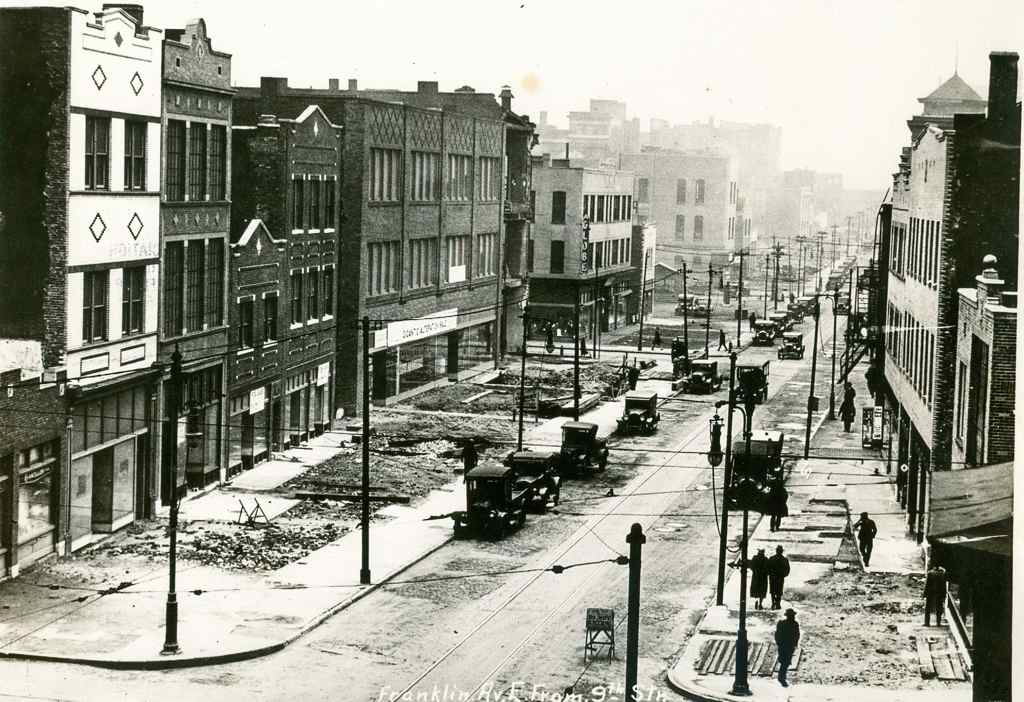
Franklin Ave looking East from 9th, 1928. Collection of the Landmarks Association of St Louis

Early writings showed he was concerned about suburban expansion — in the 1920s. He advocated widening streets to accommodate the automobile. In the above image the right-of-way of Franklin Ave from 3rd to 9th is getting widened from 50 feet to 80 feet – a 60% increase! Widened streets and numerous parking lots/garages made the decision to buy a car and move to a house beyond the streetcar line was a no brainier for many.

Soon the widened streets weren’t enough so highways were the next step. Each time steps were taken to make motoring life easier the further people moved from the core. Eventually families needed to have two cars. As a country we would have embraced the automobile anyway but he made it easier and faster. Highways cutting through cities also did much damage.

Bartholomew was a major pusher of Euclidean zoning — the rigid segregation of land uses. Overcoming this segregated view of cities today is a challenge. I’ve spent time in the basement of the Washington University archives library reading through comprehensive plans HBA prepared for hundreds of U.S. cities. Each one a repeat of the prior: widen streets, build a highway loop around downtown, build parking, require high parking standards for new construction, make the zoning even stricter.

Harland Bartholomew left his position with the City of St. Louis in 1950 and after 42 years, in 1961, he retired from the firm that bore his name. I can’t help but think our cities would be better off in the 21st century if this man born in the 19th century had become an accountant. I take some pleasure knowing the building where his office was located currently includes a mix of retail, office and residential uses.

– Steve Patterson


Sit anywhere on the bus

Fifty-four years ago today a 42 year old (my current age) woman refused to move to the back of the bus in Montgomery, Alabama.   Of course the woman was Rosa Parks:

Her refusal to surrender her seat to a white male passenger on a Montgomery, Alabama bus, December 1, 1955, triggered a wave of protest December 5, 1955 that reverberated throughout the United States. Her quiet courageous act changed America, its view of black people and redirected the course of history.  (source: rosaparks.org)

I am so grateful to her for refusing to give up her seat simply based on her race. But it wasn’t so simple:

Montgomery’s segregation laws were complex: blacks were required to pay their fare to the driver, then get off and reboard through the back door. Sometimes the bus would drive off before the paid-up customers made it to the back entrance. If the white section was full and another white customer entered, blacks were required to give up their seats and move farther to the back; a black person was not even allowed to sit across the aisle from whites. These humiliations were compounded by the fact that two-thirds of the bus riders in Montgomery were black.

Parks was not the first to be detained for this offense. Eight months earlier, Claudette Colvin, 15, refused to give up her seat and was arrested. Black activists met with this girl to determine if she would make a good test case — as secretary of the local N.A.A.C.P., Parks attended the meeting — but it was decided that a more “upstanding” candidate was necessary to withstand the scrutiny of the courts and the press. And then in October, a young woman named Mary Louise Smith was arrested; N.A.A.C.P. leaders rejected her too as their vehicle, looking for someone more able to withstand media scrutiny. Smith paid the fine and was released. (Source: TIME)

We have come a long way but we still have so far to travel. We all owe Parks (and so many others) for chipping away at the walls of hate that were commonplace at that time.

– Steve Patterson


Readers believe Post-Dispatch online editor Kurt Greenbaum should be fired

December 1, 2009 Media, Sunday Poll 14 Comments

Kurt Greenbaum didn’t like the repeated anonymous comment from a reader on the website of the St. Louis Post-Dispatch.  He saw where the comment came from (a school) so he contacted them – a violation of a portion of their privacy policy:

We will not share individual user information with third parties unless the user has specifically approved the release of that information. In some cases, however, we may provide information to legal officials as described in “Compliance with Legal Process” below.

Compliance with Legal Process
We may disclose personal information if we or one of our affiliated companies is required by law to disclose personal information, or if we believe in good faith that such action is necessary to comply with a law or some legal process, to protect or defend our rights and property, to protect against misuse or unauthorized use of our web sites or to protect the personal safety or property of our users or the public.

He claims the person that submitted the comment resigned his job when confronted by his employer.  The alternative of putting the school’s IP address on a blacklist was ruled out by Greenbaum because he says it would prevent others at the same location from commenting on the website.  The truth is it means any comment submitted would have just been held until approved by him or someone else.

He either doesn’t know what he is talking about or lied to get the public to side with him on the issue.  Either way it was enough for me to vote in last week’s poll that he should be fired.

Q: Recently Kurt Greenbaum took action that allegedly caused a person to resign their job. Greenbaum should:

  • be fired 78 (54%)
  • resign 37 (26%)
  • keep doing his job 21 (14%)
  • unsure 9 (6%)

Total votes was 145 out of 2,463 visitors during the week.

Putting information out for public consumption and moderating comments is not an easy job.  I’ve been doing it here for over five years now.  It takes a lot to earn the trust of readers and Greenbaum made that more difficult for online readers of the Post-Dispatch’s website, stltoday.com.   Traditional print media needs to do all it can to cultivate online readership as fewer and fewer get their news in printed form.

– Steve Patterson


Advertisement


[custom-facebook-feed]

Archives

Categories

Advertisement


Subscribe